Operations | Monitoring | ITSM | DevOps | Cloud

NinjaOne Fall 2023 Release (5.5) - SentinelOne Integration, MDM and Reporting Redesign

We’re happy to announce that our Fall 2023 Release (5.5) is rolling out to all regions during the month of October. With a time-saving new integration with SentinelOne, greatly enhanced reporting capabilities and more visibility into critical vulnerabilities this release offers more security, flexibility, and convenience to our customers.

What is Infrastructure Monitoring?

Infrastructure Monitoring can be a powerful tool for engineers to analyze, visualize and comprehend if a backend is affecting users, by collecting health and performance data from containers, servers, databases, virtual machines, and other backend components in a tech stack. Within this article, we will outline what Infrastructure Monitoring is, how it works, what Infrastructure Monitoring as a Service is, and some benefits of the solution.

APM vs Tracing vs Observability

Application Performance Monitoring (APM), tracing, and observability are fundamental software development and system management approaches. Each of these three concepts uniquely ensures that your applications operate, efficiently, smoothly, and reliably. Your organisation will more than likely already adopt one of these approaches, or even two, potentially all three.

What is an Internal Developer Platform

Software production has become exponentially more complex over the last few years as containerization and microservice architectures have exploded. These design decisions are rooted in aspirations of scalability and speed, but left unchecked, have devolved into data model mayhem, development silos, and environment inconsistencies.

Pepperdata Reduces the Cost of Amazon EMR on EKS by 42.5%

With Kubernetes emerging as the de facto operating system of the cloud, capable of running almost anything, it’s not a surprise that many enterprises are rapidly porting their Apache Spark workloads to Kubernetes. This includes migrating Amazon EMR workloads to Amazon EKS to gain the additional deployment and scaling benefits of a fully managed service like Amazon EKS.

How to minimize business disruption in your move to SAP S/4HANA

SAP customers must move to SAP S/4HANA by 2027 to stay compliant, but many are hesitant to do so. Although 78% of organizations in North America are planning an S/4HANA move, only 31% have started using it, according to a CIO article. The UK & Ireland SAP User Group (UKISUG) reports 89% and 25%, respectively. Moving to S/4HANA can take three to four years, according to Roland Berger, and requires a high investment at a time when companies are tightening their belts.

Adopting open-source Industrial IoT software

The industrial automation landscape is evolving rapidly, driven by a fundamental shift in how software solutions are developed and deployed. In the past, many factories had in-house IT expertise to build and maintain their basic software stacks, the present reality is quite different. Small-scale factories often lack the IT know-how to manage their increasingly complex digital infrastructure, and they often rely on contractors to set up and maintain their systems.

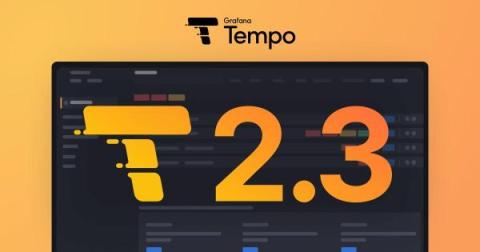
Grafana Tempo 2.3 release: faster trace queries, TraceQL upgrades

Grafana Tempo 2.3 has been unleashed upon the world, bringing with it the latest iteration of the vParquet backend! Tempo 2.3 has a little bit of everything, but the headline item here is vParquet3 and new features that improve search speeds. Watch the video above for all the details, or continue reading to get a quick overview of the latest updates in Tempo. If you’re looking for something more in-depth, don’t hesitate to jump into the changelog or our Grafana Tempo 2.3 release notes.