Operations | Monitoring | ITSM | DevOps | Cloud

Why should every organization invest in cybersecurity software?

In today’s digital age, organizations across industries are increasingly reliant on technology for their operations, communication, and data management. While this technological advancement is no doubt beneficial, it also brings with it a heightened risk of cyber threats and attacks. From data breaches and ransomware attacks to intellectual property theft and financial fraud, the consequences of a cybersecurity breach can be devastating for any organization.


21+ Stunning FinOps Statistics You Need To Read

A recent report found that managing cloud costs, alongside resource usage, is the most pressing cloud management challenge for the fifth straight year. This makes sense, considering respondents said a staggering 32% of their cloud budget went to waste in 2022 alone. It doesn't end there. The following FinOps statistics also demonstrate the value of the cloud for many organizations.

How to Log HTTP Headers With HAProxy for Debugging Purposes

HAProxy offers a powerful logging system that allows users to capture information about HTTP transactions. As part of that, logging headers provides insight into what's happening behind the scenes, such as when a web application firewall (WAF) blocks a request because of a problematic header. It can also be helpful when an application has trouble parsing a header, allowing you to review the logged headers to ensure that they conform to a specific format.

Top 4 best practice recommendations to reimagine AWS Lambda monitoring

AWS Lambda monitoring best practices Site24x7's AWS monitoring tool for AWS Lambda enhances real-time visibility into your Lambda functions. It monitors the health, efficiency, and log details of your Lambda functions. Site24x7 provides effective management of serverless operations by gathering statistics on function engagement, code execution duration, and anomalies, enhancing the performance of your AWS serverless functions.

The Resolve Automation Flywheel: A "Good to Great" Automation Journey

Organizations lean on IT as the foundational force for helping the business succeed, even more so when stakes are high, and the future is unpredictable. Considering the countless tasks and processes carried out in IT, automation is no longer a nice to have. It’s a requirement for starting, and maintaining, a system of consistency that supports the business through instability and uncertainty.

Catchpoint recognized in Six Gartner Hype Cycle 2023 Reports

Catchpoint is pleased to announce that Gartner has released six new Hype Cycle reports that mention Catchpoint in respective categories. Gartner Hype Cycles provide a graphic representation of the maturity and adoption of technologies and applications, and how they are potentially relevant to solving real business problems and exploiting new opportunities.

NestJS Monitoring with Atatus

NestJS is a popular and powerful open-source framework for building scalable and maintainable server-side applications with Node.js. It follows the principles of Object-Oriented Programming (OOP), Dependency Injection (DI), and Functional Programming (FP), making it an excellent choice for developers who prefer a modular and organized codebase. NestJs facilitates the creation of reliable, efficient, and scalable server-side applications using Node.js.

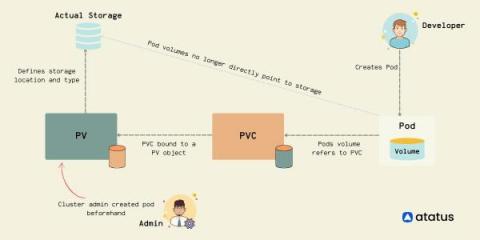
Exploring Kubernetes Storage: Persistent Volumes and Persistent Volume Claims

In today's world of container-based applications, the role of storage has become more critical than ever. One of the most significant challenges of containerization is the management of stateful applications. Kubernetes, one of the popular container orchestration platforms, provides a solution to this problem - Persistent Volumes (PVs). PVs allow the storage provision to be decoupled from the lifecycle of the Pod, making it easier to manage stateful applications.

Code, Coffee, and Unity: How a Unified Approach to Observability and Security Empowers ITOps and Engineering Teams

In today's fast-paced and ever-changing digital landscape, maintaining digital resilience has become a critical aspect of business success. It is no longer just a technical challenge but a crucial business imperative. But when observability teams work in their own silos with tools, processes, and policies, disconnected from the security teams, it becomes more challenging for companies to achieve digital resilience.