
Why AI Creative Workflows Are Moving Beyond Single-Purpose Generators

AI generation is no longer the difficult part of creating digital content.
Generating an image from a prompt can take seconds. Creating a short AI video is also becoming increasingly accessible. Editing a background, modifying an object, or producing another visual variation can often be handled with a few instructions.
The harder problem appears after the first generation.
A real content project rarely needs just one image or one video. A marketing campaign may require product visuals, social media assets, short videos, variations for different platforms, and multiple rounds of revisions. When every step happens in a different tool, the creative workflow quickly becomes fragmented.
This is why AI content production is moving beyond single-purpose generators and toward connected creative workspaces.
The Problem With Single-Purpose AI Tools
Single-purpose AI tools are useful when the task is clearly defined.
Need an image? Open an AI image generator.
Need a video? Open an AI video generator.
Need to remove an object? Open an AI editing tool.
The problem starts when these tasks become part of the same project.
A creator may generate an image, download it, upload it to another platform, recreate the context of the original prompt, generate a video, export the result, and then move everything into another application for editing.
None of these steps is particularly difficult on its own. Together, however, they create unnecessary friction.
The issue becomes even more noticeable during revisions. Changing one creative decision can require repeating several steps across multiple platforms.
For teams producing content at scale, the workflow itself can become a bigger constraint than generation time.
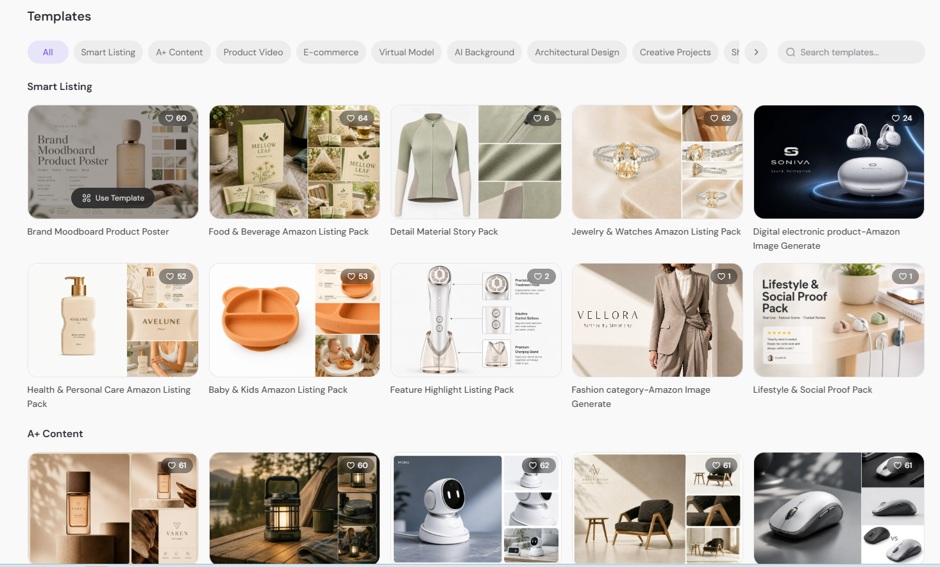
AI Content Creation Is Becoming an Iteration Problem
The first output is rarely the final output.
A product image may need a different background. A character may need a different pose. A video may require another camera movement. A campaign may need several visual variations before the team finds the right direction.
This means that the value of an AI platform should not be measured only by the quality of its first generation.
Iteration matters.
A practical AI workflow should make it easy to move between generating, editing, refining, and generating again.
Instead of:
Generate → Export → Switch Tool → Upload → Recreate → Edit
the workflow can become:
Generate → Edit → Refine → Generate Again
That difference becomes important when a project contains dozens of assets rather than a single image.
From AI Image to AI Video
One of the clearest examples of this shift is the relationship between AI Image and AI Video.
A creator may begin with a static visual because it provides a useful reference for the project's subject, composition, environment, or visual style.
The next step is to introduce motion.
For example, an e-commerce team could generate a product image showing a watch on a luxury desk. Instead of creating a completely separate video concept, the team could use that visual as the foundation for a short product sequence.
The image establishes the visual direction. AI Video then adds movement, camera changes, or environmental motion.
This creates a more connected production process:
Concept → AI Image → Image refinement → AI Video → Final asset
For marketers and creators, this can be more practical than treating image and video generation as completely separate tasks.
Why the Workspace Matters
The shift toward AI workspaces is not simply about putting more features on one website.
The more important question is whether the tools work together as part of a recognizable workflow.
PicLumen approaches AI creation as an all-in-one creative workspace, bringing image generation, visual editing, and AI Video capabilities into a broader environment for developing and refining creative ideas.
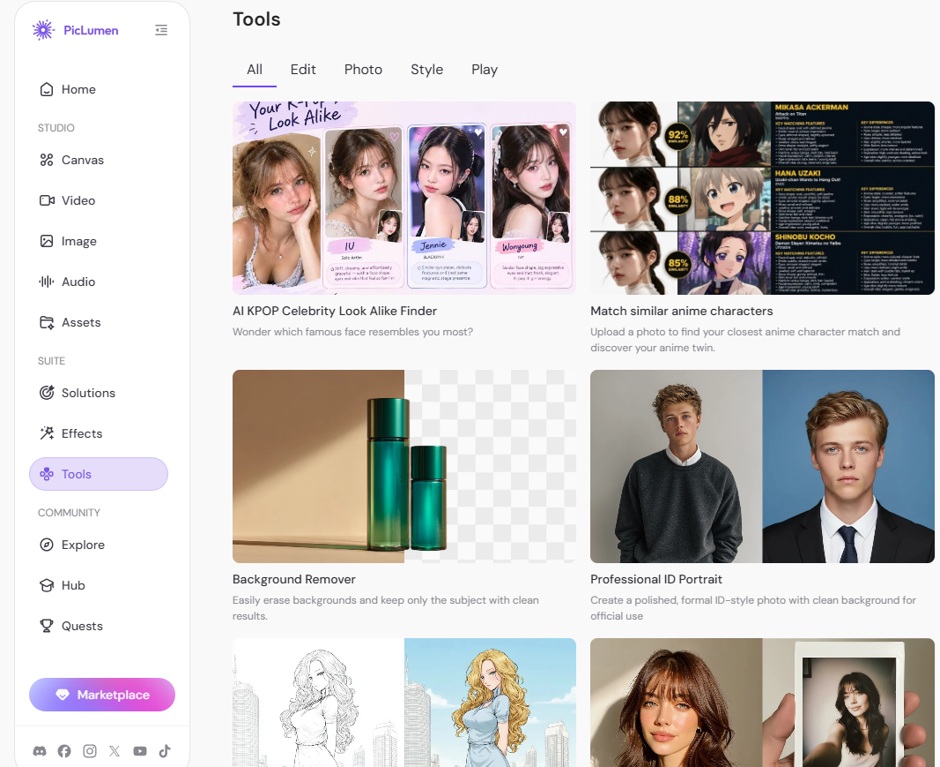
That positioning matters because modern content production is rarely limited to one format.
A creator might need an AI Image for a product page, several variations for social media, and an AI Video for a campaign. These assets may all originate from the same creative concept.
Keeping those activities within a connected workflow can reduce the amount of context that has to be rebuilt at every stage.
Consistency Becomes More Important as Output Increases
Generating one impressive image is relatively easy to evaluate.
Generating twenty images that belong to the same campaign is much harder.
As AI content production scales, consistency becomes increasingly important.
Characters need to remain recognizable. Products need to maintain their visual identity. Lighting and composition may need to follow the same creative direction. A series of images and videos should look like parts of the same campaign rather than unrelated generations.
This is one reason reference-based workflows are becoming increasingly useful.
Instead of asking AI to invent every asset independently, creators can use existing visuals as a foundation for new generations and transformations.
The goal is not simply to generate more content.
It is to generate related content.
AI Editing Is Part of Generation, Not a Separate Stage
Traditional workflows often separate generation and editing.
AI is gradually making that distinction less meaningful.
Suppose a creator generates a product image but notices that the background does not fit the campaign. Rather than abandoning the image and starting again, an AI editing workflow can modify the existing visual.
The same concept can then be adapted into another format.
This creates a continuous loop:
Create → Inspect → Edit → Extend → Repurpose
The workflow becomes more flexible because creators can make decisions after generation rather than trying to describe every detail perfectly in the first prompt.
For creative teams, that can change how AI is used.
Instead of treating AI as a button that produces a finished asset, they can treat it as an interactive production environment.
The Real Advantage Is Fewer Workflow Breaks
It is tempting to evaluate AI tools based on individual features.
How realistic are the images?
How long are the generated videos?
How many models are available?
How many editing functions are included?
Those questions matter, but they do not tell the whole story.
For production work, another question is equally important:
How many times does the creator have to leave the workflow?
Every handoff creates friction. Files have to be downloaded and uploaded. Prompts may need to be reconstructed. Versions can become difficult to track. Visual consistency can become harder to maintain.
A connected AI creative workspace addresses this problem by reducing the number of separate environments involved in the creative process.
What This Means for Content Teams
The move toward integrated AI workflows is particularly relevant for teams that produce content continuously.
Consider a small marketing team launching a new product.
Instead of commissioning or manually producing every asset independently, the team can begin with a creative brief and develop a visual direction through AI Image generation.
From there, the same creative direction can support:
- Product images
- Social media graphics
- Advertising concepts
- Short AI Video clips
- Background variations
- Campaign experiments
The team can then refine the strongest outputs rather than producing every variation manually.
This does not eliminate creative decision-making. It changes where that effort is spent.
Less time can be spent moving files between tools, while more time can be spent deciding which concepts are worth developing.
The Next AI Workflow Is About Continuity
Generative AI has already made individual creative tasks dramatically more accessible.
The next challenge is connecting those tasks.
AI Image, AI Video, editing, transformation, and asset variation are increasingly becoming parts of one production process rather than isolated capabilities.
That is where all-in-one platforms such as PicLumen fit into the evolving AI creative landscape.
The value of an AI creative workspace is ultimately not just how quickly it can produce a single image or video. It is how naturally a creator can move from the first idea to the next iteration—and from one asset to an entire collection of finished content.
As AI moves deeper into everyday creative production, workflow continuity may become just as important as generation quality.