
What DFIR Certification Should You Get First?

Image Source: depositphotos.com
Your first digital forensics and incident response (DFIR) certification should match the investigations you want to run.
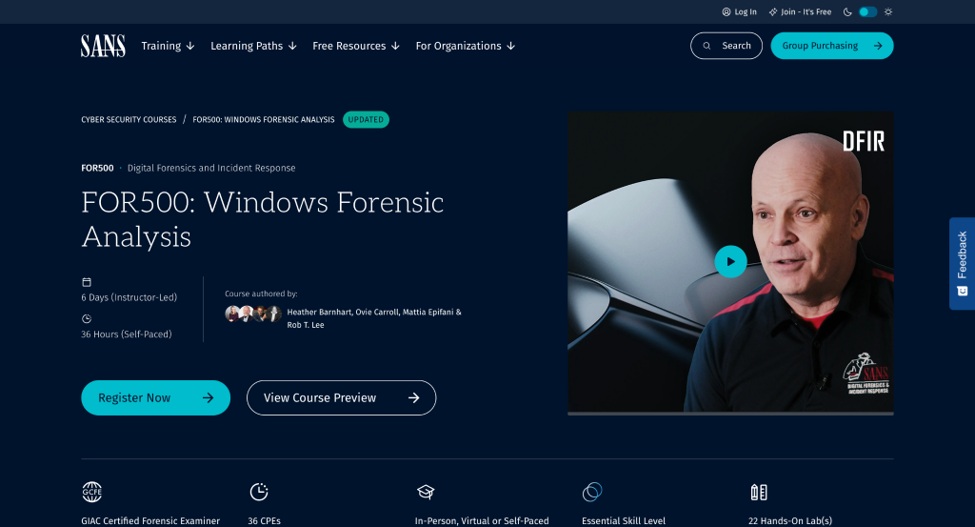
If you want to examine Windows systems as a forensic analyst, start with FOR500 and the GIAC Certified Forensic Examiner (GCFE) exam.
If you want a broader SOC analyst role first, a lower-cost practical credential such as BTL1 or PSAA is the better entry point.
We compared five routes below: FOR500 toward GCFE, Centri BTL1, TCM Security PSAA, Hack The Box CDSA and CyberDefenders CCDL1. Each section covers pros, cons, why we picked it and the published price.
Key Takeaways
- FOR500 with GCFE is our top pick for Windows forensic foundations, with 22 hands-on labs and a capstone challenge.
- BTL1 costs £399 and covers five junior defensive domains on top of security fundamentals.
- PSAA costs $249 and adds a professional report to a two-day practical investigation.
- CDSA requires the full HTB Academy SOC Analyst path before you can start its seven-day exam.
- CCDL1 pairs Windows forensics and memory analysis with Azure log investigation in KQL.
How We Picked
We reviewed each provider's own course, exam and help-center pages on October 13, 2026.
We compared prerequisites, forensic depth, exam format, reporting requirements, study access windows and what each purchase includes.
This was a documentation review, not hands-on course completion. Prices and terms change often, so every figure below is what the provider published on that date.
One distinction matters before you buy. A training course teaches the material, while a certification requires passing an assessment. Enrollment alone does not award any of these credentials.
Where to Start Based on Your Background
Your current experience decides which route makes sense first. Use this as a quick filter before reading the full reviews.
- New to IT or security: Start with BTL1, PSAA or CCDL1. BTL1 and CCDL1 list no formal exam prerequisites, while PSAA expects beginner IT knowledge, command-line comfort and a machine that runs multiple virtual machines.
- IT or security background, aiming for forensic examiner work: Go to FOR500 toward GCFE. It has no prerequisite courses, though the material assumes you already understand IT or security concepts.
- SOC fundamentals already in place: Consider CDSA, which Hack The Box pitches at an intermediate level and gates behind its SOC Analyst path.
- Aiming for senior incident response or threat hunting: Treat FOR508 toward GCFA as the advanced step after a Windows forensic foundation.
DFIR Starting Credentials Compared
|
Credential |
Assessment |
Exam window |
Study access |
Published price |
Best for |
|
FOR500 + GCFE |
Proctored exam, 82 questions, 70% to pass |
3 hours |
4 months (self-paced) |
$8,780 course; GCFE attempt is an add-on |
Windows forensic examiners |
|
Centri BTL1 |
Practical incident response exam |
24 hours, one free resit |
4 months |
£399 training and exam |
Junior defenders choosing a specialty |
|
TCM Security PSAA |
Practical investigation plus written report |
2 days, then 2 days for the report |
12 months |
$249 with one free retake |
SOC analysts who must document findings |
|
HTB CDSA |
Practical lab plus incident report |
7 days, report included |
While subscribed |
$550/year Silver Annual |
Analysts with SOC fundamentals |
|
CyberDefenders CCDL1 |
Practical exam |
48 hours |
4 months (bundle) |
$499 bundle or $349 exam only |
Tier 1 SOC roles with cloud coverage |
1. FOR500 Windows Forensic Analysis (GCFE Path)
Pros
- Windows artifact analysis runs through all six course sections
- 22 hands-on labs plus a capstone Windows Forensic Challenge
- Tool-agnostic methods on a SIFT Workstation with more than 200 DFIR tools
- In-person, live virtual or self-paced delivery
Cons
- Windows-centered scope
- Does not cover the basics of evidentiary handling, chain of custody or introductory drive acquisition
- Apple Silicon laptops cannot run the course virtual machines
Why we picked FOR500
FOR500 builds the artifact skills a forensic examiner uses daily: registry analysis, shell items, USB device profiling, email, event logs and browser forensics.
The course covers cases from Windows 7 through Windows 11, and its labs use Windows 10 and 11 evidence, so the methods carry over to real casework.
There are no prerequisite courses, though the material assumes you understand IT or security concepts.
The SANS Institute DFIR training hub maps its DFIR courses to eleven GIAC certifications, so you can see where FOR500 sits next to FOR508 and GCFA.
GCFE itself is a separate proctored exam with 82 questions, a three-hour limit and a 70% minimum passing score.
You have 120 days from activation to sit it, remotely through ProctorU or at a Pearson VUE center.
FOR500 pricing
The US course price is $8,780 for both live and self-paced formats, and self-paced study includes four months of access.
The GCFE attempt is added at checkout and comes with two practice tests, so confirm it is in your cart.
2. Centri Blue Team Level 1 (BTL1)
Pros
- Covers phishing analysis, threat intelligence, digital forensics, SIEM and incident response
- 23 browser labs with 100 hours of lab access
- 24-hour practical exam with one free resit
- Certification is awarded for life
Cons
- Training access ends after four months
- Forensics is one domain among several, not the whole course
Why we picked BTL1
BTL1 suits junior defenders who have not picked a specialty yet. Its labs use tools you will meet in DFIR work, including Autopsy, FTK Imager, KAPE, Volatility, Splunk and Wireshark.
There are no exam entry requirements, and Centri aims the course at people with up to two years of experience.
It ranks second because its breadth serves a different goal than FOR500's forensic depth.
BTL1 pricing
The £399 package covers four months of training access, the exam and one free resit. Plan your study schedule around that four-month window.
3. TCM Security Practical SOC Analyst Associate (PSAA)
Pros
- More than 30 hours of on-demand SOC 101 training
- Two-day practical investigation with no flags or multiple-choice questions
- Two more days to write a professional report
- Certification does not expire
Cons
- Needs a machine that can run multiple virtual machines
- Assumes comfort with Linux and Windows command lines
Why we picked PSAA
PSAA is for readers who need to explain findings, not just find them. Your report must document findings, investigation steps, indicators of compromise and recommended actions.
The training covers digital forensics and incident response alongside phishing, network traffic and SIEM analysis.
The exam is not proctored, and AI tools are allowed as long as you disclose them in the report.
PSAA pricing
The $249 package includes 12 months of training access, one exam attempt and one free retake. The exam voucher is valid for 12 months from the day you buy it.
4. Hack The Box Certified Defensive Security Analyst (CDSA)
Pros
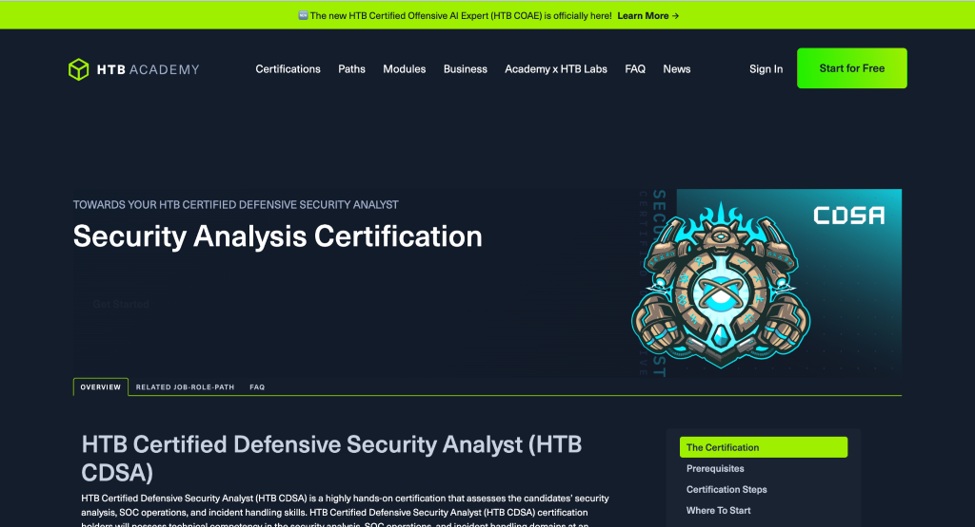
- Covers security analysis, SOC operations and incident handling
- Commercial-grade incident report required to pass
- Exam voucher bundled into the Silver Annual plan
Cons
- You must finish 100% of the SOC Analyst job-role path before starting the exam
- One seven-day deadline covers both the lab work and the report
- Pitched at an intermediate level
Why we picked CDSA
CDSA is the most demanding entry here and best for readers who already know SOC basics. If you are still building those basics, a cybersecurity career roadmap can help you plan them before committing to the SOC Analyst path.
You get seven days to work the exam lab and upload your report as an unencrypted PDF or ZIP of 20 MB or less.
Results arrive within 20 business days. If you need another attempt, it must start within 14 days of receiving feedback.
CDSA pricing
Hack The Box raised Silver Annual to $550 a year on October 12, 2026, up from $490.
The plan bundles an HTB CJCA voucher plus one specialist certification voucher, and HTB's help center lists CDSA among the eligible exams.
5. CyberDefenders Certified CyberDefender Level 1 (CCDL1)
Pros
- Windows forensics covering registry, file system artifacts and memory analysis
- Timeline building to reconstruct incidents
- Azure investigation with cloud log analysis in KQL
- Exam-only option for experienced analysts
Cons
- Built for Tier 1 SOC work, not deep forensic specialization
- Both attempt windows count from the purchase date
Why we picked CCDL1
CCDL1 fits readers who want foundational SOC skills with cloud coverage included.
Its exam outline lists disk, memory, registry, MFT and prefetch artifact analysis within the DFIR domain.
There are no formal education or experience prerequisites. Once you start the practical exam, you have 48 hours to complete it.
CCDL1 pricing
The course and exam bundle costs $499 with four months of course access, or $349 for the exam only.
Both include two attempts: the first must start within three months of purchase and the second within four months.
Conclusion
FOR500 with GCFE is the strongest first step if Windows forensic examination is your goal. Its 22 labs, capstone challenge and proctored exam match that objective directly.
If you are still choosing between SOC work and forensics, BTL1 gives the broadest junior coverage, while PSAA adds report writing for $249.
Before you pay for any of them, check the study access window, the exam deadline and exactly what the purchase includes.
Frequently Asked Questions
Can I get a DFIR certification with no experience?
Yes. BTL1 and CCDL1 list no formal exam prerequisites, while PSAA expects beginner IT knowledge, command-line comfort and a machine that runs multiple virtual machines.
FOR500 has no prerequisite courses but assumes you understand IT or security concepts.
How much does a first DFIR certification cost?
Published prices range from $249 for PSAA to $8,780 for the FOR500 course. BTL1 costs £399, CCDL1 costs $499 with training and the HTB Silver Annual plan costs $550 a year.
Do these certifications expire?
It depends on the provider. BTL1 is awarded for life and PSAA does not expire, while GIAC certifications such as GCFE renew with 36 CPE credits every four years.
Should I take GCFE or GCFA first?
GCFE comes first for most people. FOR500 is an essentials-level course, while FOR508 toward GCFA targets practitioners leading advanced incident response and threat hunting.
Which certification aligns with DoD 8140?
GIAC lists GCFE as aligned with DoD 8140, and FOR500 maps to the Forensics Analyst work role (DCWF 211). Check the exact work role named in the job posting before you choose.
Are these exams proctored?
GCFE is proctored, either remotely through ProctorU or at a Pearson VUE center. PSAA is not proctored, though TCM Security monitors traffic in the exam environment.