Operations | Monitoring | ITSM | DevOps | Cloud

The latest News and Information on Cloud monitoring, security and related technologies.

Codex vs. Claude Code in 2026: cost, capability, and which one your team should pick

Codex is OpenAI's terminal-based autonomous coding agent, bundled into ChatGPT plans and billed through token-based credits. Claude Code is Anthropic's terminal-based coding agent, sold through Claude subscriptions or the API. Codex is cheaper to enter; Claude Code is stronger on complex work. Both run $100 to $250 per developer monthly at active use.

AI coding tools cost compared: Copilot, Cursor, Claude Code & Codex

AI coding tools cost between $0, on GitHub Copilot's free tier, and $200 per developer per month at list price. GitHub Copilot is cheapest to start at $10. Codex is cheapest per task for ChatGPT subscribers. Claude Code has the most predictable ceiling. Cursor is the most variable. Once agents run all day, vendor-reported usage lands at $100 to $250 per developer monthly, no matter which one you pick.

Database monitoring: what to track, which tools to use, and what it all costs

Database monitoring is the continuous tracking of a database's health, performance, and resource consumption, covering metrics like query latency, throughput, connections, and replication lag. In the AI era, it has expanded to include a fifth dimension: spend. Modern teams monitor not just whether the database is fast, but whether the workload it serves is worth what it costs to run. In May 2025, an engineer named Bohan Zhang stood up at PGConf.dev in Montreal and broke every scaling rule in the book.

Shipped: Allocate AI spend by the tags on your IAM roles

The tags you put on the IAM users and roles that call your models now come through as dimensions you can group and filter on. Tag a role with costCenter, department, email, or name, group by that key, and the model spend those callers drove shows up underneath. That gives you the human-readable half of caller identity. A caller ARN like assumed-role/inference-gateway/session-8842 names a role.

Backup vs Sync: What's the Difference?

Cloud storage goes far beyond just uploading your files online and leaving them there. You can do much more with your files to protect, collaborate, and keep your files updated with the proper cloud storage. Two popular approaches for file management are file syncing and backups, which are different methods that you should know how and when to use to get the best from your cloud service provider.

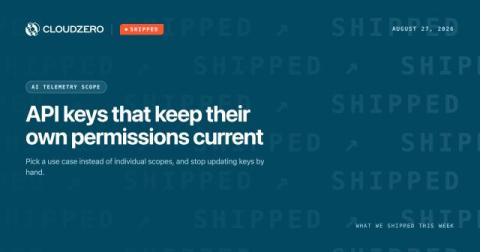
Shipped: API keys that keep their own permissions current

The most common reason to create an API key in CloudZero is to send data, such as AI telemetry or billing exports. Until now, that meant picking individual scopes from a list and hoping you chose the right ones. That works on day one. The problem is day ninety. Permissions on a key have always been a snapshot of the day you created it. A new AI telemetry endpoint ships in October, and a key created in August has no idea it exists.

Supabase pricing: plans, free tier limits, and the bills AI is quietly creating

Supabase offers four plans: Free ($0, two projects, 500 MB database each), Pro ($25 per organization per month plus usage), Team ($599 per month, adds SOC 2 and SSO), and Enterprise (custom). The base fee is the floor, not the bill. Compute ($10+ per project), egress ($0.09/GB), storage, and monthly active user charges stack on top, so real production bills run $35 to $200 per month. In June 2026, a database company most CFOs had never heard of raised $500 million at a $10.5 billion valuation.

Google Cloud Functions is now Cloud Run functions: what it is, and what it really costs

Google Cloud Functions is Google's serverless functions product, renamed Cloud Run functions in August 2024 and folded into the Cloud Run platform. You write event-driven code, Google runs it, and you pay per request, per vCPU-second, and per GiB-second after a free tier of 2 million requests a month. The catch: per-invocation billing scales your mistakes exactly as efficiently as it scales your product.

Task containers turn idle jobs into on-demand compute

Somewhere in most production setups there is a container that stays awake all week to do one job on Friday. Maybe it re-indexes a database. Maybe it runs a batch report, or a data migration that only matters at month end. Either way, the resources are billed for seven days. Task containers close that gap. They are ephemeral, API-triggered containers that spin up inside an Upsun Cloud environment, run exactly one command, and remove themselves when that command exits. Nothing sits idle between runs.