The latest News and Information on Cloud monitoring, security and related technologies.
There is a growing ecosystem of vendors that are helping AWS customers gain better observability into their serverless applications. All of them have been facing the same struggle: how to collect telemetry data about AWS Lambda functions in a way that’s both performant and cost-efficient. To address this need, Amazon is announcing today the release of AWS Lambda Extensions.
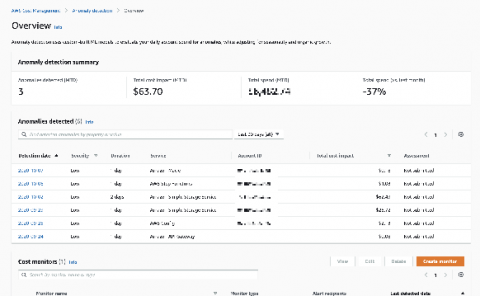
Every decision that an engineer makes in the cloud impacts cost. Yet we know that engineers aren’t cost experts, and many worry that asking them to care about cloud cost will slow them down and distract them from delivering customer value. Top cloud-native companies dedicate entire teams of engineers to build custom tools to measure unit cost and deliver cloud cost to engineering teams. But I’m guessing you don’t have eight engineers you can spare to build internal cost tools?
Modern applications are platform-agnostic which means that they can run seamlessly in hybrid and multi-cloud environments. Google Anthos, released in 2019, is an application management platform that allows developers and IT to build and run applications across on-prem and public clouds (including competing cloud providers). Hosted on Google Kubernetes Engine (GKE), Anthos helps organizations create enterprise-grade containerized applications that are secure and portable across multiple venues.
We are excited to announce a new integration to help developers add partner solutions to their serverless applications. AWS recently released Lambda Extensions to allow Lambda to augment the Function invocation lifecycle. Extensions from AWS, AWS Lambda Ready partners, and open source projects are useful for a wide range of use cases. For example, Extensions simplify a development workflow by automatically instrumenting Lambda functions or deploying operational tools without needing code changes.
We are excited to announce the preview of the Splunk extension for AWS Lambda, a new way to integrate monitoring and observability in Lambda environments. Splunk is already the pioneer in providing real-time observability into serverless environments. With the Splunk extension, capturing and ingesting observability data become seamless without the need to instrument function code.
With the economies of many countries heading towards recession, increasing regulations, growing security threats and increasing costs, financial services firms need practical solutions, now more than ever. Many of the financial technology firms (‘fintechs’) and mobile app-based challenger banks have taken advantage of modern application architectures and DevOps practices that are associated with cloud native technologies.
Welcome to the final installment of our Complete AWS Lambda Handbook series! Given Lambda is often the central point for many serverless applications, we wanted to make sure we didn’t skip or breeze past any part. In this episode, we’re looking at some limitations and difficulties using AWS Lambda and how to overcome them, and the importance of monitoring for performance and failure remediation.
So you’ve got an app ready for launch, and unlike in the past where you simply ran it on-premises, this time you want to try the cloud. You know AWS is the leading cloud platform, and decide to give it a go. The first thing you’ll bump into as you learn about AWS is the various options of cloud instances available with AWS EC2.
Amazon EKS is the most popular managed Kubernetes solution. DevOps teams can quickly spin up clusters in the cloud and get started with Kubernetes in a few clicks. As organizations embrace Kubernetes in the cloud, the challenge becomes managing clusters across multiple regions or accounts. At that point, organizations struggle to visualize all of their clusters.