Operations | Monitoring | ITSM | DevOps | Cloud

E-Commerce Micro-Friction: The Conversion Killer You're Not Measuring (...But Should Be)

Friction density (the number of stacked micro-frictions in a single session) is the predictor of abandonment we don’t talk about enough. And guess what? It beats any single UX metric by 2× when it comes to predicting lost sales.

SigNoz Community Edition now available with SSO (Google OAuth) and API Keys

One of the biggest asks from our open-source community has been to open-source our SSO support, which was part of our enterprise offering. Today, we’re thrilled to announce that support for SSO with Google OAuth is now part of our latest release. Latest version: v0.85.0 Not only that, we've also shipped another highly anticipated feature for our Community Edition: API Keys for comprehensive programmatic access to SigNoz.

Shedding Light on Kafka's Black Box Problem (with OpenTelemetry)

"All language is but a poor translation." — Franz Kafka This quote by Franz Kafka reminds me of the time when I used to look at metrics from “Apache Kafka” topics trying to figure out what was causing the huge lags and manually deleting the messages in certain partitions to get rid of polluted messages. Yep, pretty lost in translation. I wasn’t aware of the power of observability for a Kafka producer-topic-consumer system.

How to Choose an APM Solution: 5 Critical Questions for 2025

An APM solution, or Application Performance Monitoring tool, is a software application that helps businesses monitor and manage the performance and availability of software applications. APM tools gather data from systems, servers, databases, APIs, and end-user devices to provide deep insights into the root causes of performance issues. APM solutions have evolved far beyond basic monitoring.

What are Microservices? A Path to Scalability and Agility

If developing scalable, agile applications is a priority for your business, microservices may provide a compelling solution. But what are microservices exactly? The proper microservices definition refers to a modern architectural approach where an application is built as a collection of loosely coupled services. Each service is independent, self-contained, and designed around a specific business capability.

Application Performance Monitoring Guide: Strategies, Best Practices, and Tools

With the introduction of cloud services and microservices, applications have become more complicated due to their increased layers of complexity and distributed architecture. While microservices clearly offer speed, they also make things harder for the developers and operations teams. These teams need to plan for the reliable and efficient performance of such applications. To combat these challenges, application performance monitoring (APM) has surfaced as an indispensable discipline.

What is Amazon Inspector? Monitoring and Alerting with Amazon Inspector

Amazon Inspector is an automated security assessment service that scans AWS workloads for vulnerabilities, misconfigurations, unintended network exposure and compliance risks, helping organizations enhance cloud security, detect threats, and meet regulatory requirements (such as ISO/IEC 27001, HIPAA, NIS 2 and SOC 2 Type 2) in real time. Amazon Inspector discovers and scans Amazon EC2 instances, container images in Amazon ECR (Elastic Container Registry), and Lambda functions.

A New Era of Efficiency: Leveraging AI, Data, and Modernization to Improve Public Services

Greg Reeder from Datadog talks with Martha Dorris, a leader in government customer experience, about how agencies can drive efficiency using AI, real-time data, and observability. They highlight CX wins at the State Department, IRS, and CBP—showing how smarter monitoring and design improve services, reduce costs, and strengthen citizen trust.

From Cost Centre to Compounding Advantage

Most teams still treat bugs like little fires to put out. A ticket gets logged. Someone investigates. A fix gets pushed. Then it’s onto the next one. But here’s the thing nobody tells you: Every bug is a chance to get smarter. And in 2025, the best teams aren’t the ones logging the fewest bugs. They’re the ones learning the most from every bug they fix.

SigNoz Launch Week 4.0 - OpenTelemetry Powered Innovations That Redefine Observability

OpenTelemetry is rapidly becoming the backbone of modern observability, but true innovation happens when you build directly on its latest capabilities. For Launch Week 4.0, we’re excited to showcase five powerful features; each crafted to help you get more value from your telemetry, make debugging faster, and deliver a unified observability experience. Here’s a quick look at what’s new, why it matters, and how SigNoz is pushing the boundaries of what’s possible with OTel.

Tracing Funnels - Define funnels between spans | SigNoz Launch Week 4.0 Day 5

Build funnels directly on your traces and get instant answers to questions like: What fraction of spans made it from event A to event B? Between which spans are most requests failing? What is the latency between key spans? Traditional observability tools let you inspect traces and spans, but they can’t aggregate or analyze how requests flow across multiple services or stages in your system. In asynchronous, distributed architectures, the root span rarely tells the full story-and there’s no way to measure conversion, drop-off, or latency between arbitrary steps across all traces.

Tracing Funnels - Define funnels b/w spans in your distributed systems

Distributed tracing has long been the go-to for understanding the performance of microservices and asynchronous systems. But as systems grow in complexity, simply viewing individual traces and spans isn’t enough. Teams need to answer questions like: SigNoz Tracing Funnels is here to change that, bringing the clarity of product analytics-style funnel analysis to backend traces, and doing so in a way that’s never been available before.

CI/CD Observability Powered by OpenTelemetry

Modern engineering teams spend a lot of time and resources in setting up monitoring of their production systems - tracking uptime, catching errors, and responding to incidents before customers ever notice. But what about the journey before code reaches production? For most teams, observing the CI/CD pipeline is either an afterthought or completely overlooked. While we recognize its importance, do we truly understand how well our CI/CD process is functioning?

CI/CD Observability Powered by OpenTelemetry | SigNoz Launch Week 4.0 Day 4

Tired of guessing why your releases stall, which PRs are stuck, or where flaky tests are wasting your team’s time? Most teams obsess over production monitoring, but what about the bottlenecks that often hide in the CI/CD pipeline slowing delivery, draining productivity, and introducing risk before code ever ships. With CI/CD Observability, you can: So, stop flying blind in your delivery process and make every release faster, more reliable, and fully transparent!

Third party API Monitoring Powered by OTel Semantic Conventions | SigNoz Launch Week 4.0 Day 3

Is it the third-party API or my code? Your service suddenly slows down, or errors spike, and you’re stuck guessing if it’s your own logic or an external API you don’t control. We’ve seen this pain across teams: dashboards don’t tell you which vendor or endpoint is the culprit, and debugging turns into a maze of guesswork. Rate limiting, vendor errors, or integration issues often slip through until users complain.

Introducing Metrics Explorer | SigNoz Launch Week 4.0 Day 2

Ever tried to build a metrics dashboard and thought, “Wait, what metrics am I actually sending?” We heard this from users again and again-so we built Metrics Explorer. For the first time, you get a real-time, interactive view of every metric coming into your system: Whether you’re onboarding a new integration, debugging an alert, or just exploring your data, Metrics Explorer makes it easy to understand and work with your metrics-no more guesswork, just clarity.

CI/CD Observability Powered by OpenTelemetry and SigNoz

Most teams have strong monitoring for production, but what about the journey before your code gets deployed? The CI/CD pipeline is where bottlenecks, flaky tests, and process gaps silently waste your team’s time. Until now, this part of the workflow has mostly been a black box. We’re excited to announce CI/CD Observability in SigNoz - a new way to track, analyze, and improve your software delivery process, powered by OpenTelemetry.

Tracing Funnels - Define funnels b/w spans in your distributed system

Build funnels directly on your traces and get instant answers to questions like: What fraction of spans made it from event A to event B? Between which spans are most requests failing? What is the latency between key spans? Traditional observability tools let you inspect traces and spans, but they can’t aggregate or analyze how requests flow across multiple services or stages in your system. In asynchronous, distributed architectures, the root span rarely tells the full story-and there’s no way to measure conversion, drop-off, or latency between arbitrary steps across all traces.

Third party API Monitoring powered by OpenTelemetry semantics

In today’s cloud-native world, third-party APIs are everywhere. Payments, notifications, search, AI, analytics as modern applications are built on a web of external services. But what happens when one of those APIs slows down, starts throwing errors, or gets rate-limited? Suddenly, your users are facing issues, and you’re stuck asking.

How to Monitor PowerShell Activity and Detect PowerShell Exploitation Vulnerabilities

Why should you monitor PowerShell?…. PowerShell is a powerful automation tool, however its capabilities also make it a prime target for exploitation by cyber attackers. Implementing a robust, automated PowerShell monitoring solution is now essential to detect and prevent exploitation attacks before they compromise your systems. PowerShell is a powerful scripting tool that can automate tasks and manage systems, but its flexibility also makes it a target for abuse.

Metrics Explorer - Search, Query, and Analyze all your Metrics at one place

If you’ve ever found yourself staring at a dashboard dropdown, wondering, “What metrics am I even sending to my observability tool?”, you’re not alone. For most engineering teams, answering even the most basic telemetry questions is about as hard as catching a Mewtwo. Frustratingly elusive and way more complicated than it should be, like: We built Metrics Explorer to finally answer all of these questions instantly, and in one place.

Deep Temporal Observability | SigNoz Launch Week 4.0 Day 1

If Temporal powers your business-critical workflows, you know how tough it is to get real visibility into what’s happening under the hood. Most tools only show basic Prometheus metrics-leaving you guessing about bottlenecks, failures, and performance issues. Join us for a live demo of SigNoz’s industry-first Temporal integration. We’ll show you how to: Whether you’re running Temporal in production or just exploring workflow orchestration, this session will show you how to move from “just metrics” to true, unified observability.

Track GitHub Copilot Usage with Datadog #GitHubCopilot #Datadog #DevTools

Easily track GitHub Copilot usage across your organization with our new integration. On This Month in Datadog, we’re covering this integration, Datadog CoTerm, and the new Optimization page in Datadog Real User Monitoring. Check out the link in our bio to watch the new episode.

Unifying OpenTelemetry & Datadog | #Observability #OpenTelemetry #datadog

Previously, teams had to choose between adopting the OpenTelemetry Collector’s capabilities and fully leveraging our advanced features. On This Month in Datadog, we’re spotlighting our OTel Collector distribution, which unifies OTel and Datadog. Check out the link in our bio to watch the new episode.

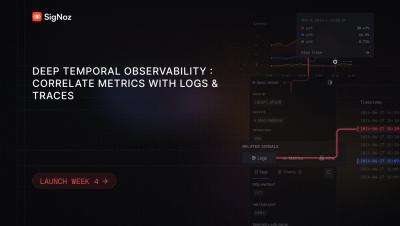
Deep Temporal Observability - Correlate Metrics with Logs & Traces

Temporal lets you orchestrate complex, reliable workflows, but when something breaks or slows down, the built-in dashboards only give you a list of events and some basic filters. You can see what happened and filter by attributes like workflow type or namespace, but you can't drill deeper. There's no way to jump straight from a metric spike to the exact trace or log line you care about.

Metrics Explorer - Search, Query, and Analyze all your Metrics at one place

Ever tried to build a metrics dashboard and thought, “Wait, what metrics am I actually sending?” We heard this from users again and again-so we built Metrics Explorer. For the first time, you get a real-time, interactive view of every metric coming into your system: Whether you’re onboarding a new integration, debugging an alert, or just exploring your data, Metrics Explorer makes it easy to understand and work with your metrics-no more guesswork, just clarity.

This Month in Datadog: OpenTelemetry Collector distribution, GitHub Copilot integration, and more

Datadog is constantly elevating the approach to cloud monitoring and security. This Month in Datadog updates you on our newest product features, announcements, resources, and events. To learn more about Datadog and start a free 14-day trial, visit Cloud Monitoring as a Service | Datadog. This month, we put the Spotlight on the Datadog Distribution of the OpenTelemetry Collector.

Third party API Monitoring Powered by OpenTelemetry Semantics

Is it the third-party API or my code? Your service suddenly slows down, or errors spike, and you’re stuck guessing if it’s your own logic or an external API you don’t control. We’ve seen this pain across teams: dashboards don’t tell you which vendor or endpoint is the culprit, and debugging turns into a maze of guesswork. Rate limiting, vendor errors, or integration issues often slip through until users complain.

Observability Best Practices: Balancing Sustainability and Cost in a Data-Driven World

Imagine this: Your IT team has invested in cutting-edge observability tools to keep systems running smoothly. But does that imply you are following observability best practices? As your business grows, so does the flood of logs, traces, and metrics—along with a skyrocketing cloud bill. What started as a way to gain better visibility is now a major expense, and suddenly, you’re asking: Are we paying too much for too little value? This challenge is becoming all too common.

Optimising OpenTelemetry Pipelines to Cut Observability Costs and Data Noise

Fat bills from observability vendors and tons of not-so-insightful telemetry data have turned out to be a very common issue today. This often leaves teams having to explain the lack of clear ROI, despite the growing costs. If you’re using OpenTelemetry to record your observability data, there are some practical methods you can apply to keep those costs from piling up.
Featured Post

How to decide between cloud and on-premise monitoring

Application performance monitoring systems tend to be available in two modes: on-premise and cloud-based SaaS. Which is the "right" choice? Well, it depends on your situation, but overall cloud-based SaaS offerings have significant benefits when compared to on-premise. However, it's not always so simple. The right selection depends on the facts on the ground. Using my experience working for a large-scale cloud solutions department, I've put together some key things you'll want to consider before you make a decision, starting with some benefits and challenges.

Why no one talks about querying across signals in observability?

In today’s complex distributed systems, observability has evolved from a nice-to-have feature to a mission-critical engineering discipline. Engineering teams across organizations depend on robust observability to maintain system reliability and quickly diagnose issues when they inevitably arise. However, current observability tooling significantly lags behind user expectations by failing to support a critical capability: querying across different telemetry signals.