Operations | Monitoring | ITSM | DevOps | Cloud

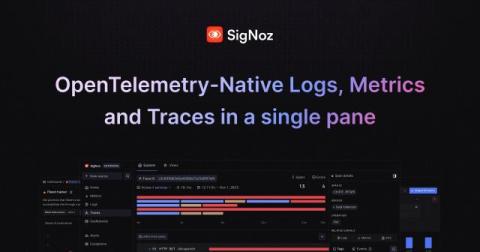
An Open Source OpenTelemetry APM | SigNoz

OpenTelemetry is a Cloud Native Computing Foundation(CNCF) project aimed at standardizing the way we instrument applications for generating telemetry data(logs, metrics, and traces). However, OpenTelemetry does not provide storage and visualization for the collected telemetry data. APM stands for Application Performance Monitoring or Application Performance Management. APM tools help engineering teams effectively monitor their applications by monitoring key metrics for application performance.

OpenTelemetry UI - See What's Possible With OpenTelemetry data

OpenTelemetry is a Cloud Native Computing Foundation(CNCF) project aimed at standardizing the way we instrument applications for generating telemetry data(logs, metrics, and traces). However, OpenTelemetry does not provide storage and visualization for the collected telemetry data. For visualizing OpenTelemetry data, you need an OpenTelemetry UI. The data collected by OpenTelemetry can be sent to a backend of your choice, which can then be visualized.

11 Top MongoDB Monitoring Tools - Including Free & Open-Source [2024]

MongoDB has become a cornerstone in modern database architectures. Its flexibility and scalability make it a go-to choice for many organizations. But with great power comes great responsibility—and the need for robust monitoring. There are many monitoring tools out there, and choosing the right one can be confusing. This article lists the top MongoDB monitoring tools, from open-source ones to fully managed SaaS solutions.

Single Pane of Glass Monitoring - Quick Guide & Open Source Solution

Single Pane of Glass (SPOG) monitoring is a term used to denote monitoring applications with a single tool that provides a comprehensive set of dashboards for the entire software system of an organization. Managing multiple monitoring tools for different aspects of the IT system becomes too cumbersome. And that’s how the concept of a single pane of glass monitoring evolved. Most modern applications are now built using distributed software systems.

Implementing OpenTelemetry with Nginx - Instrument and visualize traces

OpenTelemetry is an open-source standard for instrumenting cloud-native applications for generating different types of telemetry data. A robust observability framework set up using OpenTelemetry can help tremendously while troubleshooting software in production. Nginx is one of the most widely adopted web servers. Most often, nginx is used as a reverse proxy. It serves the frontend or backend applications behind the reverse proxy.

Health Check Monitoring With OpenTelemetry | Complete Code Tutorial

Health check monitoring is a critical practice for maintaining reliable and high-performing systems. It allows you to proactively identify and address issues before they impact your users. This guide explores the fundamentals of health check monitoring, its importance in modern systems, and practical strategies for implementation. You will also learn how HTTP endpoints can be monitored with OpenTelemetry.

Cloud Observability vs Monitoring: A Practical Guide to Go Beyond Cloud-Native Tools

As organizations move their application workloads to the cloud, understanding the difference between cloud observability vs monitoring is crucial to ensure optimal performance and seamless operations. While both concepts are often mentioned in tandem, they serve different purposes, and mastering each can help organizations thrive in increasingly complex cloud environments.

Getting started with OpenTelemetry in SigNoz was quick & easy

Cedana, a YCombinator-backed startup, offers an automated system for saving, migrating, and resuming compute workloads to ensure operational reliability during hardware failures. By enabling seamless recovery and continuity, Cedana optimizes real-time computational tasks across various environments. To ensure operational stability and continuous performance, Cedana uses SigNoz to monitor its infrastructure comprehensively.

Using ClickHouse Queries & exporting trace data for custom analysis

Cedana, a YCombinator-backed startup, offers an automated system for saving, migrating, and resuming compute workloads to ensure operational reliability during hardware failures. By enabling seamless recovery and continuity, Cedana optimizes real-time computational tasks across various environments. To ensure operational stability and continuous performance, Cedana uses SigNoz to monitor its infrastructure comprehensively.

Exception Monitoring in Java - A Guide to Handling Java Exceptions

Exception monitoring in Java plays a vital role in Java application performance monitoring by providing real-time insights into the health and stability of the application. Java is now the backbone of many critical and complex business applications in sectors such as banking, healthcare, finance, retail, and e-commerce. The complexity of these systems is also compounded by the fact that they involve distributed Java microservices that communicate across various layers.

Logs Search & Filter - Taking Quick Analysis of Logs to the Next Level

It is the last day of SigNoz Launch Week 2.0, and we’re excited to announce improvements in the logs module of SigNoz. Searching and filtering for logs to debug issues is one of the top critical workflows any developer uses. We have gathered feedback from our users and shipped some important features that focus on speeding up log searches, refining the filtering process, and enhancing the overall log analysis experience.

The future of .NET for cross-platform development with .NET MAUI and Blazor

The.NET ecosystem rapidly evolves, equipping developers with the latest tools and frameworks for cross-platform application development. In a recent Founder & Friends podcast episode, “Everything.NET,” Raygun CEO John Daniel Trask (JD) and Microsoft Principal Program Manager James Montemagno explored the present and future of cross-platform development, highlighting Microsoft’s pivotal role in shaping the direction of this rapidly evolving field.

Insights into SigNoz's Latest Features - A Conversation with Ankit, CTO of SigNoz

We sat down with Ankit, CTO and co-founder at SigNoz to get his insights on the product’s developments and what's on the horizon. He shared valuable perspectives on how SigNoz is enhancing the user experience, focusing on customer feedback, and building new features.

Introducing Alerts History: Debug application more efficiently by examining the history of alerts

Whenever an alert is triggered, developers want to examine its history. With Alerts history, developers will be able to see a comprehensive view of past alerts, with key contributors(which hosts, etc.) to it and make informed decisions about how to resolve issues more efficiently.

Introducing Alerts History and Scheduled Maintenance - Enhancing Alert Management in SigNoz

Today, we’re excited to introduce two key features that will help users with alerts in SigNoz - Alerts History and Scheduled Maintenance. These features are designed to help teams gain deeper insights into their alerts, better manage recurring issues, and streamline alert silencing during planned downtimes. Let’s dig in deeper.
Introducing Correlation - Bringing Infra/APM Metrics and Logs Together in SigNoz

It is day 3 of SigNoz Launch Week 2.0, and we’re super excited to unveil features related to one of the core tenets of SigNoz. With SigNoz, you can monitor logs, metrics, and traces under a single pane of glass. With three signals under a single pane of glass, the scope for getting more context while debugging your application is immense. Using SigNoz, you can already correlate your traces with logs and check traces associated with APM metrics.

Introducing Correlation: Check infra metrics associated with your logs & logs associated APM metrics

SigNoz provides logs, metrics, and traces under a single pane of glass. Correlation of these signals is a big part of our ongoing efforts. During this launch week, we're excited to announce that we have shipped the first version of it, which allows you to correlate logs with infrastructure metrics and APM metrics with logs.

Splunk vs Dynatrace - Detailed Comparison [2024]

Splunk and Dynatrace are two powerful platforms in the realm of observability and performance monitoring. Each offers unique strengths that cater to different monitoring needs. In this article, we'll explore the features, pros, and cons of both tools, and introduce an exciting alternative that combines the best of both worlds.

Introducing Anomaly Detection: Smarter Alerts for Dynamic Metrics

Anomaly Detection will enable users to create smarter alerts based on dynamic metrics, moving beyond traditional fixed-threshold alerts. By detecting deviations from expected patterns, Anomaly Detection will help you stay informed about critical issues without getting overwhelmed by irrelevant alerts.

Introducing Anomaly Detection - Smarter Alerts for Dynamic Metrics

Today, we’re excited to unveil the Anomaly Detection feature. It will enable users to create smarter alerts based on dynamic metrics, moving beyond traditional fixed-threshold alerts. It will soon be available to all our users and is currently undergoing beta testing with select users. By detecting deviations from expected patterns, Anomaly Detection will help you stay informed about critical issues without getting overwhelmed by irrelevant alerts. Let’s dig in deeper.

Introducing Ingest Guard - A Game-Changer for Observability Cost Control

It’s day 1 of SigNoz Launch Week 2.0, and we’re releasing Ingest Guard, a feature that will help platform and finops teams have granular control over data ingestion and observability costs. At SigNoz, we are constantly evolving to meet the needs of modern engineering teams, and this launch week, we're excited to introduce a highly anticipated feature—Ingest Guard.

Introducing Ingest Gaurd: A Game-Changer for Observability Cost Control

Ingest Guard is a feature that will help platform and finops teams have granular control on data ingestion and observability costs. This new addition to our platform is designed to enhance security, provide better cost control, and offer a streamlined approach to managing observability data.

5 Essential Questions for Developing an Effective AVD Monitoring Strategy

Is your AVD monitoring strategy truly effective? As organizations increasingly adopt Azure Virtual Desktop (AVD) to support remote work, ensuring a seamless and secure user experience becomes a priority. A robust AVD monitoring, and observability strategy is essential to achieve this, allowing you to maintain performance, security, and user satisfaction across your virtual desktops and apps. But where do you start?

Anthropic Partners with Datadog to Bring Trusted AI to All

At Datadog’s 2024 DASH conference, Anthropic President and Co-Founder, Daniela Amodei, announced the new Anthropic integration with Datadog’s LLM Observability. This new native integration offers joint customers robust monitoring capabilities and suite of evaluations that assess the quality and safety of LLM applications. Get real time insights into performance and usage, with full visibility into the end to end LLM trace. Enabling you to troubleshoot any issues, reduce downtime and get your Claude powered applications to market faster.

OpenFeature - A Guide to Open-Source Feature Flagging

Feature flags are crucial in modern software development, allowing teams to safely deploy and test new features. However, the absence of standardization has resulted in fragmentation and vendor lock-in. OpenFeature addresses this by offering an open specification for feature flagging, set to transform how developers manage and implement feature flags across various projects.

Seamless error monitoring with Spring Boot and Raygun

This guest post comes from long-time Raygun customer Midtrans, a leading payment gateway in Southeast Asia. As Midtrans grew, so did the number of applications requiring error monitoring. To tackle the challenges of scaling and standardizing Raygun across multiple teams and services, they created a custom Spring Boot starter for Raygun. Now, Midtrans is excited to share this open-source Spring Boot auto-configuration with the community.

Cross-platform mobile development with Uno Platform

Xamarin has been a popular choice for cross-platform mobile development, but Microsoft’s shift to.NET MAUI has developers seeking alternatives. Uno Platform is an open-source.NET framework for building apps across mobile, desktop, web, and embedded devices. Raygun CEO John-Daniel Trask interviewed Uno Platform’s Francois Tanguay and Sasha Krsmanovic on a recent Founder & Friends podcast. They discussed Uno Platform’s advantages over Xamarin and its productivity benefits.

Using SigNoz in the Staging Environment to improve reliability

Monitor your applications and troubleshoot problems in your deployed applications, an open-source alternative to DataDog, New Relic, etc. Backed by Y Combinator. SigNoz helps developers monitor applications and troubleshoot problems in their deployed applications. SigNoz uses distributed tracing to gain visibility into your software stack.

Centralized Observability on Kubernetes with SigNoz

Monitor your applications and troubleshoot problems in your deployed applications, an open-source alternative to DataDog, New Relic, etc. Backed by Y Combinator. SigNoz helps developers monitor applications and troubleshoot problems in their deployed applications. SigNoz uses distributed tracing to gain visibility into your software stack. If you need any clarification or find something missing, feel free to raise a GitHub issue with the label documentation or reach out to us at the community Slack channel.

FluentD vs FluentBit - Choosing the Right Log Collector

As applications grow in complexity, the ability to gather, process, and analyze logs becomes crucial for maintaining system health and troubleshooting issues. Two popular open-source log collectors have emerged as frontrunners in this space: FluentD and FluentBit. But how do you choose between them? This article dives deep into the FluentD vs FluentBit debate, exploring their features, performance, and use cases to help you make an informed decision.

8 Key Factors of a Successful MSP Monitoring Strategy - Determining your MSP Monitoring Strategy for the Next Decade

As the Managed Service Provider (MSP) landscape continues to evolve, developing a robust MSP monitoring strategy is essential for MSPs wanting to stay ahead in an increasingly complex digital environment.Rapid advancements in technology, coupled with the growing complexity of IT environments, necessitates a shift in how MSPs approach monitoring. The fiercely competitive MSP market and external pressures on costs such as cloud pricing mean that customer expectations are high but profit margins slim.
Sponsored Post

Benchmarking OpenAI models for automated error resolution

Large Language Models (LLMs) are increasingly shaping the future of software development, offering new possibilities in code generation, debugging, and error resolution. Recent advancements in these AI-driven tools have prompted a closer examination of their practical applications and potential impact on developer workflows.

Implementing OpenTelemetry in React Applications

OpenTelemetry can be used to trace React applications for performance issues and bugs. You can trace user requests from your frontend web application to your downstream services. OpenTelemetry is an open-source project under the Cloud Native Computing Foundation (CNCF) that aims to standardize the generation and collection of telemetry data. Using OpenTelemetry Web libraries, you can instrument your React apps to generate tracing data.

Log Shipper - What Is It and Top 7 Tools

Centralizing logs (arranging all records in one place) is often challenging as we need to decide whether to use a log shipper or directly log from the application. If you are not familiar with a log shipper, logging directly from the library might be a suitable option for development (it is easy to configure). However, in production, you'll likely want to use one of the available log shippers, mainly due to buffers, since blocking the application or dropping data (immediately) may not be an option.

Top 6 JavaScript errors and how developers can fix them

JavaScript errors are every developer’s nightmare. They’re not just irritating—they can stop your project dead in its tracks. And let’s face it, whether you’re a seasoned pro or just getting started, you’re bound to encounter these mistakes. But why keep tripping over the same issues? At Raygun, we’ve seen it all when it comes to JavaScript errors, and we know which ones are the real time-wasters.