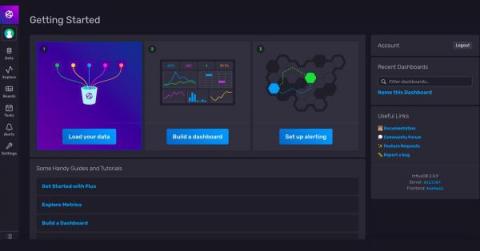
InfluxDB is increasingly being used in IoT solutions to store data from connected devices. Now it can also be used on IoT edge gateways as a data historian to analyze, visualize and eventually transmit aggregated IoT data up to a centralized server. In this article we’re going to look at three simple ways you can connect an instance of InfluxDB on your IoT Edge device to another instance of InfluxDB in the cloud.
In our blog we have posted a few articles about data centers. We like them. They have grown on us. It is a branch of technology that interests us as much as bitcoin interests brothers-in-law or neighborhood projects interest retirees. For that reason, today, in our blog, we will deal with data management as a service or DMaaS.
The 2022 Australian Open men’s singles final between Rafael Nadal and Daniil Medvedev was epic! I watched it in Australia, which meant I was up until 2 a.m. on a Sunday night. Monday morning’s dog walk was sub-joyful. Medvedev seemed unplayable, taking the first two sets comfortably. But Nadal is a legend for a reason. Point by point, he overran his rival to make history.
Although time series data can be stored in a MySQL or PostgreSQL database, that’s not particularly efficient. If you want to store data that changes every minute (that’s more than half a million data points a year!) from potentially thousands of different sensors, servers, containers, or devices, you’re inevitably going to run into scalability issues. Querying or performing aggregation on this data also leads to performance issues when using relational databases.
While relational database management systems (RDBMS) are efficient with storing tables, columns, and primary keys in a spreadsheet architecture, they become inefficient when there’s a lot of data input received over a long period of time. Databases designed specifically to store time series data are known as time series databases (TSDB). For example, an RDBMS might look like this.