Operations | Monitoring | ITSM | DevOps | Cloud

Amazon AppStream 2.0 Multi-session Service Monitoring

In late 2023, Amazon introduced the ability to deliver AppStream 2.0 using Microsoft Windows Server OS rather than the desktop of the OS. This feature enables IT admins to host multiple end-user sessions on a single AppStream 2.0 instance, helping to make better use of instance resources.

Golang Monitoring Guide - Traces, Logs, APM and Go Runtime Metrics

Golang (Go) applications are known for their high performance, concurrency model, and efficient resource use, making Go an easy choice for building modern distributed systems. But just because your Go application is built for speed doesn't mean it's running perfectly in production. When things go wrong, just checking if your service is "UP" isn't enough.

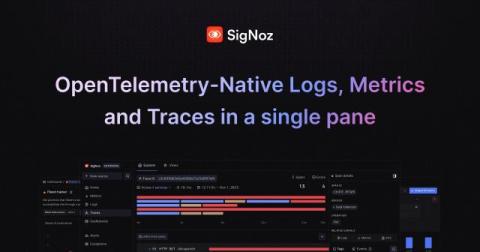
Introducing SigNoz's LLM-Powered Datadog Migration Tool

But migration is painful. Moving from Datadog means manually rebuilding dashboards, rewriting every query, and reconfiguring panels one by one. What took months to build takes weeks to migrate. Engineering teams get pulled away from actual product work to rebuild monitoring infrastructure they already had working. Critical monitoring setups and the context around why dashboards were built a certain way often get lost. We kept hearing about this from teams evaluating SigNoz, so we built a solution.

Beginner's Guide to OpenTelemetry & Django (2025)

Django is a popular open-source "batteries-included" Python web framework that enables rapid development while taking out much of the hassle from routine web development. By providing pre-built components like ORM integrations, authentication/authorization systems and more, it enables developers to focus on business logic and iterate fast. As such, developers and organizations worldwide use Django to build web apps of varying complexities.

What is OpenTelemetry? [Everything You Need to Know]

Observability used to be a fragmented mess. You had one agent for logs, a different library for metrics, and a proprietary SDK for distributed tracing. If you wanted to switch vendors, you had to rewrite your instrumentation code from scratch. OpenTelemetry (OTel) fixed this. It has become the second most active project in the CNCF (Cloud Native Computing Foundation), right behind Kubernetes.

Introducing Bits AI SRE, your AI on-call teammate

Bits AI SRE is your AI on-call teammate, built to autonomously investigate alerts and coordinate incident response. Integrated with Datadog, Slack, GitHub, Confluence, and more, Bits analyzes telemetry, reads documentation, and reviews recent deployments to determine the root cause of alerts—often before you’ve even opened your laptop. In fact, if you're using Datadog On-Call, you can view Bits’s findings right from your phone—so you’re always one step ahead, no matter where you are.

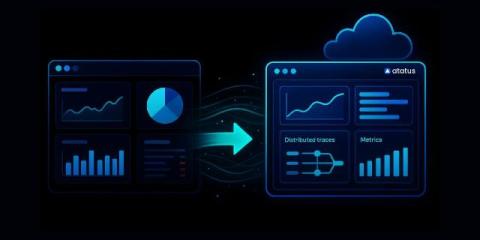
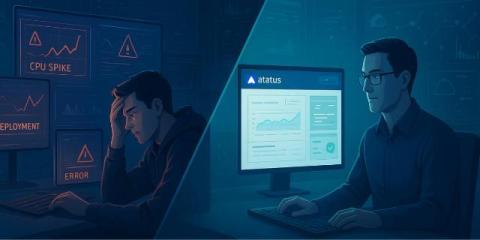
What to Expect When You Migrate to Atatus APM

As organizations aim for exceptional software reliability and user satisfaction, migrating to Atatus APM is a key upgrade in application monitoring. With nearly 80% of companies facing costly downtime exceeding $300,000 per hour, robust APM solutions like Atatus are crucial. It helps teams quickly identify bottlenecks, optimize performance, and improve the customer experience through comprehensive, real-time insights.

The Hidden Cost of Untagged Cloud Resources for SMBs

Cloud computing is a powerful enabler of growth and agility for small and medium businesses (SMBs). However, untagged cloud resources are one of the primary challenges most SMBs face in cloud environments. These untagged resources lead to a lack of visibility and accountability over cloud spending, which leads to wasted budgets and cost overruns.

Data Observability: Build confidence in the data life cycle

Datadog Data Observability provides a complete solution with quality checks (e.g., volume, row changes, freshness), custom SQL-based monitors, anomaly detection, column-level lineage across systems like Snowflake and Tableau, full pipeline visibility, and targeted alerts when data issues arise.

Explore Cloud Instance Pricing and Performance with Datadog Instance Explorer

Meet Datadog Instance Explorer — a way to explore, compare, and monitor cloud instance pricing and performance across AWS, Azure, and Google Cloud in one place. In this quick overview, you’ll learn how to: Start exploring your instance options today and make smarter, data-driven infrastructure decisions.

Datadog GPU Monitoring: Optimize and troubleshoot AI infrastructure

With Datadog GPU Monitoring, engineering and ML teams can monitor GPU fleet health across cloud, on-prem, and GPU-as-a-Service platforms like Coreweave and Lambda Labs. Real-time insights into allocation, utilization, and failure patterns make it easy to spot bottlenecks, eliminate idle GPU spend, and resolve provisioning gaps. By tying usage metrics directly to cost and surfacing hardware and networking issues impacting performance, Datadog helps teams make fast, cost-efficient decisions to keep AI workloads running reliably at scale.

Bringing Observability to Data

While observability practices have evolved in recent years, they have largely focused on application services and infrastructure. Yet it is data what powers our applications, businesses, and AI models. When data issues occur, the consequences can be far reaching, from poor product experiences to billing errors to misinformed AI outcomes. In this session, Jonathan Morin, Group Product Manager at Datadog, shares real-world examples of incidents and explains how data observability can address them, helping teams detect issues earlier, reduce costly downtime, and restore trust in their data.


The Hidden Bottleneck in Latency: GetYourGuide's Database Performance Journey

Fast front-end and back-end code alone won’t guarantee low end-to-end latency as hidden bottlenecks in the database can undermine even the best engineering efforts. In this session, Oleksii Serhiienko, Senior Site Reliability Engineer at GetYourGuide, will share how his team put database performance at the center of their monitoring strategy. He will highlight how they identified and fixed slow queries, uncovered load balancing issues that drove significant cost savings, and built monitoring practices that improved both reliability and investigation workflows.

APM vs Observability: What comes next?

Remember how I said that blog was going to be my last entry on the topic of "APM vs Observability?" Well, it turns out I had a little more to say. I'd like to spend a few moments talking about the future of APM and Observability. I think it comes down to two major initiatives: AI and Open Telemetry. (NOTE: in this section, I'm using the word "observability" to refer to the discipline of monitoring and observability as a whole, rather than any specific tool, technique, or vendor-based solution.)

Top DevOps Challenges in 2025 and How APM Solves Them

In 2025, DevOps continues to grow and change quickly, helping teams deliver software faster and more securely. But as systems become more complex with microservices, cloud platforms, and AI-driven tools, new challenges arise. Teams now need to balance speed with security, manage too many tools, control rising cloud costs, and still maintain high-quality software. This is where Application Performance Monitoring (APM) becomes essential.

Use Grok parsing to extract fields from logs | Datadog Tips & Tricks

When your logs don’t follow a standard format, it can be difficult to extract valuable information, like key-value pairs and nested JSON objects. Grok parsing lets you define flexible patterns that match unstructured log data so you can extract specific fields to query, filter, and visualize. In this video, you’ll learn how to: By refining your Grok parsers, you can make your logs more useful for analytics, dashboards, or alerts, and get even more value from your logs.

Detecting an AWS Outage and DR Lessons

A few weeks ago, on 20th October 2025, AWS suffered a widespread outage in its US-EAST-1 region that affected a large number of customers globally. More than 1,000 apps and websites were impacted including major banks and popular games, streaming and social platforms such as WhatsApp, Snapchat, Fortnite and Pokémon Go.

What is APM? Understanding application performance monitoring

The rapid advancement of technology has revolutionised the way businesses operate and engage with their customers. A delay of even a few seconds can lead to significant drop-offs in engagement and conversions. According to Google's findings, "just a 100-millisecond lag can reduce revenue by 1%, and a half-second delay can cause a 20% drop in search engine traffic".

Bits AI SRE, Flex Frozen, and GPU Monitoring | DASH 2025

Get a first look at Datadog’s biggest product reveals from DASH 2025. Meet Bits AI SRE, your 24/7 autonomous AI Site Reliability Engineer, Flex Frozen for up to 7 years of managed log retention, and GPU Monitoring for full visibility into your AI workloads. Experience the future of observability in action.

How OpenTelemetry Is Redefining Application Performance Monitoring

The data is there, but it’s scattered across domains, formats, and vendors. Teams are often left piecing together an incomplete story of what went wrong, long after the damage has been done. Now, a new open standard is changing that. OpenTelemetry (OTel) is fast becoming the connective tissue of modern observability—an open-source framework designed to make telemetry data (metrics, logs, and traces) universally accessible.

Top 10 APM Tools [2026 Guide]

In 2026, application performance isn’t just a technical metric—it’s a business-critical factor. As organizations move deeper into cloud-native architectures, distributed systems, and AI-driven workflows, ensuring speed, reliability, and uptime has become non-negotiable. According to Gartner, by 2026 more than 70% of new APM implementations will be cloud-native, and businesses that leverage advanced observability platforms are expected to reduce downtime by up to 60%.

Triaging an Incident with a Critical Data Pipeline at #rivian

Rivian makes electric vehicles to advance its mission to keep the world adventurous forever. As software defined vehicles, Rivian’s R1T and R1S are connected to the cloud from day 1, and telemetry data is at the heart of enabling mobile notifications, remote diagnostics, fleet management, and more. With so many critical pipelines in the cloud, observability is a top priority for the data platform.
Sponsored Post

Transform your workflow with Raygun's remote MCP

We're happy to announce Raygun's new remote MCP server, giving AI tools direct access to live error data so they can investigate issues, surface root causes, and take action with real context, not guesses. It's been nearly a year since Anthropic released the Model Context Protocol (MCP), and a lot has changed in the AI space. Since then, almost all major players now support MCP, allowing them to tap into the massive and ever-expanding catalogue of MCP servers. When MCP first launched, we shipped our own Raygun MCP within 48 hours of the spec dropping, which was an early step toward giving LLMs visibility into Raygun data.

Safely Roll Out Features with Datadog Feature Flags

In this short demo, see how Datadog Feature Flags help teams release new functionality safely and efficiently. Datadog provides advanced targeting, progressive rollouts, and automatic rollbacks — all integrated with powerful observability data. Learn how you can use simple on–off flags or multi-variant configurations to test and deploy features with confidence. With built-in monitoring of key guardrail metrics, Datadog can automatically pause or reverse rollouts when issues are detected, keeping your releases stable.

Building Smarter AI Products #Datadog #DASH #AI

AI capabilities are advancing faster than ever — transforming how teams design, build, and ship intelligent products. In this teaser from Building Successful AI-powered Products at Datadog DASH, experts discuss the rise of agent-based systems, evolving model capabilities, and how to stay ahead in the new era of automation.

How Datadog is Reinventing On-Call #Datadog #OnCall #DevOps

Datadog is reimagining how engineers handle incidents—moving beyond simple alerts to an intelligent, voice-driven on-call experience. With Datadog On-Call, teams can acknowledge alerts, access runbooks, post to Slack, and collaborate in real time, all before even touching their computer. See how Datadog brings incident response, communication, and automation together so you can respond faster and keep customers informed.

The APM paradox

Application Performance Monitoring (APM) means many things to many people. At its core, it enables developers to diagnose why their applications are slow and helps them provide a better experience to their users. Traditionally, this is accomplished by collecting a lot of data and displaying it in the form of dashboards and request traces. The problems you're trying to solve are generally known up front.

Monitor OCI spend, AI in DDSQL Editor, OTLP Metrics API, and more | This Month in Datadog

See how you can gain insights into cloud costs by tracking OCI spend and easily comparing instance types in October’s episode of This Month in Datadog. Join us for a spotlight of Cloud Cost Management’s support for Oracle Cloud Infrastructure, and the product’s new feature, Instance Explorer, which enables you to visualize and easily compare the cost and performance of instances across AWS, Azure, and Google Cloud.