Operations | Monitoring | ITSM | DevOps | Cloud

How we're making date_histogram aggregations faster than ever in Elasticsearch 7.11

Elasticsearch's date_histogram aggregation is the cornerstone of Kibana's Discover. And the Logs Monitoring UI. I use it all the time to investigate trends in build failures, but when it is slow I get cranky. Four seconds to graph all of the failures of some test over the past six months! I don't have time for that! Who is going to give me my four seconds back?! So I spent the past six months speeding it up. On and off.


What to bear in mind before migrating to Serverless?

Serverless has been gaining more and more traction over the last few years. The global serverless architecture market was estimated at $3.01 billion in 2017 and is expected to hit $21.99 billion by 2025. The number is reflected in the increasing amount of enterprises starting to look for ways of decoupling their current monolithic architectures and migrating their stack to serverless. Read more about the popular enterprise use cases for AWS Lambda.

Detecting the Sudo Baron Samedit Vulnerability and Attack

On January 26th, 2021, Qualys reported that many versions of SUDO (1.8.2 to 1.8.31p2 and 1.9.0 to 1.9.5p1) are vulnerable (CVE-2021-3156) to a buffer overflow attack dubbed Baron Samedit that can result in privilege escalations. Qualys was able to use this vulnerability to gain root on at least Ubuntu 20.04 (Sudo 1.8.31), Debian 10 (Sudo 1.8.27), and Fedora 33 (Sudo 1.9.2), some of the most modern and widely used Linux operating systems.

InfluxData is SOC 2 Certified

At InfluxData, we focus on our customers’ productivity — time to awesome, as we call it. Usually this is about product capabilities — InfluxDB’s features, speed, scalability, etc. But for some, your project will grow in size to the point where you need to purchase InfluxDB. And in some cases, you’ll need your compliance and/or security teams to sign off on the purchase.

SLA vs SLI vs SLO: Know the differences between them.

SLA basically means a Service Level Agreement. It’s a formal agreement between you and your customer. It basically describes the reliability of your product/service so you can have a formal agreement which basically says our product will be online 99 percent of the time annually and if we fail to achieve that objective we will give 30% of your annual license fee back. SLA’s also include penalties in the contract.

How PA Server Monitor Can Monitor CPU Temperature

High CPU temperature is a common issue with laptops and desktops, and it shouldn’t be ignored. If a computer system routinely generates high temps—above 80°C is usually considered undesirable—it can begin experiencing poor system performance. Over time, heat may progressively damage CPU components in addition to causing the system to lock up or shut down.

How to get started quickly with the new synthetic monitoring feature in Grafana Cloud

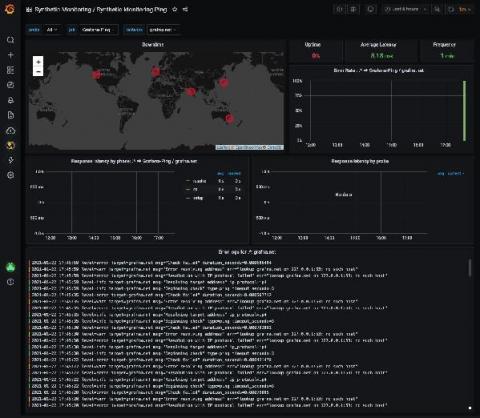
We recently launched synthetic monitoring, which helps you understand your users’ experience and improve website performance by proactively monitoring your services. This feature, which surfaces the powerful capabilities of Prometheus blackbox exporter, is the next iteration of worldPing.

Managing Compliance Drift: Break the endless scan-fix-drift cycle

In the first post of this series, we provided guidance for managing the many facets of a compliance program — taming the “compliance beast.” While there are many factors to consider, I’d argue that none is more essential than a reliable means of enforcement.

Is Alert Fatigue Hindering Your DevOps Work?

This year, you tell yourself, you are going to be prepared! You will arm yourself with a new status page, and create web monitoring for every important service in your arsenal. Like the proverbial Eye of Sauron, nothing will escape your omnipotence. But too many tools in your set can contribute to alert fatigue. Alert fatigue occurs when your team starts to feel like they are always on call. They might already secretly feel this way.

Azure Data Factory - Key to migrate data in Azure Cloud

Data sources ingest data in different sizes and shapes across on-premises and in the cloud, including product data, historical customer behaviour data, and user data. Enterprise could store these data in data storage services like Azure Blob store, an on-premises SQL Server, Azure SQL Database, and many more. This blog will highlight how users can define pipelines to migrate the unstructured data from different data stores to structured data using the Azure ETL tool, Azure Data Factory.