Operations | Monitoring | ITSM | DevOps | Cloud

The latest News and Information on Containers, Kubernetes, Docker and related technologies.

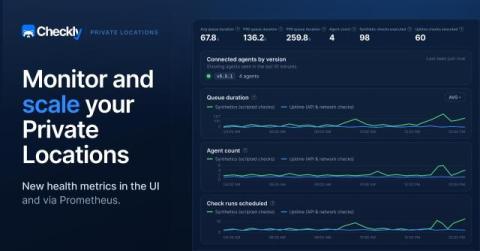
Autoscaling Checkly Private Location Agents in Kubernetes with KEDA

Monitoring load is not always steady. A team might add a new batch of checks or run several ad hoc tests during a rollout. When that happens, your Private Location agents need to pick up more work at once. If there aren’t enough agents available during a burst, checks start piling up in the queue, which can delay or disrupt check execution. But solving this by running a high number of agents around the clock has the opposite problem: most of that capacity sits idle until the next busy period.

Cloud repatriation strategies: From public dependency to hybrid flexibility

For years, "move everything to the cloud" was the default. But the economics have shifted. Join Russell Smith to explore why enterprises are reconsidering their cloud strategies, and how modern private cloud platforms are changing the game. We'll cover the real costs of public cloud lock-in, achieving feature parity without the price premium, and how to navigate today's hardware constraints, especially if you've got existing infrastructure assets that can still deliver value.

Sovereign cloud for financial services: Meeting FCA and PRA requirements with UK infrastructure

Financial services in the UK operates under one of the most demanding regulatory frameworks in the world. The FCA and PRA between them set expectations for operational resilience, outsourcing, data governance, and concentration risk that shape every infrastructure decision a regulated firm makes. Cloud adoption in the sector has happened, but it's happened under regulatory scrutiny that's grown steadily more pointed over the last several years.

Cloud freedom with AI built in

Most cloud providers give you the hardware and leave you to figure out the rest. Civo AI is different. Chief Innovation Officer Josh Mesout explains how Civo thinks strategically about AI adoption, guiding organisations through the full lifecycle from planning and infrastructure through to running and scaling workloads, powered by best-in-class NVIDIA GPUs.

What is the sovereignty tax, and is your organization paying it?

Most organizations know cloud costs are rising. Fewer realize that some of what they're paying isn't for infrastructure at all; it's a penalty for not being in control of it. That penalty has a name: Sovereignty Tax. It isn't a line item on your invoice. It won't appear in your cloud dashboard. But it's accumulating quietly, in egress fees, outage exposure, audit blind spots, and the creeping realization that leaving your current provider would be harder, and more expensive, than you ever anticipated.

Building vs. Buying your platform: The honest framework nobody discusses

Most organizations get the build versus buy decision wrong in the same way. They underestimate the cost of building while overestimating the cost of buying. In the recent Konstruct monthly webinar with M R Rishi (Platform Engineer at Civo), we explored the discussion surrounding whether you should build or buy your platform. If you want to watch the full discussion, watch the recording here.

How AI is changing platform engineering

AI is changing software development fast. But what does that actually mean for platform engineering teams? In this conversation, Civo's John Dietz and M R Rishi dig into what they're seeing on the ground, the 10x effect of AI on app count, what it means for platform team workloads, the debugging skills that are quietly being lost, and whether Kubernetes itself might eventually become just another abstraction.

How Kubernetes Operators May Conflict With Resource Optimization (And How to Avoid It)

A Kubernetes Operator is a method of packaging, deploying, and managing a Kubernetes application. It extends the native Kubernetes API by combining custom resources (CRDs) with a dedicated controller: a custom control loop that continuously watches the state of those resources. The primary purpose of an operator is to automate complex, stateful applications (like databases, message queues, or monitoring suites) that require human operational knowledge to maintain.