Operations | Monitoring | ITSM | DevOps | Cloud

Trace an AI SRE Agent: AURA Docker Quickstart with Phoenix and OTel

You get an answer from the agent and no way to check how it got there. The route it took is recorded, and so is the reason it gave for taking it. AURA emits OpenTelemetry spans, and the Docker quickstart wires them straight into Phoenix. Four services come up together: AURA Web Server as the persistent agent harness, LibreChat as a browser interface for chatting with the agent, Phoenix to receive the spans, and MongoDB to store stateful data for LibreChat. The Compose file arrives pre-configured to point AURA at Phoenix and to enable content recording for the local demo.

Recurring Office Hours with the AI SRE Agent Team Behind AURA

Building an agent and not sure how to approach something? Bring it. AURA office hours are recurring working sessions with the people who build it. The team has been talking to people trying out AURA and hearing the same good questions come up more than once. Office hours are the answer to that: a standing slot on a schedule, rather than one conversation at a time. The format is deliberately loose. Nobody is arriving with thirty slides to spend an hour talking at you. The session goes wherever the questions go.

Why AURA Scratchpad Is Rad: Bound the AI SRE Agent Context Window

A big tool result does not have to be a big context cost. AURA moves it to disk and hands the model a pointer plus the tools to navigate what is there. A large MCP tool result can consume or overflow an agent's context window, and on a third-party server you do not control how much comes back. Scratchpad breaks the link between how big a tool result is and how much context it costs: the full output goes to disk, and only the slice the model asks for ever enters the window. Errors always pass through inline, so the model can react to them.

Multi-Agent Orchestration for SRE: AURA Runs a Model per Specialist

Give one agent every tool and every incident is a question of trust. This one hands each job to a worker that can only reach what that job needs. One AURA configuration defines a coordinator and three specialist workers. Qdrant stores the runbooks, Prometheus measures workload health, and Kubernetes provides inspection and remediation, and each of the three is wired to one worker.

From alert to answer: a hands-on investigation with trace analysis in Mezmo

Authored by Sven Delmas, VP of Research at Mezmo I wanted to know what Mezmo's new trace features feel like with real telemetry behind them, so I built the smallest honest rig I could: the OpenTelemetry demo application running in a local Kubernetes-in-Docker cluster on my machine, one collector, and one deliberately simple Mezmo pipeline.

Run an AI SRE Agent Entirely Inside AWS with Bedrock and S3: AURA

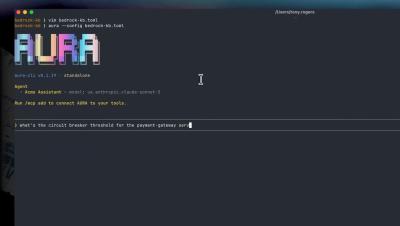
An on-call question returns the threshold and the escalation owner from your own runbooks, and the answer comes back without a call to anyone outside. AURA runs against Bedrock as its model provider, using Claude Sonnet 5 served by AWS in the same region. Authentication is the normal AWS credential chain: a profile on a laptop, an IAM role in EKS.

Builder in the loop: what production agents were missing before AURA

Builder in the loop is a Mezmo interview series with the engineers, product leaders, and operators shaping AURA. Each installment looks past the product layer to explore the decisions, tradeoffs, and lessons involved in building agents for real production work. This installment features Mike Shearer, the engineer who built AURA and, until recently, its only developer. AI agents are easy to believe in when the task is small.

What an AI SRE agent actually finds when you point it at a broken Kubernetes cluster

‍ Most of the AI features that shipped into observability tools this year summarize alerts. You get a paragraph that restates the dashboard you were already looking at, and the agent never reads the cluster itself, because giving it cluster access is a security conversation nobody wanted to start. This walkthrough starts it.

No Custom Adapter: AI SRE Agent AURA Debugs Product Catalog in Dash0

The platform shows you which service is failing and which paths it touches, and stops there. Point AURA at the same telemetry and the cause comes back too. Dash0 shows the product catalog service in a failed state across the selected window, with errors on the path from the frontend service.

Kubernetes AI SRE Agent Finds a Crash Loop Nobody Asked About: AURA

You ask for a routine health check and expect a clean baseline. What came back was a pod that had restarted 788 times, unrelated to the question. AURA is connected to a Kubernetes cluster and to Prometheus through read-only MCP servers, running as one coordinator with two specialized workers. The prompt is one sentence: check the health of the cluster, and confirm whether all the pods are running. What comes back is not a baseline. AURA names the state as CrashLoopBackOff and attaches the restart count to it.

From Log Line to Merged Fix: AI SRE Agent AURA with GitHub MCP

Knowing why it broke is not the same as having it repaired. Point the agent at the repos behind the service and the change comes back as a pull request. A Govee integration crash-loops under Home Assistant because the container cannot write to a directory it does not own. That much was already established: the previous homelab video stopped at the root cause on purpose, so the next pass could improve the agent's configuration first.

Argo CD Deployment Failed: AI SRE Agent AURA Finds and Fixes It

A deployment fails validation and the sync stops. Argo CD hands the report to AURA, which finds the wrong version, fixes it, and re-runs the sync. Normally, a failed sync means a person opens the application, reads the hook logs, and works out which value is wrong. Here, the sync fail hook sends AURA a short failure report and an incident ID over the agent-to-agent protocol, then exits. It does not say how to investigate or what to change.

AI SRE Agent Debugs a Lambda Timeout with the AWS MCP Server: AURA

A scheduled Lambda quietly stops completing and nothing pages you. AURA finds the function, reads its logs, and comes back with a three-second timeout. The usual path is opening the console, tracking down the right log group, and reading CloudWatch by hand. Here AURA connects to AWS through the MCP proxy AWS publishes, run locally with uvx against an AWS CLI that is already configured, so there are no new credentials to issue.

Scheduled Autonomous AI SRE Agent as a Kubernetes Guardian: AURA

Some agent work should pause for a person. This is the other case: a health check every two minutes, one bounded action, and a result nobody approved. Each scheduled run starts the normal AURA image in one-shot mode: check one workload, act if something is wrong, write the result to the job log, and exit. Overlapping runs are forbidden.

Paste a Slack Bug Report into an AI SRE Agent: AURA Finds the Cause

A coworker says checkout is broken and nothing else. That is the whole prompt. AURA reads the live logs and comes back with the payment service. Normally a message like this is the start of guessing at a service and opening dashboards until something looks wrong. Here it is the entire input: no service named, no error string, no time range.

Homelab AI SRE Agent: AURA Debugs Container Permissions in Docker

A root cause is not a fix. AURA keeps working the problem, taking what you find on the host and coming back with the user ID mismatch behind the failure. What follows a root cause is normally manual: check the mount, compare ownership on the host against the user inside the container, and get it wrong at least once before it lands.

Open Source AI Agent for SRE: Why AURA Is Free

The most common question since we started 31 Days of AURA: how do you plan to make money? The short answer is the control plane, not the agent. Mezmo sells an enterprise-grade control plane for running large numbers of agents across large environments, where coordinating across environments, governance, access control, and the efficiency of preprocessing MCP data start to matter. If a hundred people run AURA and three or four of them need that, the model works. The more people running AI agents in production, the bigger the market for the tooling underneath them.

Free Open Source AI Agent for SRE and More: Why We Give AURA Away

Wondering what the catch is on a free, vendor-backed agent? There is not one in the license. AURA stays Apache 2, fully capable, and free to run. If you are weighing an open source tool with a company behind it, the first question is what the catch is. You have seen the project that turns out to be open core, or that is quietly hindered in one key way. This is Mezmo's answer for AURA.

Install an AI SRE Agent in Kubernetes with AURA and Helm

AURA does not have to live on your laptop. Install it into the cluster with Helm and it is still there the next time something breaks. AURA is a fully open source AI agent built specifically for SRE work. Rather than one general assistant, you configure workers: separate agent roles, each scoped to a job like inspecting the cluster.