
Operations | Monitoring | ITSM | DevOps | Cloud

Next.js already traces your requests. Here's how to export them with OpenTelemetry.

Traces are a goldmine of information that can help you, or your AI, find slow pages and fix them. Next.js comes out of the box with support for tracing. Incoming requests, fetch() calls, middleware, and server-side rendering are all wired up and ready to send traces to any OpenTelemetry-compatible backend. The catch is, unless you configure an exporter, you’ll never see those traces.
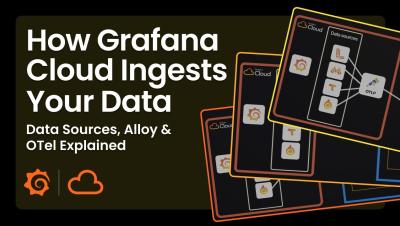
How Grafana Cloud Ingests Your Data | Data Sources, Alloy & OTel Explained

Learn the two main ways to get data into Grafana Cloud. In this video, we break down how Grafana Cloud connects to over 150 external data sources (like Salesforce, Postgres, and CloudWatch) where your data stays in place, and how you can send raw telemetry into Grafana’s fully managed databases for logs, metrics, traces, and profiles.

The Data Plane Reality: OTel Scales, While Topology UX Lags

OpenTelemetry won the architectural standards battle. At scale, though, telemetry breaks more like plumbing than code. It breaks quietly, across a graph, with a blast radius you don’t understand until it’s expensive. With over 65% of organizations now running more than 10 collectors in production, hybrid deployments across Kubernetes and VMs are accelerating fast. Telemetry standardization is no longer a project milestone. It is a baseline expectation.

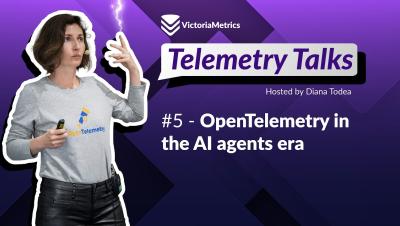
Telemetry Talks ep. 5 - OpenTelemetry in the AI agents era

Telemetry Talks explores how OpenTelemetry’s CNCF graduation arrives at a pivotal moment for AI-powered development. Together with Alex Marshalov, we dive into vibe coding, AI agents, and the growing need for observability in GenAI systems — from prompts and token usage to reasoning chains and distributed traces — using the VictoriaMetrics stack and OpenTelemetry as the foundation for understanding the next generation of autonomous software.

Use This OTel Processor to Prevent Your Dashboards From Breaking

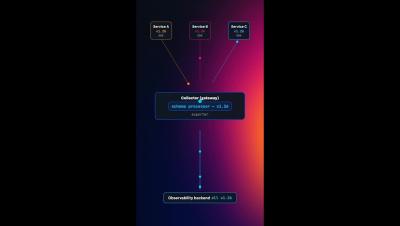
A semantic-convention rename (http.method → http.request.method) can silently break your RED metrics — no errors, just gaps in dashboards and alerts. The OpenTelemetry Collector's schema processor fixes it: put it first in your pipeline and it normalizes attribute names no matter what each service emits. Migration mode writes BOTH the old and new names, so you get zero-downtime upgrades while queries keep working.

Monitoring Protocols Compared - Which Standard for What

Modern applications are distributed, ephemeral and built from a dozen moving parts. To keep them reliable, you need real visibility: not just “is the server up?”, but“how is this request behaving, right now, across every component it touches?”. The good news is that the observability world has converged on a handful of open standards.

Grafana Tempo: The distributed tracing journey to 3.0 (June 2026 Community Call)

Our distributed tracing journey from the inception of Tempo to 3.0. Can't comment in the chat? You may need to create a channel. Grafana Cloud is the easiest way to get started with Grafana dashboards, metrics, logs, traces, and profiles.

If You Are Building a Startup from a Vibe-Coded App, Don't Skip This #devops #programming #ai

Everyone is vibe coding products right now. But most applications are missing one crucial thing: Observability. In this video, I talk about: You can literally start this weekend: If you are turning your vibe-coded app into a real startup, observability should not be an afterthought.

Running the OpenTelemetry Collector as a Lambda

The OpenTelemetry Collector is usually deployed as a long-running process: a sidecar, a DaemonSet, an EC2 instance, a docker container on my computer. It sits there listening for telemetry. That's fine when I want to send telemetry all day, but not when telemetry is rare. Like right now, when I have an agent defined on AgentCore, and it runs a few times a week maybe. Or my website that hardly sees any traffic. Can I run the OpenTelemetry Collector as a Lambda function?

Errors, traces, logs, metrics: when to reach for what

When should I reach for a log, a trace, or a metric? I hit that question constantly when I instrument code, and I watch coding agents hit it too. It sounds like it should be obvious. Errors, traces, logs, and metrics are the four kinds of telemetry most apps run on, four tools in one box, and they overlap enough that the honest answer is every developer’s favourite: it depends. You can stuff context into span attributes instead of logging it. You can count log events instead of emitting a metric.

Your AI App Is Lying to You - Here's How to Fix That #devops #observability #programming

You shipped your AI app. But do you have all the answers? Do you actually know which model ran, how many tokens it consumed, or why it stopped? This is what LLM observability gives you, and most AI engineers are skipping it entirely. I built an SOS detection app and used OpenTelemetry to get full visibility into every single call. Token usage, model version, finish reason, and cost per call all in one place, standardised across any provider. Check out the OpenTelemetry GenAI docs in the link below; there is a lot more you can track than you think.

Observability Summit NA 2026: What the Community Is Thinking About

Two days in Minneapolis with the OpenTelemetry community, talking about where telemetry pipelines are headed and what the AI wave is doing to them. Two topics dominated everything: AI and cost reduction. Not as separate conversations, either. The more the community talked about AI telemetry, the more the cost question followed right behind it. I joined Diana Todea from VictoriaMetrics and Antonio Jimenez Martinez from Cisco ThousandEyes on the Telemetry That Matters panel.