Operations | Monitoring | ITSM | DevOps | Cloud

The latest News and Information on DevOps, CI/CD, Automation and related technologies.

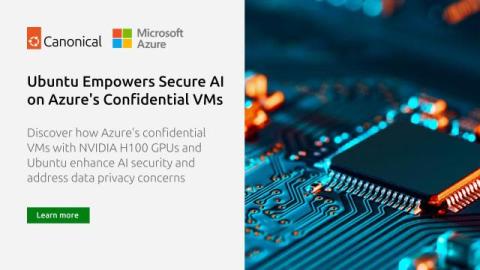
Ubuntu powers Azure's confidential AI offering

Microsoft Azure has announced the general availability of their confidential virtual machines (VMs) with NVIDIA H100 Tensor Core GPUs, powered by Ubuntu. This offering combines the hardware-based protection of AMD EPYC processors with NVIDIA’s latest GPU technology to enable secure and high-performance AI workloads in the cloud. Combining these technologies allows sensitive sectors to unlock AI adoption through addressing previous concerns of critical data privacy.

Launching Your Ubuntu Confidential VM with Intel TDX on Google Cloud: A Guide to Enhanced Security

In the world of cloud computing, we rely on abstraction layers to manage complex systems. While this simplifies development, it also creates vulnerabilities for sensitive data. Traditionally, privileged software within the cloud has access to your data, and could pose a significant security risk, if not managed properly. But there’s a new way to protect your data: confidential computing.

Infrastructure and Observability as Code | An Introduction

In this video I will introduce you to the concept of Observability as Code and what that looks like in Splunk Observability Cloud. I’ll first discuss the issues you might encounter managing infrastructure manually, and then define Infrastructure as Code so that you have a better understanding of the motivation behind Observability as Code. We’ll briefly introduce Terraform and then I’ll discuss the benefits of implementing Observability as Code using Splunk’s Terraform provider in Splunk Observability Cloud.

5 Azure Optimizations That Make Cloud Cost Savings Simple

As both the State Of FinOps 2024 and the State Of Cloud Costs In 2024 indicate, reducing cloud waste remains a top priority for cloud-driven organizations. Cloud spenders care more than ever about cost efficiency — and CloudZero is working tirelessly to make cloud savings simpler. To this end, we’re proud to announce that we’ve added a suite of automated Azure optimizations to our already robust library of automated Insights.

Integrating Open edX with AppSignal

Imagine stepping into the role of a DevOps engineer at an online learning company that utilizes Open edX as its core Learning Management System (LMS). As the platform scales to accommodate more learners, a myriad of challenges begin to surface: These are just the tip of the iceberg. It's pivotal that you provide timely reports on site performance and error tracking in real time, and fix any issues before they affect a significant user base.

Peering: How Local Is Local?

Optimize network performance by ensuring both you and your peers are locally connected. When it comes to Internet Exchanges (IXs), there are two types of peering: local peering and remote peering. And depending on your network setup and goals, the type you use can have a significant impact on your network performance. While remote peering has valuable use cases, we often see customers using it in scenarios where it is actually doing more harm than good to their network performance.

15 Essential Kali Linux Commands Ethical Hackers Need to Know

As ethical hacking continues to grow in importance, professionals require a reliable operating system to assist them in their tasks. A Debian-based distribution, Kali Linux is the go-to OS for ethical hackers and penetration testers. But why has it become the industry standard? This post will explore what makes Kali Linux essential and dive into the key commands every ethical hacker should know.

Google Cloud Monitoring Guide: Best Practices And Tools To Use

Google Cloud Platform (GCP) offers a great alternative to Amazon Web Services (AWS) and Microsoft Azure. If you use Google Products extensively at work, such as Google Workspace, moving to GCP may be a natural choice. Perhaps you already use GCP with AWS, Azure, or another cloud provider as part of your hybrid cloud strategy. But maybe you struggle to manage GCP costs, monitor security and compliance, and observe performance.

Golang Wrapper: Dependency Wrapping, in Go

All but the simplest applications borrow code. You could write everything yourself from just core language features but who has time for that? Instead you take on dependencies, pieces of code written by others that usually give us 80% or more of what we need with 20% of the effort. Sometimes these dependencies are made to interact with a specific technology like a database, or perhaps it’s just a library providing some feature that would be onerous to write yourself.

Heroku Alternatives: Why Bunnyshell is the Best Choice for Modern Cloud Deployment

With Heroku announcing significant changes, such as the discontinuation of its free tier, developers are left seeking alternatives that offer similar ease of use but more robust and scalable options. While Heroku was once the go-to for rapid deployment and management of applications, several alternatives now stand out, each offering unique benefits on different cloud platforms like AWS, Google Cloud, Azure, DigitalOcean, Linode, Hetzner, Vultr, and Scaleway.