

Operations | Monitoring | ITSM | DevOps | Cloud

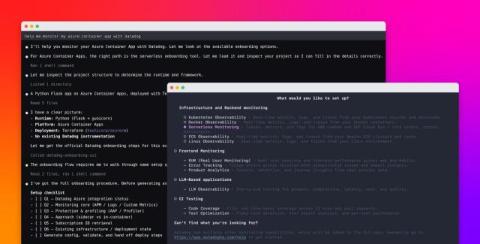
Instrument serverless apps with agentic onboarding

Serverless platforms like AWS Lambda, Google Cloud Run, and Azure Container Apps let teams run applications without managing infrastructure. However, getting full visibility into those workloads has traditionally required a lot of manual setup. A single team may deploy serverless applications across multiple clouds by using tools such as Terraform, AWS SAM, AWS CDK, and the Serverless Framework. Each of these platforms, runtimes, and deployment tools requires its own instrumentation steps.
Peer Review: CircleCI's CFO & CMO on What Comes After AI Code Generation

Last year was the year of AI code generation. This year is everything that comes after: validation, quality, and making sure what gets built actually ships. Nobody's better positioned to talk about that than CircleCI, and in this episode of Peer Review, CFO Blake Buisson and CMO Chitra Balasubramanian dig into what that moment means for the company and the people building it.

How to Manage AI Infrastructure in Your Traditional Enterprise Data Center

Managing AI infrastructure in a traditional enterprise data center comes down to validating that sufficient capacity exists before hardware arrives, then maintaining accurate infrastructure data to support planning, deployment, troubleshooting, and ongoing operations. This is because AI has changed what enterprise data centers were built to handle.

Every AI Agent You Add Leaves Something Behind to Clean Up

Adding a second AI agent to a project feels like doubling your output. In practice, it usually means doubling your bookkeeping too. Every agent needs its own worktree so it can work without touching the branch someone else, human or otherwise, is using. Multiply that by five agents across three repos, and the isolation that made parallel work possible starts generating its own kind of work: which worktree goes with which branch, which ones are stale, which upstream nobody remembers creating.

Scheduled Autonomous AI SRE Agent as a Kubernetes Guardian: AURA

Some agent work should pause for a person. This is the other case: a health check every two minutes, one bounded action, and a result nobody approved. Each scheduled run starts the normal AURA image in one-shot mode: check one workload, act if something is wrong, write the result to the job log, and exit. Overlapping runs are forbidden.

Best AI Image Generators (2026)

If you still think that creating high-quality images must take a lot of time and resources, think again, because in 2026, that is no longer the case. Now, AI image generators can instantly help you turn simple ideas into impressive visuals in just a few seconds. It doesn't matter if you want to create content for social media, design more complex marketing materials, or just bring your most random ideas to life; there's probably an AI image generator that can help you achieve exactly what you need.

From Incident Data to Operational Knowledge: A Safer Role for Generative AI in IT Ops

IT operations teams produce an enormous amount of information. Alerts, logs, incident messages, deployment records, support tickets, runbooks and post-incident reviews all contain operational knowledge. The problem is that much of this knowledge remains fragmented and difficult to reuse. Generative artificial intelligence can help organise and transform this information, but its safest role is not unrestricted control over production infrastructure. Its strongest initial use cases involve reading, summarising, classifying and drafting information for an engineer to review.

The MetricFire MCP Server | AI-Powered Monitoring

Monitor your infrastructure using natural language with the new MetricFire Model Context Protocol (MCP) Server. In this video, you'll learn how to connect the MetricFire MCP Server to AI assistants like GitHub Copilot and use simple prompts to search metrics, visualize data, create alerts, and manage your monitoring environment—without writing API calls. In this video, you'll learn how to.

Paste a Slack Bug Report into an AI SRE Agent: AURA Finds the Cause

A coworker says checkout is broken and nothing else. That is the whole prompt. AURA reads the live logs and comes back with the payment service. Normally a message like this is the start of guessing at a service and opening dashboards until something looks wrong. Here it is the entire input: no service named, no error string, no time range.