Operations | Monitoring | ITSM | DevOps | Cloud

The latest News and Information on CyberSecurity for Applications, Services and Infrastructure, and related technologies.

What is Interactive Application Security Testing (IAST)?

Interactive Application Security Testing (IAST) finds vulnerabilities in running applications by monitoring code from the inside. Learn how it works and where it fits. Interactive Application Security Testing (IAST) is a method for finding security vulnerabilities in an application while it's running, by instrumenting the code and observing how it behaves during normal use or testing.
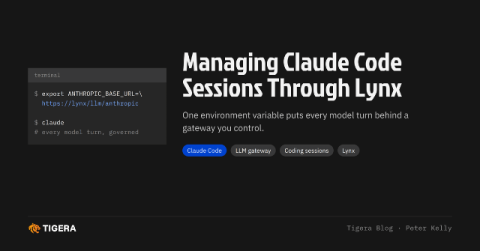
Managing Claude Code Sessions Through Lynx

At Tigera, we spend a lot of time thinking about agent security: identity, policy, runtime controls, and the record left behind after an agent acts. Coding agents create an interesting problem because, in most organizations, they didn’t arrive through the front door. Few companies ran a platform evaluation and rolled Claude Code out to 500 developers. Developers installed it themselves.

Does a TLS Certificate Need a Common Name?

Technically: no. In practice: maybe. Lot’s of teams are experimenting with shorter duration certificates from Let’s Encrypt to get ready for the 47-day mandate. Those certs come with a big gotcha: no more Common Name. A modern browser is perfectly happy with a TLS certificate that has no Common Name. Your VPN or mail server might have other opinions. And since those are probably things you’d like to keep working, there’s a little more nuance to the answer.

From SOCI Compliance to Continuous Infrastructure: How Puppet Helps Protect Critical Infrastructure

Australia’s critical infrastructure landscape has changed significantly. The Security of Critical Infrastructure Act 2018 (SOCI Act) has evolved from a framework focused primarily on identifying critical assets and reporting incidents into a broader risk-management and operational-resilience regime. The 2024 reforms reinforced that direction, increasing the focus on the systems, data, and technology dependencies that underpin Australia’s essential services.

CT alerts: know when someone gets a certificate for your domains

A couple days ago, I told you how a spammer got a certificate for dev-docs.trackjs.com, and that we only found out because Google emailed us. Google knew because the spammer claimed the hostname in Search Console. An attacker running a phishing page wouldn’t have done that, but they would still need a certificate. Every publicly trusted certificate gets written to a public log, and we track that log in our database. We just weren’t watching it. Now we are, and you can too.

The Clearinghouse For AI Agents Has A Blind Spot

Jamin Ball’s recent piece, “Systems of Record Won the SaaS Era — Clearinghouses Will Win the Agents Era,” is the cleanest articulation I’ve seen of where the durable moat goes next. His argument is simple and, I think, correct: the SaaS era rewarded whoever owned the system of record, and the agent era will reward whoever owns the clearinghouse.