Operations | Monitoring | ITSM | DevOps | Cloud

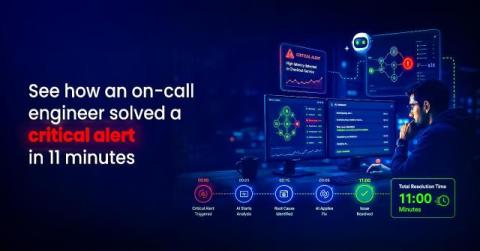
See how Mezmo's AI Assistant instantly pinpoints root causes

This video shows how Mezmo's AI Assistant turns noisy telemetry into clear answers when errors spike. By preprocessing data and surfacing only the most relevant patterns, Mezmo quickly identifies issues like database connection failures or resource shortages and delivers actionable recommendations. Watch how AI-powered root cause analysis helps teams troubleshoot faster and with confidence. Mezmo's AI Assistant is built for platform engineers and SREs who need fast, reliable root cause analysis across high-volume telemetry pipelines — without manually sifting through noise.

Meet AURA: The Open-Source Agent Harness for Production AI : Autonomous Incident Response Demo

Watch AURA autonomously respond to a production incident in real time—from building its reasoning context and querying PagerDuty and ClickHouse, to triggering a human-in-the-loop approval with the on-call SRE, to removing the stuck pod and validating remediation. Every behavior is defined in a simple config. AURA is Mezmo's AI-powered incident response agent built for platform engineers and SREs managing high-volume telemetry pipelines.

Harness Cursor Plugin Demo: AI for Software Delivery from Your IDE

Stop context-switching between your IDE and your CI/CD dashboards. In this video, we demonstrate the new Harness Cursor Plugin, a native integration that brings the full power of the Harness AI Software Delivery Platform directly into Cursor. Using the Cursor Agent window and the new Harness Model Context Protocol (MCP) server, you can now manage your entire software delivery lifecycle through natural language. From triggering pipelines to governing deployments, this plugin ensures you stay in your flow while maintaining enterprise-grade security and control.

Meet Auvik AI: Bringing Practical Intelligence to IT Operations

Across the IT industry, AI is being positioned as the next evolution of operations. But for many IT teams, AI still feels disconnected from the tools they rely on every day. Dashboards get smarter. Reports get faster. But workflows stay the same. Stuck in vendor silos or a CLI, IT teams have been looking for ways to bolt AI into workflows, but what often comes out is a Frankenstein-like web of APIs and MCP hosts. AI is meant to make life easier for IT teams – not make it more difficult.

How Auvik AI Solves the Biggest Challenges in IT Operations

Modern IT operations aren’t short on tools. Monitoring tools. Ticketing systems. Alerting platforms. Documentation repositories. Dashboards. Scripts. Runbooks. And yet, when something breaks, the workflow still looks strangely familiar: Somewhere along the way you’re asking yourself: Is the problem even here? This is the everyday friction of IT operations. Not the big outages. Its the constant small mysteries that take far longer to solve than they should.

Securing the World's Biggest Machine: Critical Infrastructure, AI, and the Ethics of Innovation

What happens when decades of critical infrastructure experience meet today’s rapidly evolving AI landscape? In this episode, host Bob Slevin sits down with Ernie Hayden, award-winning author, former Navy nuclear officer, ethical hacker, and founder of 443 Consulting, for a deep dive into what it truly takes to secure modern, interconnected systems.

Two AI agents, one incident: Rocky AI comes to the terminal

A Playwright Check fails at 2 am. The login flow is broken. Until today, that alert triggered a human to get up, open the Checkly dashboard, copy Rocky AI root cause analysis (RCA), and then tell an agent to get to work. There were two AI agents, one incident, and no way for them to talk to each other. The extended checkly checks and new checkly rca CLI commands close that gap. Your coding agent can now pull Rocky AI's analysis into its ongoing work, read the diagnosis, and go fix the code.

New in the Honeycomb Academy: Learn to Use the Honeycomb MCP

Two things happen when engineers first connect the Honeycomb MCP to their AI assistant. The first is the blank page problem. The Honeycomb UI gives you something to react to: a heatmap, a query builder, a trace to click into. An AI assistant gives you a cursor and nothing else. When you don't know where to start, that's a hard place to be. The second shows up right after you get past the first one. You ask a question, you get a confident-sounding answer, and you're not sure whether to trust it.

Building for Resilience: An Engineering Guide to the Mythos Era | Harness Blog

The release of Anthropic Mythos and Project Glasswing marks an exciting and pivotal new chapter in software development. As the industry advances, the speed and economics of vulnerability exploitation have fundamentally shifted. What once took weeks of manual reconnaissance can now be scaled rapidly through automated models. However, this is not just a security problem to solve. It is a massive engineering opportunity to build cleaner, more robust systems.

From Vibes to Signals: Observing Your AI Coding Workflow

Agentic coding tools like Claude Code and Codex have taken centre stage and inserted themselves into the critical path of software development. This shift has happened fast, and for most teams, the visibility hasn’t caught up. Until now we’ve been evaluating our vibe coding the same way – on vibes. You might say “this feels faster” or “that seems like a better approach”. That’s not going to scale.