Operations | Monitoring | ITSM | DevOps | Cloud

15: Optimizing AI Workloads: Balancing Cost, Performance, and Scalability with Bijit Ghosh

In this episode, Andrew Hillier and Bijit Ghosh discuss the evolving landscape of AI, discussing the growing prominence of inference over training, hybrid cloud strategies, balancing cost with performance, and the orchestration of complex hardware environments. The conversation also touches on emerging concepts like AI factories, the challenges of sovereign cloud, and how enterprises are navigating data gravity and regulatory constraints. It's a deep dive into optimizing AI infrastructure, managing costs, and the disruptive changes that are transforming both technology and business outcomes.

Demo - Selector Platform CoPilot Diagnosis

See how Selector’s AI Copilot accelerates issue diagnosis in real time. In this demo, watch how natural language queries and AI-driven insights help teams quickly analyze incidents, surface root cause, and understand impact - without digging through multiple tools. Instead of manual investigation, Selector guides operators to answers faster, reducing noise and speeding up resolution. Built for network and operations teams who need clarity, speed, and smarter troubleshooting.

Introducing the Cortex AI Assistant (now in Slack)!

Mention @Cortex in any Slack channel the Assistant has been invited to, public or private, and get grounded answers pulled from your Cortex data. Questions can be as simple as "who owns payments-api?" or as analytical as "what's driving our incident trends this quarter?" The Assistant pulls context from all across Cortex, including ownership, Scorecards, Initiatives, on-call, dependencies, and Eng Intelligence metrics, and holds context across a threaded conversation.

Accelerating AI Agent Development on Google Cloud with JFrog MCP Registry

Developers building agentic AI on Google Cloud have powerful infrastructure at their fingertips: Gemini 3 for reasoning, Google’s Agent Development Kit (ADK) for orchestration, and a rapidly expanding ecosystem of Model Context Protocol (MCP) servers that connect agents to data and tools. So why are so many teams still waiting weeks to ship their first agent to production?

90% AI Adoption. Still Failing. DORA Explains Why.

AI adoption is nearly universal. So why are most teams still struggling? In this session from GitKon, Nathen Harvey, head of DORA at Google Cloud, shares findings from the 2025 DORA State of AI-Assisted Software Development report, drawing on data from nearly 5,000 developers worldwide. The answer isn't more AI. It's what surrounds it.

That's Not a Job for an LLM: The Right Way to Apply AI to Network Operations

LLMs have sucked all the oxygen out of the AI conversation — but AI is much more than just LLMs, and network engineers have been using AI techniques (machine learning, statistics, fuzzy logic, expert systems, neural networks) for decades. So what should LLMs be doing in network operations, what shouldn't they be doing, and how do agentic AI architectures fit in?

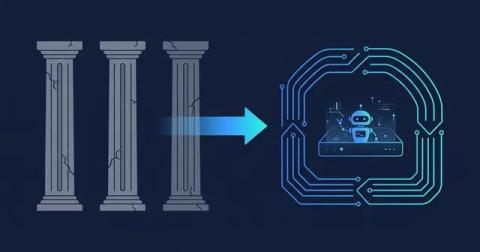
Why Your Agentic AI Aspirations Need to Evolve from Models to a Workflow Data Fabric

Enterprise conversations today are dominated by one phrase: Agentic AI. Across boardrooms and innovation labs, organizations are experimenting with copilots, autonomous agents, and AI bots capable of resolving tickets, recommending actions, and orchestrating complex processes. The promise is real — AI that doesn't just generate insights, but takes meaningful action. Here's the uncomfortable truth: most enterprises are architecturally unprepared for the agentic future they're trying to build.

Understanding disaggregated GenAI model serving with llm-d

llm-d is an open source solution for managing high-scale, high-performance Large Language Model (LLM) deployments. LLMs are at the heart of generative AI – so when you chat with ChatGPT or Gemini, you’re talking to an LLM. Simple LLM deployments – where an LLM is deployed to a single server – can suffer from latency issues, even with just one user. This can be because of lack of memory-bandwidth on the server, or because of KV cache pressure on system memory.

SRE agent vs. traditional engineer: 7 key differences

The role of a Site Reliability Engineer (SRE) is evolving. The focus has shifted from simply working harder during an outage; A new kind of teammate is here to help: the SRE Agent. But what are the key differences when you compare an SRE agent versus a traditional site reliability engineer? This isn’t just a superficial change. It signifies a fundamental alteration in how teams construct and sustain dependable services.