Operations | Monitoring | ITSM | DevOps | Cloud

AI SRE Agent ChatOps: How AURA Runs in a Slack Incident Channel

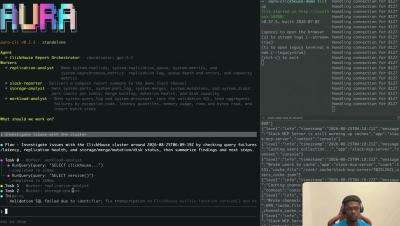
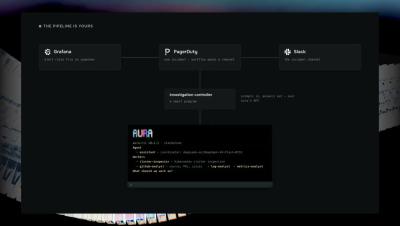
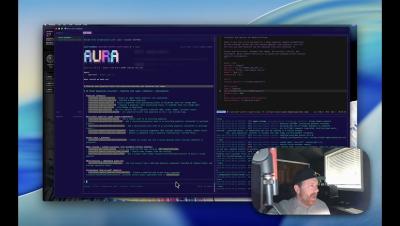
AURA runs as a standalone service and knows nothing about Slack. A separate bridge streams events off its API, which is what makes the chat tool swappable. This is the implementation behind the automated PagerDuty investigation demo. Jeff Vogt walks the whole path an incident takes: a Grafana alert fires PagerDuty, PagerDuty opens a Slack channel and sends a webhook, and a service called AURA Bridge picks it up and calls AURA's API with an investigation prompt.
AI SRE Agent Approval Workflow: Identity Forwarding to MCP Servers

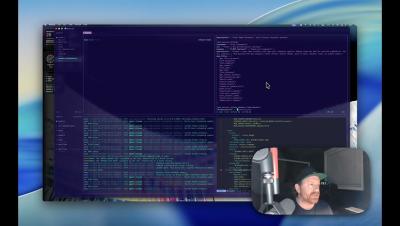
Two engineers can hold the same approve button and still not be allowed to make the same change. The key riding with the approval settles it. AURA's human in the loop config gates the create_pipeline tool on the Mezmo MCP server and sends each request to a webhook for review. A mock UI stands in for the approval system here, and Mike walks through the payload schema so you can point it at your own.

AI SRE Agent MCP Authentication by Header: Keep Keys Out of the Config

Nobody wants an API key sitting in an agent's config file on a shared server. Mike shows how AURA takes the credential off the request instead. AURA can hold your keys in its config file, but it does not have to. Mike Shearer, one of AURA's creators, walks through the alternative: AURA reads named headers off the incoming request and forwards them to the MCP servers it calls, so the credential never has to sit on disk.

Codex vs. Claude Code in 2026: cost, capability, and which one your team should pick

Codex is OpenAI's terminal-based autonomous coding agent, bundled into ChatGPT plans and billed through token-based credits. Claude Code is Anthropic's terminal-based coding agent, sold through Claude subscriptions or the API. Codex is cheaper to enter; Claude Code is stronger on complex work. Both run $100 to $250 per developer monthly at active use.

The availability of SEO and AI search services in the Western Balkans

SEO and AI search services in the Western Balkans are making a significant impact on the international market. Agencies in this region are uniquely positioned to provide expertise for clients in the USA, UK, and EU, thanks to a combination of skilled talent and competitive costs. Understanding the advantages of hiring a Macedonian agency can help organizations maximize digital visibility and optimize online performance.

Will AI agents replace database IDEs? The future of database development

AI is already good at writing SQL, which is why people keep asking whether AI agents will replace database IDEs. But letting an agent work on a production database is still a much bigger leap. In tests reported by BIRD, a text-to-SQL benchmark built from 95 real databases across 37 professional domains, human experts reached 92.96% execution accuracy. The best single-model entry reached 80.04% in June 2026. The model failed roughly one task in five; the humans, about one in fourteen.

The Safest Place to Run an AI Agent Is On a Cluster That Doesn't Trust It

Every organization running AI agents has already made a hosting decision. Most made it by accident. The sales team switched on the agent built into their CRM. Engineering is piloting a coding agent in a vendor’s cloud. Someone on the data team deployed a LangGraph service to a VM with a database key in an environment variable, and someone else is running an agent framework on a laptop with production credentials in a dotfile. Each of these is a hosting decision.

When Intelligence Stops Being Scarce

As intelligence becomes increasingly accessible, competitive advantage shifts to the operational capabilities that transform insight into consistent, confident action. As AI makes operational insight easier to generate, competitive advantage is shifting to the platforms, workflows, and operational foundations that turn intelligence into trusted action.