Operations | Monitoring | ITSM | DevOps | Cloud

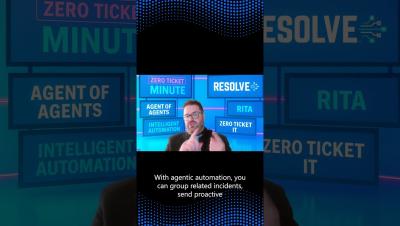
Resolve's Zero Ticket Minute - Ep. 2 #itautomation #aiautomation #servicemanagement

Last month, Azure + AWS outages spiked global incidents by 250%. Help desks lit up fast. Zero Ticket IT keeps teams steady with proactive updates and instant deflection of those “is it down?” floods.# Don’t miss your 60-second IT news hit.
Skylar One Juneau: Real-World Intelligence for Service-Centric Ops

Service-centric operations demand more than observability, they demand understanding. The Juneau release of ScienceLogic Skylar One brings that understanding into sharp focus with greater clarity, intelligence, and ease-of-use for the IT and service operations teams who keep modern digital businesses running. Engineering enhancements in this release of Skylar One (formerly SL1) make it even more accurate, more intuitive, and more aligned with the way operations teams actually work.

ScienceLogic Named a 2025 NVTC Tech100 Honoree

ScienceLogic is proud to be recognized as part of the 2025 Northern Virginia Technology Council Tech100. The annual list highlights the companies, executives, entrepreneurs, and emerging leaders who are shaping the region’s technology landscape and strengthening its economic growth. Earning a place on this list again underscores our momentum and commitment to helping organizations modernize IT with trusted data, intelligence, and automation.

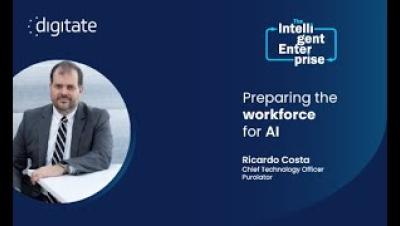
Episode 1 - Preparing the workforce for AI | The Intelligent Enterprise

In our first podcast episode of The Intelligent Enterprise, Ricardo Costa, Senior Vice President and Chief Technology Officer at Purolator, gives us his views on how to prepare the workforce for AI. In his role as a technology "translator" connecting business strategies with tech implementations, Ricardo highlighted the importance of translating complex tech concepts into simple, understandable stories and addressing leadership challenges in preparing the workforce for AI, including upskilling and ethical considerations.

Five ITOps best practices to stay ahead during major third-party outages

When external providers fail—whether it was CrowdStrike outage last year, AWS outage last month, or the Cloudflare DNS outage yesterday—the symptoms inside your environment often look like internal issues: timeouts, login failures, API errors, service degradation, or sudden spikes in dependency-related alerts. It’s natural for teams to start searching through their own infrastructure first, but none of these symptoms clearly point to your systems as the root cause.

Navigating External Outages: How Selector Cuts Through the Cloudflare Noise

Yesterday’s widespread Cloudflare outage reminds us how crucial external dependencies are to the stability of our own applications. When a key edge provider like Cloudflare goes down, the impact on your internal monitoring systems can look like a catastrophic, internal system failure triggering a massive storm of alerts and sending engineering teams into frantic, misdirected debugging sessions.

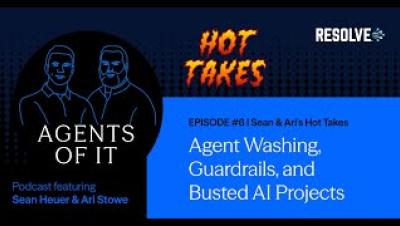
Agents of IT podcast - Ep. 6 - What's real agentic AI and what's just hype?

Sean Heuer and Ari Stowe break down “agent washing,” governance, and what it really means for AI to take action instead of just chatting. In this clip from Agents of IT, they share practical ways to spot the difference between chatbots, scripted automations, and true agentic systems that can plan, reason, and execute autonomously. Watch the full episode to hear their perspective on.

AlOps - Laying a Strong Foundation with Full-Stack Observability

It is fair to say that AIOps is much more than just a catchy tagline; in fact, it is now a fundamental aspect of every enterprise looking to manage a modern, cloud-native architecture along with a distributed system. As AIOps becomes more widely adopted and organizations start expanding, the amount of logs, metrics and traces becomes too much for role-based tracking and monitoring tools. This is the moment in which full-stack observability tools are needed, providing valuable data that observability AIOps engines rely on for their predictive, proactive, and performance issue detection.

Beyond Isolated AI: How the Selector MCP Server Connects Agents, Context, and Action

AI in network operations is evolving faster than ever. But while new models and agents are emerging almost daily, they’re often working alone, with each confined to its own context, data, and domain. One model might analyze telemetry, another handles automation scripts, and a third generates summaries or recommendations. Each model might be intelligent on its own, but without a way to share context, they end up thinking in isolation, limiting what they can achieve together.

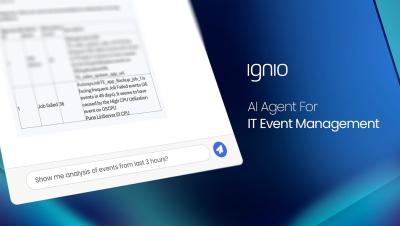
ignio AI Agent for IT Event Management | AI Agent for alert noise reduction

Discover how ignio’s AI-powered agents are transforming IT event and alert management by combining Agentic AI, AI/ML algorithms and automation. In this video, we introduce ignio AI Agent for IT Event Management — a purpose-built, autonomous agent designed to reduce alert noise, group related alerts and predict future events. Whether you’re managing a large-scale enterprise infrastructure, cloud-native environment, or hybrid IT setup, this AI agent empowers your SRE and IT operations (ITOps) teams with real-time observability, automated alert correlation and suppresion, and predictive intelligence What You’ll Learn in This Video.

BigPanda Acquires Velocity: Accelerating the Future of Agentic IT Operations

Today marks an exciting milestone for BigPanda and for the future of IT Operations. We’re thrilled to announce that BigPanda has acquired Velocity, an AI SRE company whose technology and team share our passion for transforming how enterprises keep the digital world running. Velocity brings deep expertise in Site Reliability Engineering (SRE) and major incident response, developed alongside some of the world’s most sophisticated technology organizations.

The Architecture of Automation: Why IT Doesn't Lie

Let’s start with something most people get wrong. Automation isn’t magic. It’s math. It does exactly what it’s told. Nothing more, nothing less. Every action, every response, every output is a reflection of truth in motion. And that’s where value actually begins. Most organizations still treat automation like a shortcut: a way to go faster, to handle more alerts, to “keep up.” But speed isn’t the value. Truth is.

Show Me the AI: Rethinking How AI Fits Into Network Operations

Over the last couple of years, nearly every network and infrastructure observability platform has added the word “AI” to its messaging. Some have introduced helpful capabilities. Others have simply added a chatbot on top of the same dashboards that have existed for a decade. In many ways, the term has started to lose meaning. But inside network operations, the conversation hasn’t disappeared. It has simply become more blunt.

From Telemetry to Truth: Why Observability Must Be Service-Centric

Modern enterprises depend on systems that appear calm: dashboards glow, availability reads steady, and metrics suggest composure. But the signals only tell part of the story. Conversion softens at the margins, regional sign-in times drift, a compliance report misses an expected field. The puzzle isn’t visibility; it’s meaning. Components describe status; services carry outcomes.

AI Agent for Proactive Problem Management: A Shift Toward a Ticketless Future

As organizations rely on increasingly complex IT infrastructures, incident management often turns into a constant cycle of alerts, escalations, and fixes. While reactive responses may keep operations running, they rarely address the deeper systemic issues that slowly erode performance. Recurring incidents, silent failures, and hidden patterns are usually symptoms of unresolved root causes that traditional approaches struggle to uncover.