Operations | Monitoring | ITSM | DevOps | Cloud

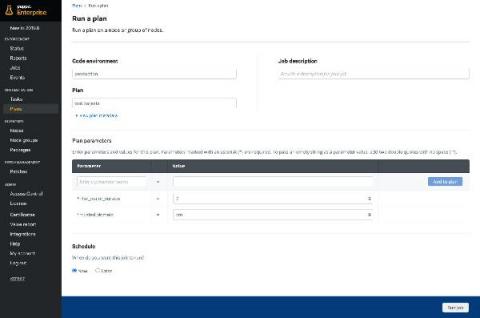
Selecting targets for plans in Puppet Enterprise

Do you author plans for Puppet Enterprise? Looking for ways to improve them? Read on! The Puppet Plan language allows a variety of methods to pick targets. In this article we will explore two of these methods (TargetSpec parameters and PuppetDB queries) and how plan authors can employ the latter to: Note: the following examples assume that you are running against targets that have the Puppet agent installed.

Boost your skills with Puppet Practice Labs

Puppet products and solutions are designed to make your work day easier—and learning how to use them should be just as easy. That's why we’re excited to launch Puppet Practice Labs—hands-on, always accessible, browser-based tutorials that make it simpler than ever to explore automating and managing your infrastructure and application workflow with Puppet.

Modernizing without compromising mission-critical systems

This blog is the third in a four-part series on infrastructure automation for government agencies that are modernizing digital systems while grappling with budget and staffing constraints and the challenges of COVID-19. The COVID-19 pandemic moved up the timeline for digital transformation projects considerably.

How to achieve acceptance testing through abstraction

Beaker is a Puppet testing harness focused on acceptance testing via interactions between multiple (virtual) machines. It provides platform abstraction between different Systems Under Test (SUTs), and it can also be used as a virtual machine provisioner setting up machines, running any commands on those machines, and then exiting. Recently, Vox Pupuli, a collective of Puppet community authors, has taken over responsibility to care and feed Beaker for its continued widespread community use.

Kubernetes automation with Relay

Kubernetes — a popular open source container orchestration system — enables you to easily deploy, monitor, and scale cloud-native application workloads in both private and public cloud environments. In other words, Kubernetes does the hard work of managing containerized applications, giving you more time to spend building it.