The latest News and Information on DevOps, CI/CD, Automation and related technologies.
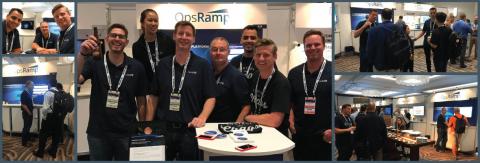
Gartner Catalyst Conference 2019 is consistently a great venue for learning, sharing, and connecting. OpsRamp was a silver sponsor at this year’s event and our seven-member contingent had a wonderful time meeting with industry thought leaders, demoing OpsRamp to senior IT executives, and having fun in the streets of San Diego. In this post, I will summarize the most interesting themes that stood out from the conference keynotes and sessions, as well as other key takeaways from the week.
Organizations of all sizes—but, in particular, the larger ones—view hybrid cloud infrastructures as the new normal. The Rightscale 2019 State of the Cloud Report from Flexera (registration required) surveyed close to 800 business, IT, and development professionals around the globe. They worked for both large and small organizations across a wide range of verticals.
k3sup: From zero to KUBECONFIG in < 1 min K3s is an open-source, lightweight Kubernetes distribution by Rancher that was introduced this year and has gained huge popularity. People not only like the concept behind it, but also the awesome work that the team has done to strip down the heavy Kubernetes distribution to a minimal level. Though k3s started as a POC project for local Kubernetes development, its development has led people to use it even at a production level.
If anyone asks: what is a patch? we have to abandon the semantic field of piracy and go to serious and technical things, so to speak.
Containers and serverless computing are two of today’s hottest technologies for application deployment. When used the right way, they both help DevOps teams to deploy applications faster and more cost-effectively. Although the features of containers and serverless architectures overlap in some respects, they are not interchangeable technologies. Containers work better for some use cases, while in others, serverless is what you need.
In part one of this series, I recapped a good bit of the fireside chat with Kelsey Hightower, Caleb Hailey, and Sean Porter at Sensu Summit 2018. They discussed the evolution of monitoring tools and related DevOps technologies, and how to incorporate new tools into both modern and legacy infrastructure.
Google Kubernetes Engine (GKE), a service on the Google Cloud Platform (GCP), is a hosted platform for running and orchestrating containerized applications. Similar to Amazon’s Elastic Container Service (ECS), GKE manages Docker containers deployed on a cluster of machines. However, unlike ECS, GKE uses Kubernetes, an increasingly popular open source orchestrator that can deploy, schedule, and scale containers on the fly.