
Operations | Monitoring | ITSM | DevOps | Cloud

Vulnerability Scanning vs. Penetration Testing: Know the Difference

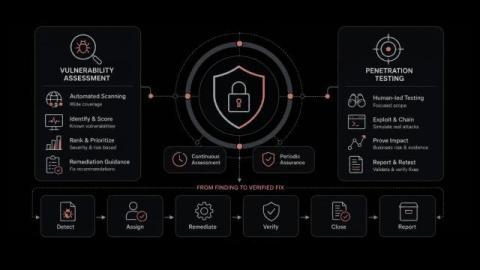
Cyber security isn't a one-size-fits-all solution, and for many UK business owners, the terminology can feel overwhelming. Identifying the right way to protect digital assets is essential to maintaining a strong security posture. Two of the most common methods for assessing risk are vulnerability scanning and penetration testing, but they serve very different purposes.

Accelerate Vulnerability Remediation with Atatus: From Detection to Secure Deployment

In microservices and cloud-native environments, vulnerabilities buried in transitive dependencies or runtime behaviors can go undetected for weeks. During that time, your attack surface keeps expanding and production systems remain exposed. The longer remediation is delayed, the greater the risk of exploitation, compliance failures, and operational disruption.

Continuous Security Monitoring: The Practical Guide for Modern Ops Teams

If you've ever been on call during a "nothing changed... except everything" incident, you already understand the real problem with traditional security checks: they're snapshots. And snapshots are useless the moment your infrastructure shifts, a new SaaS tool gets approved, a developer spins up a service in a different region, or a vendor quietly exposes an admin portal to the internet. Modern environments don't stay still. So security can't, either.

Chrysalis Backdoor: What You Need to Know - and How Progress Flowmon Threat Briefing Helps You Stay Ahead

A newly analyzed threat, Chrysalis, is a sophisticated backdoor attributed to the Chinese APT group Lotus Blossom. The malware employs advanced evasion techniques including heavy obfuscation, API hashing, dynamic DNS resolution, custom encryption and stealthy C2 communication disguised as legitimate traffic.

Exposure Management vs. Vulnerability Management: Which Delivers Real Risk Reduction?

Vulnerability management has served organizations and the cybersecurity industry for years. It is a capable practice that has helped companies defend their attack surface and prevent threat actors from exploiting vulnerabilities. But technology and IT infrastructure have evolved. Vulnerability management no longer can meet the challenges that come with this evolution.

Addressing Critical Linux CVEs and React Vulnerabilities #patch

Key Takeaways December Patch Tuesday lineup includes one known exploit in the Windows OS that warrants attention. Third-party Patch Tuesday updates include Mozilla and Adobe. Google Chrome released iOS updates so far, but a Chrome Desktop release is expected this week. Here we are at the final Patch Tuesday for 2025. Microsoft has resolved 56 CVEs (two Critical and 54 Important). Included in this release is one known exploited (CVE-2025-62221) and two publicly disclosed CVEs (CVE-2025-54100 and CVE-2025-64671).

Understanding Today's Biggest Cyber Threats and How Professionals Can Prepare

Cyber threats are growing faster than many organizations can keep up with. As technology becomes more connected and embedded in daily life, the risks around digital systems rise just as quickly. Businesses, individuals, and governments depend on networks, cloud services, and remote tools, and each layer introduces new vulnerabilities. Attackers continually refine their methods, making the threat landscape constantly shift.

Latest Software Updates: Adobe, Microsoft, and Mozilla #shorts #patch

Adobe has released five updates, featuring a major cold fusion update addressing over 140 CVEs. Microsoft has issued six updates, with no critical CVEs in its OS update. Mozilla has rolled out three critical updates for Firefox. Effective management of CVEs relies on risk-based prioritization, as individual ratings may not accurately represent real-world risks.

HAProxy Enterprise WAF Protects Against React2Shell (CVE-2025-55182)

On December 3, 2025, the React team announced a critical security vulnerability in React Server Components (RSC). Identified as CVE-2025-55182 (and covering the now-duplicate CVE-2025-66478), this flaw allows unauthenticated attackers to execute arbitrary JavaScript code on backend servers.