Operations | Monitoring | ITSM | DevOps | Cloud

The latest News and Information on Containers, Kubernetes, Docker and related technologies.

4 Cloud-Native Challenges AI SRE Is Solving in 2026 and the 3 New Ones to Look Out For

AI SRE is making real strides in resolving some of the greatest pains related to incident response, troubleshooting, and complex root cause analysis. The on-call rotation, the war room, the week-long RCA, and the ticket queue that ate a third of every platform engineer’s week all look different now than they did two years ago.
Governance Starts at the Network: How We Put AI Agents in Production

AI agents are becoming a new persona in the org chart. Learn how Qovery enforces data control, limited access, and auditability at the network level. Romain is a staff engineer at Qovery working on the control plane and AI integrations. He writes about distributed systems, incident response, and MCP-based tooling.

Safely Troubleshooting Customer Production Incidents Using MCP and AI Skills

See how Qovery's MCP server and AI skills turn vague production incidents into evidence-backed diagnoses while keeping engineers in control. Guillaume is a Staff Solutions Architect at Qovery. He helps customers troubleshoot production infrastructure and writes about Kubernetes operations, AI agents, and reliable cloud platforms.

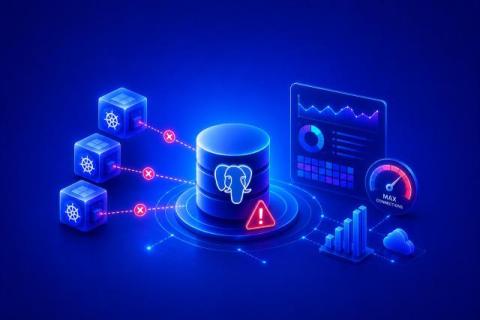
PostgreSQL Connection Pool Exhausted in Kubernetes: Causes, Diagnosis and Fixes

"Connection pool exhausted" is one of PostgreSQL's most misleading production errors. The database is often healthy, while your application waits behind full connection pools. In Kubernetes, every pod and replica maintains its own pool, amplifying issues like connection leaks and slow queries across the cluster.

Bring Your Own VLAN: Moving VMs to Kubernetes Without Changing a Single IP

For many organizations, modernizing their VMs before migrating them is not a realistic option, especially when external events trigger the migration. Mapping dependencies and refactoring network configurations before the deadline is impractical, forcing VMs to move as they are. The mechanics of moving a VM are largely solved.

Top Kubernetes Alternatives in 2026.

Key Takeaways In modern software delivery the pressure to iterate quickly is real. Kubernetes sparked a revolution in container orchestration, and it remains a huge forward step for many teams. But the truth is, adopting Kubernetes is not a guarantee that you'll suddenly move faster or reduce pain. Managing a Kubernetes cluster at scale requires deep expertise, dedicated operations, and often more overhead than many organizations anticipate. This has led many companies to explore Kubernetes alternatives.

Why eBPF Is Useful for Watching and Sandboxing AI Agents

Most of our runtime security habits were built for deterministic workloads. A service does what its code says: review the code, sign the image, and its behavior is bounded. Agents are different. An agent’s behavior emerges from a model reasoning over whatever lands in its context window, and some of that context comes from places we don’t fully control — a retrieved document, a tool’s output, a user’s prompt.

Migrate First, Modernize Later: A Leadership Guide to Converging VMs and Containers to Run AI Workloads

Every so often the ground under enterprise IT moves. It’s moving now. Across industries, organizations are consolidating fragmented infrastructure onto a single, self-hosted platform capable of running both containers and virtual machines side by side. The motivation is simple: simplify operations, lower cost and reallocate resources & budget to AI initiatives. Kubernetes is emerging as the primary platform for many of these workloads.