Operations | Monitoring | ITSM | DevOps | Cloud

The latest News and Information on Containers, Kubernetes, Docker and related technologies.

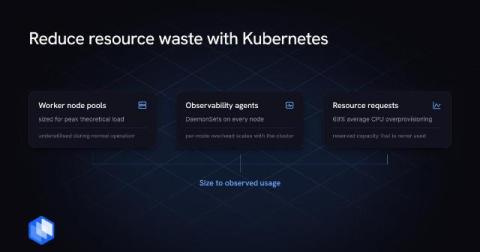
How to Reduce Resource Waste with Kubernetes

Kubernetes has changed the way teams deploy and scale applications, but many organizations overlook a critical aspect of running it well: resource utilization. Kubernetes excels at scheduling and scaling workloads. Making sure those workloads actually use the resources they reserve still falls on operations teams.
Cloud Migration Providers: Comparing Systems Integrators, Dev Shops, and Self-Service Platforms

Three ways to run a cloud migration compared: systems integrators, dev-shop staff augmentation, and self-service PaaS platforms like Qovery. How to choose. Melanie leads content at Qovery. She covers platform engineering trends, Kubernetes operations, FinOps, and the tools that help engineering teams ship faster.

Building AI SRE Agents, Part 2: Leave the Laptop, Earn Trust

Moving the agent off your machine and pointing it at real clusters — read-only, in shadow mode — then climbing a trust ladder toward carefully scoped action. This is the second article in a three-part series on taking an AI SRE agent from a weekend experiment to enterprise production. Part 1 built a local agent on a throwaway cluster: read-only, propose-only, refined against a small eval set, with portable skills and no production write access.

Safer Kubernetes rollouts with minReadySeconds

Picture the scene: you’ve just deployed a rolling update to your service. Half of your pods are running the new version, they all passed their readiness checks, and Kubernetes terminated the old replicas. Suddenly, the new pods start throwing 503 errors. Thankfully, you still have pods on the old version, so you stop the update. If the rollout had been a little bit faster, you’d have an outage. This is the failure mode minReadySeconds exists to prevent.

Private cloud vs. Public cloud: Which delivers greater control and flexibility?

As businesses evolve in today’s digital landscape, the need for efficient and scalable computing resources has become paramount. In the early days of the Internet, large corporations would build or rent out large data centers to run their applications and serve customers. This was great as they could use dedicated hardware and expand as they pleased.

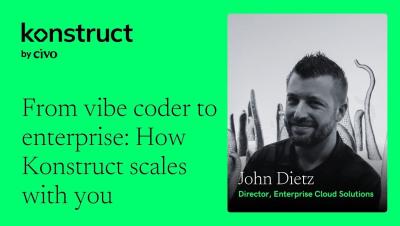
From vibe coder to enterprise: How Konstruct scales with you

Platform teams spend 6–12 months building the thing Konstruct gives you on day one. Secrets, certs, DNS, cluster provisioning, then doing it all again for the next team, the next cloud. Konstruct is one control plane that scales from a solo builder to a hundred-person platform org, without you ever re-architecting. Climb the responsibility ladder on your terms, hosted app, hosted cluster, hosted control plane, fully self-hosted. You decide where the line sits.

Infrastructure Automation Tools Comparison: Provisioning vs. Orchestration Layer

Infrastructure automation tools by layer: provisioning (Terraform, OpenTofu, Pulumi, CDK, Crossplane) vs. orchestration (Spacelift, env0, Scalr, Qovery). Melanie leads content at Qovery. She covers platform engineering trends, Kubernetes operations, FinOps, and the tools that help engineering teams ship faster.

Our Newest Infrastructure Partner: Cherry Servers

We're thrilled to announce that we've added Cherry Servers, a European infrastructure provider, as another native integration to the Cycle platform. With this integration, Cycle clients have more choice in where, and how, they deploy their applications as Cherry offers a variety of bare metal server configurations across 7 data centers located around the globe. For a more formal announcement, please see our joint press release with Cherry Servers.

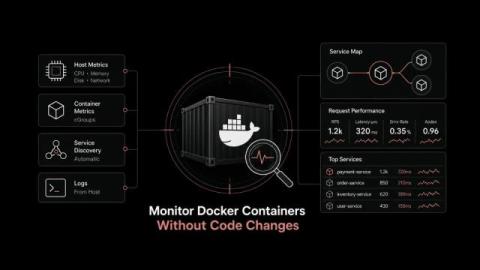
How to Monitor Docker Containers You Cannot Rebuild or Redeploy

How long would it take you to get one new line of code into the container running your payment service? In a lot of organizations, the answer runs to weeks, because the change has to clear a build owner, a test cycle, and a release window that nobody wants to open early. That timeline is why so much monitoring advice fails on contact. Most of it opens by telling you to add a library, rebuild the image, and push a new version. If you could do that this afternoon, you would have done it already.

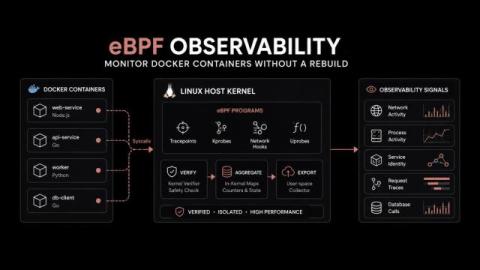
How eBPF Observability Monitors Docker Containers Without a Rebuild

How many containers are running in your production environment right now that nobody can see inside? A vendored service, a compiled binary, an application whose build pipeline left with the developer who wrote it: each one runs, serves traffic, and reports nothing. Instrumenting those workloads means a code change, a rebuild, and a redeploy, and on these containers none of the three are available.