Operations | Monitoring | ITSM | DevOps | Cloud

Data-Driven Decisions: What Ops Can Borrow from ERP Dashboards

In operations, we talk a lot about metrics. Teams rely on dashboards, charts, and alerts to spot issues before they spiral. But the truth is, many Ops dashboards are overloaded with noise and lack the clarity that decision-makers need. Business leaders in other domains, like enterprise resource planning (ERP), often take a more disciplined approach. Their dashboards are built to show exactly what matters for day-to-day and long-term performance.


Getting started with Jira dashboards

Jira is an industry favorite when it comes to managing software projects, yet its native dashboards can sometimes leave teams wanting more insight. The default views give a general update, but often lack the connection to the day-to-day activity happening in other parts of your workflow. As organizations use a wide mix of modern tools – from code repositories and cloud services to spreadsheets and reporting apps, it’s easy for critical details to get scattered or overlooked.

How should Prometheus handle OpenTelemetry resource attributes?

Note: A version of this post originally appeared on the OpenTelemetry blog. Victoria Nduka is user experience designer and open source contributor making her way into the cloud native space. She writes about design, accessibility, and open source with the same curiosity she brings to her work. On May 29, I wrapped up my mentorship with Prometheus through the Linux Foundation mentorship program.

Optimize application performance at the network layer: introducing HTTP Performance Insights in Frontend Observability

Imagine you’re a frontend engineer monitoring the user experience for an e-commerce app. You notice your checkout flow has a 15% abandonment rate. Your API responses are inconsistent. Your users are frustrated, and you’re drowning in data and complex queries trying to figure out why. Sound familiar? You can use real user monitoring (RUM) to determine what has happened, looking at page load times, error counts, user sessions, etc.

Building a Preventive Maintenance Dashboard for Fleet Operations

Preventive maintenance takes precedence in fleet management. With careful planning and well-executed strategies, it can optimize vehicle efficiency, reduce downtimes, and elongate the life cycle of all your assets. It can be a hard nut to crack if you manage a large fleet. That's why companies invest massively in real-time solutions like preventive maintenance dashboards to overcome this challenge.

Manage your dashboards and monitors at scale

In the early stages of building a system, a few well-placed dashboards and monitors can provide sufficient visibility into service health and performance. However, as infrastructure scales and teams grow, so does the complexity of the monitoring landscape. In organizations where individual teams manage their own services but rely on a central platform or observability team for tooling and guidance, this complexity can quickly multiply.

Grafana Campfire - Using the Drilldown Apps (Grafana Community Call - August 2025)

In this Campfire Community call, we will discuss about the new Grafana Drilldown Apps and how they differ from Explore. We will discuss how it has been continuously evolving to become a core part of Grafana OSS, enabling users to access data easily.

Grafana Mimir: 3 reasons to run the TSDB for Prometheus on bare metal

Wilfried Roset is an engineering manager who leads an SRE team and he is a Grafana Champion. Wilfried currently works at OVHcloud where he focuses on prioritizing sustainability, resilience, and industrialization to guarantee customers satisfaction. Whether it’s for efficient resource allocation, flexibility, high availability, or scalability, it makes a lot of sense to run Grafana Mimir on Kubernetes—but it’s not the only way to deploy Mimir.

How To Visualize Your Sales Data: Salesforce Enterprise Data Source for Grafana

Learn how to monitor your organizations sales performance by connecting Salesforce with Grafana! In this quick-start tutorial, Shawn Pitts walks you through everything — from setting up your Salesforce connection to visualizing real-time data in Grafana. Whether you’re on a free Grafana Cloud plan, a paid tier, or running Grafana Enterprise on-prem, you’ll see exactly how to unlock powerful dashboards for your team.

Visualize Salesforce data in Grafana: flexible query options, powerful data correlations, and more

As part of our big tent philosophy at Grafana Labs, we think you should be able to dig into your data and find meaningful insights — wherever that data happens to live. For many of our users, that data lives in Salesforce, the cloud-based customer relationship management (CRM) platform. In this post, we’ll take a closer look at how you can use the Salesforce Enterprise data source for Grafana to quickly and easily visualize your Salesforce data using Grafana dashboards.

How to Track IT Asset Warranties With a Dashboard

In this video, our product specialist, Matt Beran, shows us how dashboards can help you visualize warranty status, manage expirations, track inventory levels, and make smarter decisions about costs, vendors, and repairs. You’ll learn how warranty tracking works in InvGate Asset Management, how to spot trends that affect IT performance, and how to budget more effectively with interactive dashboards.

Secure credential storage for your observability stack: Introducing secrets management in Grafana Cloud

The more your infrastructure grows, the more likely you are to face a familiar challenge: where to safely store the API keys, passwords, and tokens that power your observability stack. Unfortunately, a common response to this dilemma is to scatter credentials across configurations, making security and management of secrets increasingly complex.

Grafana Cloud updates: onboard teams with new AI-powered tooling, secrets management for enhanced security, and more

We consistently roll out helpful updates and fun features in Grafana Cloud, our fully managed observability platform powered by the open source Grafana LGTM Stack (Loki for logs, Grafana for visualization, Tempo for traces, and Mimir for metrics). In case you missed them, here’s our monthly round-up of the latest and greatest Grafana Cloud updates. You can also read about all the features we add to Grafana Cloud in our What’s New in Grafana Cloud documentation.

How to monitor Claude usage and costs: introducing the Anthropic integration for Grafana Cloud

Generative AI is becoming a core part of modern applications, making it essential to monitor and manage how these services are used. That’s why, today, we’re excited to introduce the Anthropic integration for Grafana Cloud, a new solution that lets you connect directly to the Anthropic Usage and Cost API from within Grafana Cloud.

Why Alert Fatigue is a Major Challenge in Observability (2025 Survey Insights) | Grafana Labs

Over 1,200 engineers, leaders, and teams shared their biggest observability challenges in our third annual Observability Survey — and the results are in. In this video, Marc Chipouras (Head of Emerging Products, Grafana Labs) breaks down the top insights: Thanks for watching!

The first rule of DORA Metrics...

DORA Metrics are widely regarded as the gold standard for measuring the performance of software development teams. The metrics themselves though are generic, high-level pointers – they are not an instruction manual. Adopting the DORA approach is the first step down the path to continuous improvement. The next steps are deciding how the measures should be defined in the context of your own organisations processes and then figuring out how to retrieve (and present) the relevant data.

Integrating Deno and Grafana Cloud: How to observe your JavaScript project with zero added code

Andy Jiang is a JavaScript engineer with nearly 10 years of experience. He’s interested in making JavaScript and TypeScript simpler to use. He currently works at Deno as a product marketing manager. Outside of work, Andy likes cooking, writing, and playing tennis. Observability is essential for modern applications. Metrics, logs, and traces allow you to troubleshoot production issues, monitor performance, and understand usage patterns.

AI in observability at Grafana Labs: Making observability easy and accessible for everyone

Did you know that observability has been around for more than six decades? It all goes back to a Hungarian-American inventor named Rudolf Kálmán who thought about how external outputs could measure the internal state of a machine. Kálmán wrote about monitoring single-input single-output systems, but our demands are very different today. We need to observe monoliths, microservices, clusters, pods, regions, and many more.

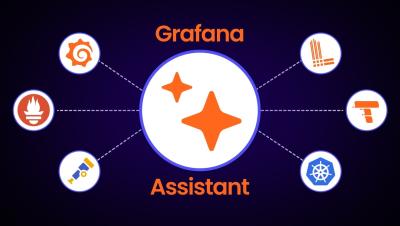
AI for Grafana onboarding: Get your teams started quicker with Grafana Assistant

Grafana puts a powerful set of observability capabilities right at your fingertips, but onboarding entire teams to the sophisticated platform is often a nontrivial exercise—one that can slow adoption and prevent organizations from getting immediate value. We want to make the process as frictionless as possible, which is why we’re excited to tell you that Grafana Assistant is now available in public preview to all Grafana Cloud users.

Getting Started with Grafana Cloud's AI Assistant for Observability

The pace of software delivery in 2025 is unprecedented — cloud-native apps, microservices, and AI-generated code are shipping in days, not months. But one challenge never changes: ensuring reliability and visibility when systems fail. In this video, we explore how the new Grafana AI Assistant brings true, context-aware observability to your stack. Watch as we deploy an open-source Python service with Kafka, Postgres, Kubernetes, and Prometheus then use the AI assistant to instantly generate dashboards, alerts, and reduce un-needed telemetry volume.

LLM-powered insights into your tracing data: introducing MCP support in Grafana Cloud Traces

Distributed tracing data is a unique and powerful observability signal, allowing you to understand how your services interact and the relationships between them. Sometimes it can be difficult, however, to turn raw tracing data into actionable insights. This is exactly why we introduced Grafana Traces Drilldown, an application that lets you quickly investigate and visualize your tracing data through a simplified, queryless experience.

Observability trends in Brazil: insights from our localized survey

Organizations in Brazil are eager to adopt some of the latest observability trends and technologies as they look to keep their software running as smoothly as possible, according to analysis of a micro survey recently conducted by Grafana Labs. Observability is an evolving space, and this is the first time Grafana Labs has run a Brazilian version of our annual Observability Survey.

Grafana Pyroscope: New eBPF profiler in Alloy & Source Code Integration (Community Call August 2025)

Christian is going to talk about the new eBPF profiler in Grafana Alloy as well as new Grafana Pyroscope Source Code Integration UI updates. Have questions? Please bring them! Can't comment in the chat? You may need to create a channel. Grafana Cloud is the easiest way to get started with Grafana dashboards, metrics, logs, and traces. Our forever-free tier includes access to 10k metrics, 50GB logs, 50GB traces and more.

Grafana Tempo: Performance Moonshots & MCP Server (Community Call August 2025)

We'll have Marty talking about Grafana Tempo Performance Moonshots and Joe will update us with what's new with the MCP Server! Have questions? Please bring them! Can't comment in the chat? You may need to create a channel. Grafana Cloud is the easiest way to get started with Grafana dashboards, metrics, logs, and traces. Our forever-free tier includes access to 10k metrics, 50GB logs, 50GB traces and more.

Learn OpenTelemetry tracing through a grand strategy game: introducing Game of Traces

A trace always remembers! Okay, okay. I will try to keep my Game of Thrones references to a minimum throughout this post, but there is a lot of truth to that statement. In observability, a trace is the “when” and “where” of telemetry signals, allowing us to track the state of interactions between services within a microservice architecture. This makes traces the ideal observability signal for discovering bottlenecks and interconnection issues.

How to use SQL to learn more about your Grafana usage

Wilfried Roset is an engineering manager who leads an SRE team, and he is also a Grafana Champion. Wilfried currently works at OVHcloud, where he focuses on prioritizing sustainability, resilience, and industrialization to guarantee customers satisfaction. Grafana needs a database to store all its objects, such as users, dashboards, or even data sources. Each time a user creates a dashboard, it results in a new row created in the database.

Deletion protection in Grafana Cloud: a simple way to safeguard your observability stack

We’ve all had that “uh-oh” moment. You press Enter and your blood runs cold, as you realize you just deleted something critical. For engineering teams, this type of disaster takes many forms. For example, maybe you used a DELETE statement without a WHERE clause to delete a row in a database, and accidentally deleted all of them instead. To protect you from the accidental deletion of critical resources in Grafana Cloud, we’re introducing a feature called deletion protection.

Getting started with Freshdesk dashboards

Freshdesk is a popular incident management system known for its ease of use, robust ticketing system, and powerful automation capabilities as part of the Freshworks suite of tools. While Freshdesk comes with native reporting and dashboards, they can be limited in terms of customization and data correlation across different sources. Additionally, building complex visualizations in Freshdesk often requires more advanced knowledge of their reporting tools. This is where SquaredUp comes in!

Getting started with MongoDB dashboards

MongoDB is a popular NoSQL database used by many modern web applications. Once your web application is up and running, you might find you need to monitor the application data for operational purposes. For example, you may need to report on user sign-ups, or monitor for problems like invalid data. SquaredUp is an easy-to-use dashboard that plugs directly into your MongoDB database to visualize and monitor your data.

New in Grafana Alerting: a faster, more scalable way to manage your alerts in Grafana

Effective alerting is the backbone of any observability strategy. But as your systems grow, managing hundreds or even thousands of rules can become a significant challenge. And when something goes wrong, the last thing you want is to fight with your tooling. That’s why we’re thrilled to announce the launch of our brand new alert rules list page, which we built to provide a faster, more intuitive, and scalable experience for teams of all sizes!

Building on the foundation of OpenTelemetry eBPF Instrumentation: what's new in Grafana Beyla 2.5

Earlier this year, Grafana Labs donated Grafana Beyla — our open source eBPF-based, zero-code instrumentation tool — to OpenTelemetry under the new project name OpenTelemetry eBPF Instrumentation. In addition to reflecting our deep and long-standing commitment to the OpenTelemetry project, the donation marked a significant milestone in the evolution of zero-code eBPF instrumentation within the open source community at large.

7 Ways Looker Studio Consultants Maximize Data ROI for Growing Companies

When a company scales fast, data can feel like an overstuffed email inbox: new messages pile up quicker than anyone can read, let alone act on them. Looker Studio (formerly Google Data Studio) promises order, yet many teams still wrestle with sluggish dashboards, unclear metrics, and runaway BigQuery bills. That's where specialized Looker Studio consultants step in. They blend technical skill with business savvy to turn raw data into repeatable revenue wins.