Operations | Monitoring | ITSM | DevOps | Cloud

.NET 9 Preview Rolls Out: What's New?

.NET 9 will be released this November, featuring versatile performance and security upgrades, C# syntax enhancements, and new LINQ methods along with the.NET Aspite stack for cloud-native development, ML.NET for extended AI capabilities, and an array of other handy updates. However, while we are still one month away from the official.NET 9 launch, its Preview version is already here, giving developers an early look at the latest advancements. Keep reading to explore the upcoming improvements in detail.


Simulating Database Performance Under Load with Speedscale

Big data storage tools like BigQuery, Hadoop, and Cassandra are used to manage large volumes of structured and unstructured data generated by modern applications. Unlike traditional databases, these tools provide scalable and distributed infrastructure that efficiently stores, processes, and analyzes petabytes of data across clusters.

PostgreSQL Tutorial: Fundamentals and Resources

With an expanding community of users and an array of data management features under the hood, PostgreSQL has outperformed less popular databases in 2024 and is expected to become a huge trend in the upcoming year. For those who know their way around other RDBMSs, this database management system is quite easy to master, even though it has a more complex architecture.

Open Source Software Licenses vs Revenue Growth Rates

I don’t understand why pure open-source licenses, such as Apache2, MIT or BSD, should be replaced with a source available license in order to increase profits from enterprise support contracts. That’s why we at VictoriaMetrics aren’t going to change the Apache2 license for our products. Our main goal is to provide good products to users, and to help users use these products in the most efficient way.

Elasticsearch vs MongoDB - Battle of Search and Store

Elasticsearch is primarily a search engine optimized for fast, complex search queries, especially text searches, and is often used for log and event data analysis. MongoDB, on the other hand, is a general-purpose, document-oriented database that excels in storing and retrieving structured and semi-structured data. It is commonly used for mobile, social, and IoT applications. While Elasticsearch provides superior search capabilities, MongoDB offers more robust data processing and storage features.

Visualize CockroachDB in Grafana: Introducing the CockroachDB Enterprise data source

We’re excited to announce the addition of CockroachDB as an Enterprise data source for Grafana. The data source, available now in private preview, enables secure and seamless access to the CockroachDB distributed SQL database, while leveraging Grafana’s powerful visualization capabilities.

Fetch Zoho Books Data in a .NET Application

Zoho Books is an online accounting software that helps you manage finance, automate business workflows, and streamline collaboration across departments. Integration of Zoho Books data into a.NET application can be extremely beneficial when handling large amounts of data. This approach provides a simplified reporting method, saving your team’s time Fetching data from Zoho Books to an external application can enhance data analysis, reporting, and integration with other business processes.

Connecting to Shopify With Devart ODBC: A Guide to Data Analysis Using Power BI

Choosing the Devart ODBC Driver for Shopify enhances your ability to conduct in-depth data analysis and improves the integration process, offering a dependable and efficient connection to your Shopify data. In this article, we’ll demonstrate how to use the Devart ODBC Driver to connect to your Shopify database, followed by utilizing Power BI for data analysis.

How to Connect to a Remote Oracle Database With the Devart ODBC Driver Using HTTP/HTTPS Tunnel

When there is no Oracle DBA on the development team, connecting to a new remotely hosted Oracle database can present several challenges. These include dependency on the Oracle database version, limitations specific to Oracle databases, and certain customization restrictions. However, despite these obstacles, it is still possible to manage the task without any prior experience by using the ODBC Driver for Oracle from Devart.

Understanding SQL Server Triggers

In SQL, triggers allow developers to automate actions based on events within the database, such as INSERT, UPDATE, or DELETE operations. They can also be useful for maintaining database integrity and maintaining code accuracy. Still, you should be careful when using them since they may impact database performance. In this article, we’ll make a brief overview of SQL triggers and events that can initiate them.

Unlock Sybase ASE performance: Transform monitoring metrics into actionable insights

Sybase Adaptive Server Enterprise (ASE) is a robust solution for handling critical business operations. To keep it running at peak performance, it's essential to monitor it continuously and collect a range of performance metrics. These metrics provide detailed insights into various aspects of the server’s health, including connection times, memory usage, cache efficiency, transaction management, and database health.

Haley Wang - VictoriaMetrics At KubeCon China 2024

Haley Wang, a software engineer at VictoriaMetrics, presented at KubeCon China 2024 on August 22nd, 2024! In her talk, "Building a High-Performance Time Series #Database from Scratch: Optimization Strategies," Haley shared valuable insights and strategies for optimizing time series databases.

Enhancing Marketing Analytics: A Comprehensive Guide to Connecting HubSpot and Power BI

Understanding the nuances of marketing data is no longer a luxury but a strategic necessity; and this is where the fusion of two powerful tools, HubSpot and Power BI, takes center stage, offering an integration that transforms raw data into meaningful intelligence.

Simple Talks Podcast | Episode 5 - SQL Server and Postgres

Steve, Grant and Ryan return to Simple Talks to discuss SQL Server and Postgres. The advocates share their experiences with both systems, highlighting what works and what doesn’t. From time series and Query Store to extended events, tooling and log shipping - this is a quick-fire deep dive into the pros, cons and differences between the two. There’s also conversation around making the transition from one system to the other, and Ryan reflects on his challenging introduction to Postgres…on the first day of a new job.

Exploring the Power of Laravel Eloquent Joins

If you're a web developer using the Laravel framework, then you know that Eloquent ORM is a real game-changer, making database interactions not just easier but also more intuitive. With its elegant syntax and powerful features, Eloquent provides an advanced, yet approachable way of handling database operations. Understanding how to leverage Eloquent joins can significantly simplify your code and enhance performance. In this article, we will delve into the world of Laravel Eloquent Join, comparing them with traditional joins, exploring advanced techniques, and showcasing real-world scenarios where they have a clear advantage. Below, we uncover the tools and tricks to master Eloquent joins.

16 Best MySQL GUI Clients for macOS

Well, we can’t argue that Windows is the key platform for database development and management software—but what if you are a Mac user? Who said you can’t have equal opportunities to set up easy daily work with, for instance, MySQL databases? Simply take a closer look and you’ll see an abundance of top-tier MySQL tools for your Mac just around the corner.

Optimize the performance of your Oracle databases with ITUnified's offering in the Datadog Marketplace

Many organizations use Oracle databases for their ability to be deployed anywhere, embedded security features, robust data analysis capabilities, and scalability. But manually managing Oracle databases can be impractical, requiring constant attention to optimize performance.

How to Create Indexes in PostgreSQL for Optimal Database Performance

An index in a database is a special data structure that speeds up the search and retrieval of records from a table. It works similarly to an index in a book, where you can quickly find the needed page by topic or word without having to flip through the entire thing. In this article, we are going to talk about different types of indexes and how to create and use them in both command-line and GUI tools like dbForge Studio for PostgreSQL.

VictoriaMetrics Cloud reduces monitoring costs by 5x

We’re happy to announce VictoriaMetrics Cloud, a hosted monitoring platform and managed service for metrics that allows organizations to monitor and store large amounts of time-series data, without having to run the underlying infrastructure. At a time when almost every enterprise relies on complex data to run, VictoriaMetrics Cloud delivers the power of the popular VictoriaMetrics open-source time series solution, which has reached 750 million downloads, with enterprise features.

The rising need for database monitoring in Financial Services

Every IT and data team in Financial Services is already faced with many challenges. They manage large database estates with Personally Identifiable Information (PII) that is particularly sensitive, requiring governance and process protection. They have to constantly adapt to changing customer expectations with better products, more seamless experiences, and five-nines availability. They’re expected to deliver new features and services quickly, while keeping data safe.

Benefits as Well as Drawbacks of AI in the Industry - Kellyn Gorman | Redgate

Kelly Gorman, Director of Data and AI at Silk, shares the biggest benefits as well as drawbacks of AI in the Industry. Test Data Management is the process of providing DevOps teams with test data to evaluate the performance and functionality of applications.

NiCE MongoDB Management Pack 1.1 for Microsoft SCOM

NiCE IT Management Solutions is pleased to announce the release of the NiCE MongoDB Management Pack v1.1 for Microsoft System Center Operations Manager (SCOM). This latest version introduces several key enhancements, making it even easier to monitor and manage MongoDB environments.

Simple Talks Podcast | Episode 4 - Coffee chat with Jason Romans

Host Louis Davidson is joined by regular Simple Talk contributor and community speaker Jason Romans for coffee and a chat. From his early days owning a Commodore 64, juggling retail work with his studies and becoming an ‘accidental DBA’, all the way up to his current position as a Business Intelligence engineer, Jason has quite a few stories to tell. Other topics discussed include a shared love of theme parks, the travel benefits of attending conferences, and the challenges of sharing a name with ‘JSON’…

Integrating dbForge Studio With Azure for Advanced Java Web UI Development

Developing web-based applications often requires a robust, scalable, and efficient database solution that can handle dynamic data needs. Azure SQL Server provides developers with a cloud-based platform that fulfills these requirements. By combining Azure SQL Server with modern web development technologies, developers can build powerful, data-driven web applications that offer distinctive user experiences.

How to convince your boss you need a Test Data Management solution

If you’re a developer, you may well be familiar with the scenario. You’re writing code and you want to test your changes against a copy of the production database. One that’s representative of the size and distribution characteristics and retains referential integrity so that, when your changes are released, they won’t result in a failed deployment that will take hours to resolve. But there’s a problem. The database copy you’re working with isn’t up to the job.

Troubleshooting Time Series Databases: Where Did My Metrics Go?

Complex modern applications rely heavily on observability, and metric monitoring is a crucial part of observability. The most common process of metric monitoring, which includes data scraping, processing, storage, and visualization, can be summarized in the diagram below: If an issue arises, for example, when users ask, “I have already recorded metrics in the application, why can’t I see my metrics on Grafana?”, how should we troubleshoot it?

The wait is over, Flyway community: Git integration is here for everyone!

After a successful rollout for Flyway Teams and Flyway Enterprise, we are pleased to announce Git integration has been extended to Flyway Community users for Flyway Desktop. Today, Flyway Community users can enjoy seamless version control for their databases, integrated with popular Git systems like Azure DevOps Git, AWS CodeCommit, GitHub, GitLab, and Bitbucket – to name a few.

Introducing Flyway Pipelines - your new window into the health and history of your database deployments

We’re excited to share Flyway Pipelines with you, a new service available in preview for all Flyway users of our Community, Teams and Enterprise editions to view the health and history of their database changes through a single pane of glass. Over recent years, one of the biggest challenges Flyway users have shared with us is how to gain easy visibility of all the database changes that teams are developing and deploying with Flyway.

The State of Database Landscape Survey | Redgate

The database landscape is constantly evolving, driven by major technologies like Artificial Intelligence that are now widely available. Which new technologies and trends are most important for you, and how will these impact your career trajectory? Join our latest survey to explore the current hot topics and enter our prize draw for the chance to win a $250 Amazon voucher.

Beyond the Job Title: Real Stories of IT Accountability

The top query from database administrators is: what is this database for, and why do I care? The life of a DBA is one of infinite gifts, even if those gifts are unwanted. If you've ever had an application owner drop a database in your lap, then this session is for you. Hear from professionals who have dealt with this problem time and time again. Spoiler alert: better tooling gives you and the application owner the insight they need to make informed decisions.

The risks - and rewards - of using production data for testing

Data, and the way enterprises use data in areas like development and testing, has not traditionally been a focus for business leaders but that’s now changing. Data is more varied and complicated than ever before, for example, with enterprises using two or more different database platforms – and 40% using four or more. It’s also spread wider and further, with enterprises hosting their databases in a combination of cloud and on-premises infrastructures.

How to Use UniDAC and RAD Studio to Access Oracle Database

Developers using the RAD Studio environment frequently encounter challenges with database engines like Oracle. This happens particularly when they have to ensure compatibility and seamless data integration or struggle with matching Delphi data types to the ones used in a database. On the other hand, Universal Data Access Components can efficiently connect to and interact with different databases, including Oracle, without additional access layers or needing extra time to build tailored connectivity.

MySQL Performance Monitoring Tools and the Most Important Metrics to Monitor

This article covers some of the most popular MySQL performance monitoring tools alongside the key performance metrics that can help improve and optimize query performance in MySQL databases. MySQL is an open-source relational database that a lot of users prefer to utilize in their work and daily operations due to the variety of storage engines it supports, its flexibility and high performance, strong data security, cost-effectiveness, easy management, and reliability.

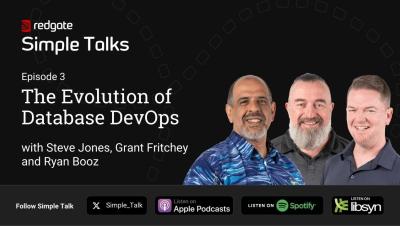
Simple Talks Podcast | Episode 3 - The Evolution of Database DevOps

Ryan Booz, Steve Jones and Grant Fritchey discuss the evolution of Database DevOps, from its origins to its significance today. They discuss what they were doing at the time of its inception as a concept and how it impacted their day-to-day, while also looking at the various pieces that make up the Database DevOps puzzle – from automation to testing - and where it may go next.