Operations | Monitoring | ITSM | DevOps | Cloud

The latest News and Information on Cloud monitoring, security and related technologies.

2025 Cloud Pricing Comparison: An In-Depth Guide

Over $44.5 billion in cloud spend goes to waste annually, per the FinOps Foundation. No wonder reducing unnecessary costs is critical to protecting your margins. A logical place to start? Cloud service pricing. Providers like AWS, Azure, and Google Cloud continue to evolve their pricing models. They are offering new discounts, regional rates, and shifting commitments. All to win your business. Yet, a cloud pricing comparison alone doesn’t give you a complete picture.
How to be prepared for cloud provider outages

GCP’s recent outage on June 12th was a reminder of just how interconnected modern architectures are. The 2 hour and 28 minute outage affected dozens of companies and spanned 80+ Google services and products. But what was really illuminating was just how far the outage spread due to hidden dependency risks. Many companies that don’t run on GCP were startled to find their services suddenly affected because they had dependencies or depended on vendors that did use GCP.

How to reduce Cloud Costs (with Open Source!)

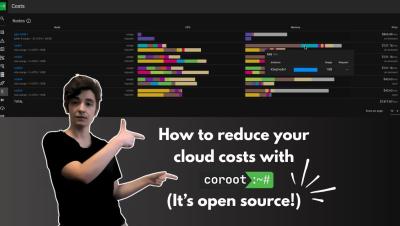
We strongly believe that simple observability should be an innovation everyone can afford to benefit from: which is why Coroot is open source, and includes cost monitoring for Azure, GCP, AWS, or your own custom settings. eBPF automatically tracks how each deployment impacts your cloud costs, so you can easily roll back changes and avoid lovecraftian monthly bill when necessary.

Myth #3 of Kubernetes Resource Optimization: Instance Rightsizing

In this blog series we are examining the Five Myths of Kubernetes Resource Optimization. So far we’ve looked at Myth 1: Observability and Monitoring and Myth 2: Cluster Autoscaling. Stay tuned for the entire series! The third myth addresses another common assumption of many Kubernetes practitioners: Choosing the right instances will eliminate waste in a cluster.

What Are Two Types Of Cloud Backup Methods?

Backing up files in the cloud or locally is a crucial step you must take when managing your files. Protecting your files with multiple types of data backup methods will help you recover your files instantly, protect against ransomware, and ensure you can always access your files no matter what happens to your device. But what are the two types of cloud storage backup solutions which are fast, simple to use, and the best way to protect your files?

Lumigo Copilot AI Launches to Automate Root Cause Analysis and Remediation

Today, we’re announcing the general availability of Lumigo Copilot, the most intelligent AI-powered observability assistant on the market, built for the complexities of modern microservices. Copilot emerged from a simple realization: Distributed systems produce too much fragmented data across too many layers, making troubleshooting slow, reactive, and deeply manual. Copilot changes that.

Boosting your AWS monitoring ROI: Strategies that deliver

AWS gives you the power to scale, deploy, and innovate at speed. However, with that speed comes a good amount of complexity. Services multiply, resources balloon, and performance issues sneak in when you least expect them. That’s where monitoring comes in. But it isn’t about checking boxes on dashboards. It’s about getting the most value for every dollar you spend or, maximizing your return on investment (ROI) from AWS monitoring. So, how do you actually do that?

Why your Shopware store feels fast until it doesn't

Shopware is a powerful platform, but its performance depends entirely on how it is used. In this article, we explore the most common and avoidable causes of slowdowns in production environments, including plugin overload, cache fragmentation, and misconfigured admin settings. Whether you are preparing for a high-traffic event or simply aiming to keep your storefront fast and responsive, this guide will help you identify the root causes of performance regressions.

A Simple Guide To GKE Cost Allocation And Cluster Spend

Running workloads on Google Kubernetes Engine (GKE) delivers impressive scalability and flexibility. Yet, it can also introduce a tricky challenge: tracking GKE costs accurately. Remember, GKE costs rarely scale linearly. Overprovisioned nodes, idle autoscalers, and orphaned workloads can quietly balloon your bill in the background. And while GKE’s native tools offer some visibility, they often miss the full picture.

Achieving Comprehensive Network Observability for VMware Cloud Foundation

Private cloud infrastructure adoption is accelerating rapidly. This move is driven by the ongoing “cloud reset” as leaders rethink their hybrid and multi-cloud strategies, seeking greater control, security, and flexibility for their IT workloads. As a matter of fact, leaders in 69% of organizations are considering repatriating workloads, and one-third already have.