Operations | Monitoring | ITSM | DevOps | Cloud

Shipa Integration with CircleCI

Kubernetes can bring a wide collection of advantages to a development organization. Properly leveraging Kubernetes can greatly improve productivity, empower you to better utilize your cloud spend, improve application stability and reliability, and more. On the flip side, if you are not properly leveraging Kubernetes, your would-be benefits become drawbacks. As a developer, this can become especially frustrating when you are focused on delivering quality code, fast.

Considerations for Product-Led Growth in Enterprise Software

Product-led growth has become a popular go-to-market strategy in the digital age. In its superlative form, everything a company does from marketing, sales, operations, development and support is driven by and through the product. The goals are to make products easier to acquire, onboard, use and achieve quick time to value. The product-led growth market strategy revolves around the user and is best geared toward engaging with smaller accounts rather than large enterprise companies.

Configuring and Troubleshooting Multicast Protocols

There are two important protocols required to get your network to forward multicast packets: IGMP and PIM. In this article, I’ll show you how to set up these protocols on your network and how to troubleshoot them. PIM (Protocol Independent Multicast) has two main versions called “dense-mode” and “sparse-mode.” There is also a “sparse-dense-mode,” which has features of both versions and is really just used to help to bootstrap a multicast network.

A Migration of 1000 Workloads Starts with a Single...

You’ve heard that old Chinese proverb that says a journey of a thousand miles begins with a single step. It’s sound advice … except if the journey you’re talking about is the one from the data center to the cloud. With cloud deployment at the center of virtually any digital transformation effort, the journey itself can have a profound impact on the successful outcomes you seek at the destination. So you have to get it right. But what does that actually mean?

Filling gaps in Kubernetes observability with the Sensu Kubernetes Events integration

Kubernetes and its various APIs offer a wealth of information for monitoring and observability. In a recent webinar with the CNCF (as well as a whitepaper based on that webinar), Sensu CEO Caleb Hailey goes in-depth into the most-useful APIs for cloud-native observability. In this post, we’ll focus on the Kubernetes Events API — including why it matters and how it can add context for your observability strategy.

Performing Your Best in the Virtual Age!

Application performance monitoring is vital for keeping software and gaming companies at a level above with providing effective data and cloud usage for applications, software, and platforms for their employees and customers. The rise of remote working has coincided with a boom in streaming, gaming, and other virtual activities. This has led to increased usability, and performance management challenges for gaming and software organizations.

Generate process metrics to analyze historical trends in resource consumption

Your application’s health depends on the performance of its underlying infrastructure. Unexpectedly heavy processes can deprive your services of the resources they need to run reliably and efficiently, and prevent other workloads from executing. If one of your applications is triggering a high CPU or RSS memory utilization alert, the issue has likely occurred before.

Getting Started with Sematext Browser SDK for Front-end Performance Monitoring

Open-sourcing a code base for the world to see after working on it for a long time is a great experience. You should care about what your users want. You want your users to have a great experience using your product. Everything has to fall into place. Performance, responsiveness, user experience, etc. all have to be exceptional. That’s why I think front-end performance metrics are crucial.

Trace discovery in Grafana Tempo using Prometheus exemplars, Loki 2.0 queries, and more

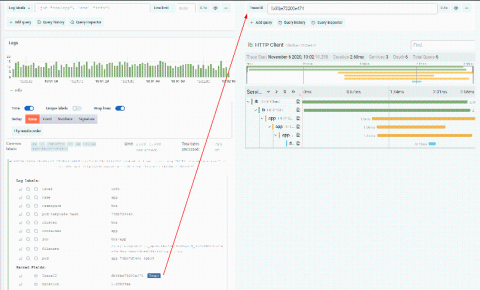
Grafana Tempo, the recently announced distributed tracing backend, relies on integrations with other data sources for trace discovery. Tempo’s job is to store massive numbers of traces, place them in object storage, and retrieve them by id. Logs and exemplars allow users to quickly and more powerfully jump directly to traces than ever before. Let’s dig into some examples with a live playground to try it out!

How to Minimise your Azure Blob Storage Costs

We all know that while Microsoft provides an almost seemingly infinite amount of storage. Compare this to your normal datacentre virtual infrastructure, you often need to do some capacity planning for expected Virtual Machine Compute and Storage way ahead of time. As Microsoft does the capacity planning for you (and everyone else who is using their services), your own Operational Support no longer needs to order disks or more servers to keep up with your business growth and expectations.