Operations | Monitoring | ITSM | DevOps | Cloud

The latest News and Information on Cloud monitoring, security and related technologies.

Virtana Announces New Funding from its Major Investors

San Jose, CA, May 13, 2020 – Virtana, the leader in enterprise hybrid cloud migration and optimization, announced today a new $15 million investment from HighBar Partners and Benhamou Global Ventures. The funding will allow Virtana to help more customers optimize performance, cost, and capacity in on-premises and cloud data centers.


How to deploy an app to AWS: Route 53 and DNS explained

In our series on how to deploy an app to AWS with the least effort, we've talked about getting started, preventive measures, and securing your app. Today, we're going to focus on DNS (domain name system), specifically the AWS DNS service Route 53. As you're deploying your web app, you will inevitably use DNS.

3 Ways to Run Kubernetes on AWS

Kubernetes is hugely popular and growing, and is primarily used on the cloud — 83 percent of organizations included in a large CNCF survey said they run Kubernetes on at least one public cloud. Amazon is a natural option for Kubernetes clusters, due to its mature and robust infrastructure, and a variety of deployment options with a varying degree of automation.

Dashbird's Lessons Learned from Launching a SaaS Application

From the development and operations side, launching a new software application can be quite challenging. Deciding which tools to use, how to organize the task pipeline, managing collaboration among team members, monitoring performance and potential issues after launch, etc. It’s not easy to get it done right. Dashbird recently went through all of this. Behind the scenes, our amazing development team worked really hard to overcome all challenges and deliver the best value to our users.

Detailed view on Azure Function Custom Handlers

Custom Handler is a feature in Azure Functions which lets you bring your own command, script, or executable, and hook it up to Azure Functions Triggers and Bindings. Custom Handler implements a lightweight Web Server. In other words, you can write your own APIs, in any language i.e. it need not be a language supported by Azure functions. You can just hook up your Azure function host with your custom API and let your function act as a proxy.

Manage logs from multiple clouds and on-premises workloads together

We’ve heard from our customers that you need visibility into metrics and logs from Google Cloud, other clouds, and on-prem in one place. Google Cloud has partnered with Blue Medora to bring you a single solution to save time and money in managing your logs in a single place. Google Cloud’s operations management suite gives you the same scalable core platform that powers all internal and Google Cloud observability.

Feature Spotlight: Auto-Tracing

Lumigo’s Auto-Tracing allows you to implement distributed tracing on your Lambda functions with 3-clicks and no manual code changes. If you’ve already decided to move to a serverless infrastructure, you probably understand the importance of monitoring your AWS Lambdas and what it might entail. For the few out there that are still wondering what monitoring AWS Lambda means, I’ll break it down for you in a couple of steps.

AWS Lambda Monitoring - what to keep an eye on with serverless

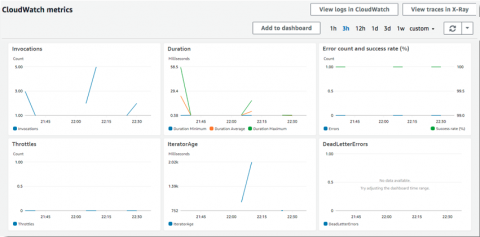
AWS Lambda is the leading serverless computing solution and is one of AWS’ most successful products, to date. Its popularity is in large part because of the way it makes development easier and faster. Lambda completely abstracts away the maintenance of underlying infrastructure including compute, storage, memory, and networking. Developers simply upload their code in the form of Lambda functions and the service fully handles the execution of these functions.

Getting Microsoft Azure Data into Splunk

If you're reading this, you're probably wondering how to get data from various Microsoft Azure services into Splunk. With the growing list of Azure services and various data access methods, it can be a little cloudy (pun intended) on what data is available and how to get all that data into Splunk. In this blog post, I'm going go over how Microsoft makes Azure data available, how to access the data, and out-of-the-box Splunk Add-Ons that can consume this data. So let's dive right in.