
Operations | Monitoring | ITSM | DevOps | Cloud

How to enrich logs and metrics using an Elasticsearch ingest node

When ingesting data into Elasticsearch, it is often beneficial to enrich documents with additional information that can later be used for searching or viewing the data. Enrichment is the process of merging data from an authoritative source into documents as they are ingested into Elasticsearch. For example, enrichment can be done with the GeoIP Processor which processes documents that contain IP addresses and adds information about the geographical location associated with each IP address.

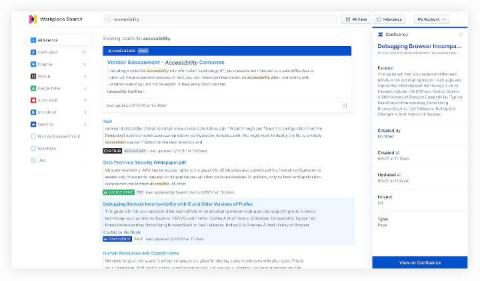
Searching Confluence with Elastic Workplace Search

For many companies, Elastic included, wikis developed with Confluence are a critical source of content, procedures, policies, and plenty of other important info, spanning teams across the entire organization. But sometimes finding a particular nugget of information can be tricky, especially when you’re not exactly sure where that information was located. Was it in the wiki? In a Word doc? In Salesforce? A GitHub issue? Somewhere else?

Coming in 7.7: Significantly decrease your Elasticsearch heap memory usage

As Elasticsearch users are pushing the limits of how much data they can store on an Elasticsearch node, they sometimes run out of heap memory before running out of disk space. This is a frustrating problem for these users, as fitting as much data per node as possible is often important to reduce costs. But why does Elasticsearch need heap memory to store data? Why doesn't it only need disk space?

Creating modern customer service experiences with Elastic Enterprise Search

Let’s be honest. No one wakes up in the morning thinking of reasons to contact customer support. It’s tedious, onerous, and can eat into your evening Netflix time. Thankfully, most brands realize that customer experiences drive brand loyalty and repeat purchases.

Virtual Meetup: Multilingual Data & Search - Solving the Common Problems

It’s no secret: multilingual search is hard! Each language is unique. In some languages there is no whitespace between words, in others using the dictionary form of a word is essential to finding more relevant results. Your data can be in one or several languages or even worse, one document can be written in one or more languages. How do you maximize your chances of getting relevant results? This 35min talk will cover some customer use case and the following challenges.

Smooth mocking with the Elasticsearch Node.js client

A classic problem that every backend developer has faced during their work is testing an application that uses a database. A perfectly valid solution is to use the real database for testing your application, but you would be doing an integration test, while you want a unit test. There are many ways to solve this problem. You could create the database with docker, or use an in-memory compatible one, but if you are writing unit tests that can be easily parallelized this will become quite uncomfortable.

SEMplicity: Scaling Large ECE Deployments

From the trenches: what does it really take to scale up a large Elastic security log deployment? Elasticsearch for enterprise security log storage & management is a hot topic today. Specular gains in performance, functionality and cost are ready for harvest. But what exactly does it take to create a large Elastic log storage infrastructure? This talk will present war stories related to at 150,000 events per second Elastic log storage implementation with 2 month retention built at a large commercial client.

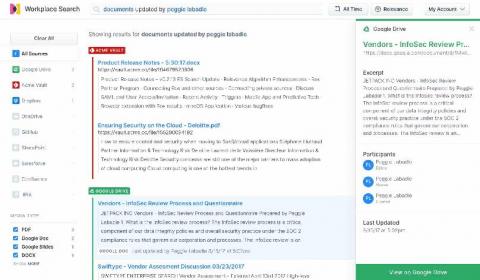
Virtual Meetup: Elastic Workplace Search-Finding Where That Document Went

Supporting employees in a work from a home environment can be challenging. Do they have access to these systems? Can they locate the documents they need? This would be easier if documents are centrally located. In most organizations, documents can live in services like Dropbox, Goole Drive, and or Github. In this virtual meetup, I will show you how to create a search box between these different services and finally solve the question.. "Where did that document go?"