Operations | Monitoring | ITSM | DevOps | Cloud

The latest News and Information on Cloud monitoring, security and related technologies.

The Architecture Question That Never Dies: From BPMN and M&A to MCP

Twenty years ago at RMIT, I became preoccupied with a question that sounded technical but was really about corporate value: could you predict how difficult a company would be to acquire by looking at the shape of its APIs? It was 2006. I was completing Honours in a Bachelor of Applied Science in Software Engineering, and the brief for my research project was unusually open: find an impactful software research hypothesis that hasn’t been done before.
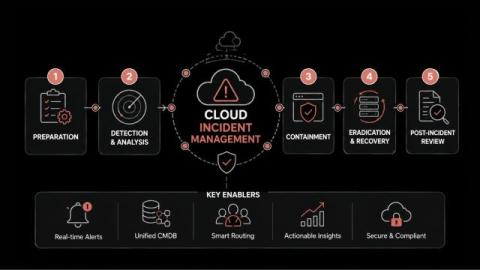
Cloud Incident Management: Process, Tools, and Practices

How do you resolve an outage your organization has no authority to fix? A managed database drops into read-only mode and stops accepting writes. There's no host to reach, no configuration file to edit, and no restart command available to your engineers. Cloud incident management begins at that boundary, where the response depends on a support channel and a provider status page. Plenty of what you already know still applies here.

Don't build the autonomous AI factory first

Here's a scene playing out in engineering teams right now. An engineer spends the weekend running four or five coding agents in parallel. Monday morning, a teammate opens their laptop to 53 changed files with 2000+ diffs and a message that says, more or less, "should be good to merge." Nobody asked for this much output. Nobody has time to review it properly. The team doesn't feel faster. It feels ambushed.

Shipped: Cut the notification noise so real cost anomalies stand out

A view is scoped to the costs your team cares about, and now its notifications are too. Weekly and monthly trend summaries, and global anomaly alerts, only reach a channel when your team wants them there. That keeps a shared channel signal, not static, so the alerts that need action don’t get lost next to irrelevant updates. Your team decides, per view, which notifications reach its channel.

LLM cost management: a practical guide for teams that own the budget

LLM cost management is the practice of tracking, allocating, budgeting, and governing large language model spend so every dollar maps to a feature, team, and business outcome. It has five levels: provider visibility, business allocation, unit economics, model governance, and a continuous optimization loop. It matters because 68% of companies say AI initiatives ran over budget last year, and per CloudZero's 2026 survey, 30% of finance leaders still reconcile AI spend manually.

Pentagon-shaped org charts are coming. Intellectually curious leaders will get a head start.

If you spend even fifteen minutes reading about AI’s impact on the future of work, you’ll take in a lot of fear-based analysis. The fears are real — 40% of workers fear losing their jobs (Metaintro), 60% believe AI will eliminate more jobs than it creates (Yardi Kube), and 52% generally worry about the impact of AI in the workplace (Pew Research) — but the analysis is all wrong.

Data localization for Indian Fintech: RBI rules and your cloud choice

Indian fintech operates under one of the most specific data localization regimes in the world. The Reserve Bank of India has published progressive guidance since 2018 requiring payment system data to be stored in India, with subsequent extensions to other categories of financial data. The rules aren't optional. For fintechs operating in India - whether payment providers, lending platforms, wealth managers, or neo-banks - the localization requirements shape fundamental infrastructure choices.

Cloud Outage Resilience: On-Call Lessons for 2026

Cloud outage resilience has quietly become the most important reliability topic of the year. Analysts now treat large scale cloud downtime as a matter of when, not if. Forrester has predicted at least two major multi day hyperscaler outages in 2026, and the reasoning is hard to argue with. AWS, Azure, and Google Cloud together account for well over half of enterprise cloud spending, so when any one of them stumbles, a huge slice of the digital economy stumbles with it.

Shipped: Stop guessing why that billing connection exists

Every team with more than a few data connections has had this moment: someone opens the connections list, points at one, and asks “what is this for?” The answer lives in a former teammate’s head or in a Slack thread. And cleaning up the wrong connection can break cost ingestion. Now each connection can carry a note that explains why it exists, and anyone who opens the connection sees it.