Operations | Monitoring | ITSM | DevOps | Cloud

Why the U.S. Locked Down Fable and Mythos: AI, National Security, and the Workforce Squeeze

The U.S. just barred foreign nationals from accessing two advanced AI models — Fable and Mythos — citing national security. Around the same time, the Five Eyes intelligence alliance warned that AI-enabled cyberattacks are "months, not years" away. In Season 5 of ShipTalk, host Adam and co-host Martin dig into whether that warning is already overdue — and what it means for the people actually defending software.
Why colocation is becoming the foundation of sovereign AI

The last few years have seen AI conversations dominated by the need for investment in hyperscale infrastructure as firms race to build ever larger training models. But as those conversations evolve, the emphasis is shifting to the next phase of AI adoption, focusing on the scaling of use cases and real-world value. In line with this shift, organisations are looking beyond where AI is trained to the specifics of where it is actually used.

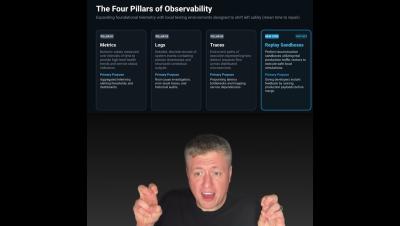
AI is Exposing Observability's Dirty Secret

The 3 pillars of observability are breaking. For years, dev teams relied on Logs, Metrics, and Traces to know when something went wrong. But now? AI agents are writing, deploying, and changing code in real-time. When an AI hallucination pushes a bug to production, standard monitoring sees nothing wrong.To survive the AI era, we need a 4th Pillar of Observability. Watch to find out what it is and why the old way of monitoring just became obsolete.

Introducing AI-Powered Incident Correlation & Root Cause Detection

An API latency spike hits your checkout service, and within ninety seconds your on-call phone won't stop buzzing. A CPU threshold breaches. A database connection pool exhausts. A pod restarts. An error rate crosses 5% on a downstream service. Six engineers get paged inside four minutes. Forty alerts. Seven services. One incident. Every monitoring tool in the stack is doing exactly what it was configured to do, telling you that something is wrong.

99% of database professionals are seeing AI benefits. So why are the security challenges increasing?

The numbers from the 2026 State of the Database Landscape: AI Edition are striking. 99% percent of respondents using AI report at least one measurable benefit for their database work. Automation is up, performance is improving, and three-quarters report significant cost savings. By almost any measure, AI is delivering. However, sitting alongside that near-universal positivity in the same dataset, security and privacy concerns have climbed to 64%. Regulatory compliance anxiety has risen to 40%.

IT on the 4th of July? Not with AI. | Zero Ticket Minute

What if your IT team could enjoy the Fourth of July without getting interrupted by password resets, VPN issues, and routine service requests? In this week's Zero Ticket Minute, see how agentic AI and automation help eliminate repetitive tickets so IT teams can enjoy the holiday while work gets done.

How We Secured AI Worker Agents in Harness | Harness Blog

When we launched Autonomous Worker Agents, the message we led with was simple: governance is inherited, not integrated. Agents don't get security bolted on after the fact. They inherit the OPA policies, RBAC, and audit trails already running your production pipelines. This post is about the layer underneath that promise: isolation. We let an Autonomous Worker Agent run shell commands and call APIs inside our pipelines.

Part II: Inside Alert AI Analysis: From a Single-Agent Prompt to an Agent Harness

TL;DR: This is the engineering companion to our announcement post, Upgraded Alert AI Analysis: Automated Incident Investigation, read that one for what the new generation does for your team; read on for how it works under the hood. Interested in hearing more? Book a demo to see the Alert AI Analysis Agent live. Root cause analysis is one of the harshest tests you can give an AI.