Operations | Monitoring | ITSM | DevOps | Cloud

Navigating the Evolving Landscape: A Deep Dive into REST API Versioning Strategies

In the ever-evolving landscape of APIs, ensuring seamless interactions and managing changes becomes crucial. While innovation and adaptability are essential, maintaining backward compatibility is equally important to avoid disruption for existing users. This is where REST API versioning comes into play. Versioning allows you to introduce new features or changes to your API in a controlled manner, while simultaneously keeping older versions running smoothly.

Balancing Innovation and Reliability: A Guide for SRE Teams

In today's rapidly evolving technological landscape, striking a balance between innovation and reliability is a constant challenge for Site Reliability Engineering (SRE) teams. On one hand, businesses and customers crave the constant stream of new features and functionalities that fuel progress. On the other hand, ensuring system stability, minimal downtime, and optimal performance remains paramount for user experience and business continuity.

Best Practices For Building A Resilient On-Call Framework

Whether a business is small scale, medium-sized, or a large enterprise, downtime issues can affect any organization as no business is exempt from experiencing downtime. However, the swifter the acknowledgment of an issue, the quicker the response, resulting in a reduced impact on business. An effective On-Call framework not only aids in prompt issue resolution but also plays a vital role in minimizing the overall downtime impact on business operations.
Sponsored Post

The 6 Best Incident Management Software in 2024

When the siren blares and your IT infrastructure is under siege, panic can be your worst enemy. In the heat of these digital battles, robust incident management software becomes your indispensable weapon. Forget fumbling through spreadsheets and frantic Slack threads - you need a clear-headed commander-in-chief, a champion of incident response who orchestrates your team to victory.

Streamlining Incident Management With Squadcast and ServiceNow Bidirectional Integration

Revisit our insightful webinar to explore how Squadcast’s latest bidirectional integration with ServiceNow can make the best of your ServiceNow implementation. Discover this powerful bidirectional integration's key features and benefits, designed to streamline incident resolution and enhance collaboration within your DevOps and IT teams. Learn, share, and grow with us as we journey towards a more reliable and efficient digital world..

Incident Commander Training Strategies: What The Books Don't Tell You

It has been lightly revised and reposted with his permission from the original article on Medium. So, you’re training incident commanders (IC), and you have your group read Google’s SRE books. Everyone knows what they are supposed to do and you are ready for any incident, right? Not quite. Half of your team complains that the descriptions are too vague or don’t apply to their situations, and the other half just starts to improvise. The result?


Performing Seamless Root Cause Analysis With Squadcast

Critical incidents can pose significant challenges in organizational operations that demand prompt and effective resolution. A vital aspect of this resolution process involves Root Cause Analysis (RCA) reports, which dissect incidents to uncover their underlying causes and pave the way for preventive measures.

Breaking Down the 2024 VOID Report: "Exploring the Unintended Consequences of Automation in Software"

In an era where automation and artificial intelligence are increasingly integral to software development and operations, the 2024 VOID Report sheds critical light on the nuanced impacts of these technologies. Here, we delve deeper into the report's key findings and explore predictions for the near future, weaving a comprehensive narrative highlighting challenges and opportunities.

Manage Different Teams Within An Organization With Role Based Access Control In Squadcast

In a dynamic business landscape, organizations specifically Managed Service Providers (MSPs) often find themselves juggling the needs of multiple customers. It's crucial for them to maintain strict data segregation to prevent the mixing of customer information. Likewise, large organizations with distinct departments like the customer service or the technical department face similar challenges.

Demystifying Digital Operations: A Comprehensive Overview

In today's hyper-connected world, digital operations underpin every successful organization. Yet, with countless tools, processes, and complexities involved, it can be challenging to understand the big picture and optimize performance. This blog aims to demystify digital operations by providing a comprehensive overview. We'll explore key topics, illustrate them with real-world examples, and highlight practical use cases to shed light on this vital aspect of modern business.

Simplify Service and Alert Management at Enterprise Scale with Squadcast Global Event Rules (GER)

Tired of managing a web of webhooks for your various services? Squadcast's Global Event Rulesets offers a centralized solution. Define alert routing rules from a single configuration point and apply them across all services, reducing complexity, boosting your efficiency, and simplifying your Incident Management process. This explainer video dives into GER, your secret weapon for.

Introducing Squadcast and ServiceNow Integration For Enhanced Operational Efficiency & Faster Incident Management

We are excited to announce our bidirectional integration between ServiceNow and Squadcast, designed to elevate your Incident Management capabilities. ServiceNow provides a robust platform-as-a-service, delivering advanced automation and process workflow tailored for enterprise environments. Through this integration, you can harness ServiceNow's workflow and ticketing features alongside Squadcast's strong On-Call scheduling and SRE-driven incident response capabilities.

What is Ping Command: A Deep Dive into Network Diagnostics

The Ping command is an essential tool in network diagnostics, crucial for checking connectivity, solving problems, and measuring network performance. In the complex world of digital communication, where connections stretch across long distances and pass through many devices, knowing how to use the Ping command is extremely important. In this detailed exploration, we will examine the Ping command thoroughly, exploring its uses, and highlighting its importance in keeping networks strong and reliable.

Building a Privacy-First AI for Incident Management

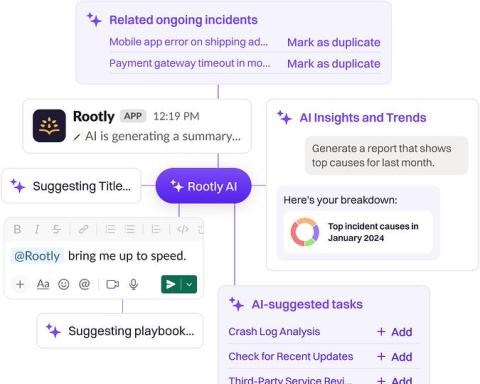
At Rootly, we're integrating AI into incident management with a keen eye on privacy. It's not just about tapping into AI's potential; it's about ensuring we respect and protect our customers’ privacy and sensitive data. Here's a quick overview of how we're blending innovation with strong privacy commitments.

Bridging the Gap: Overcoming Communication Challenges Between Helpdesk, SREs, IT Teams, and Database Administrators

One area where communication breakdowns commonly occur is between helpdesk / IT teams / SREs and database administrators (DBAs), especially when troubleshooting application problems associated with databases. Smooth communication between different teams is key to resolving application performance issues efficiently and speedily. However, it is usually inappropriate for helpdesk staff to have access to the database monitoring privileges and tools used by DB administrators.

Automating On-Call Scheduling With Squadcast: Simplify Managing Schedules

Navigating an extensive excel sheet to determine On-Call schedules and vacation plans can be daunting. The struggle of maintaining On-Call Schedules manually is real. But we've got a solution that can help. This blog addresses the challenges associated with manualOn Call Scheduling processes.

SRE Metrics: Availability

Understanding SRE metrics and how they impact your platform's availability are fundamentals of Site Reliability Engineering. How available is your website, service, or platform? What must you monitor and measure to ensure availability? How do you translate uptime into availability? This chart has numbers that every Site Reliability Engineer (SRE) should know.

Leverage Past Incidents for Faster Incident Resolution with Squadcast

Squadcast's Incident Management platform helps you learn from the past to resolve future incidents faster. In this video, we'll show you how to use Squadcast's Past Incidents feature to: 🔑Gain historical context for new incidents🔑See how similar incidents were resolved in the past🔑Identify patterns and trends in past incident activity By leveraging past incidents, you can improve your incident response times and reduce the impact of incidents on your business.

Mastering IPM: Protecting Revenue through SLA Monitoring

If you’re an SRE, then you already know your SLOs from your SLAs, not to mention your SLIs. But even if you’re not au fait with those acronyms, you’ll soon discover how widespread and applicable these concepts are in this installment of our IPM Best Practices Series. We’ll explore these concepts in detail and explore how external monitoring can enhance the tracking of Service Level Objectives (SLOs), leading to positive user experiences and informed decision-making.

Enhancing On-Call Efficiency with Squadcast's Custom Content Templates

Critical information during Incident Management includes the incident's nature, impact, urgency, affected systems, and current status, enabling efficient resolution. Yet, the excessive details in incident notifications frequently hinders rather than aiding the process.

eBPF: Revolutionizing Observability for DevOps and SRE Teams

Whether you're a system administrator, a developer, or any other DevOps or Site Reliability Engineering (SRE) professional, you know that staying ahead in cloud-native computing is crucial. One way to keep your competitive edge in the technology game is to embrace the benefits of eBPF (Extended Berkeley Packet Filter). On top of advances in security and networking, eBPF-based tools are particularly impacting the observability landscape.