Operations | Monitoring | ITSM | DevOps | Cloud

Assessing the Per-Minute Cost of an Outage for YOUR Company

Software vendors and analysts love to rattle off scary numbers about how many thousands of dollars per minute or hour an infrastructure outage will cost the typical company. Those numbers can be scary indeed; for example, Gartner quotes $5,400 per minute as the cost borne by a medium to large-sized retailer. Your company, however, is most likely not identical to the “typical” company on which the numbers are based.

July 2019 Update: Alert Opt-In and Out, Apps Section and Getting Started

July 2019 Update introduces the option to opt-out for certain categories as well as some enhancements in the Web portal. You can now opt-in/out of certain categories under Settings -> Services & Systems. This works on a per-user basis and is useful when you do not want to receive certain alerts but your team members still need to get them. Another scenario is to listen in, meaning you see what is going on but all notifications can be muted.

The Ins and Outs of Postmortem Documentation

No matter how you design your architecture or what technologies you implement, critical incidents will happen. When things go wrong, it is easy to get carried away and forget about the bigger picture. But your work isn’t done after you fix the immediate problem; now is the time to take a look at how the incident actually happened so that you can learn from it.

One Size Does Not Fit All: Tailoring Incident Response Messages to Different Stakeholders

In a simpler world, incident response notifications would be a one-size-fits-all type of item. You could deliver the same notification to everyone with equally successful results. But in the real world, incident response messages must be nuanced. Unlike baseball hats or wristwatches, the messages you send to different stakeholders when an incident occurs need to be tailored to each category of recipient.

Reduce Alert Volume and Gain Timely Event Insights with First-Response Policies

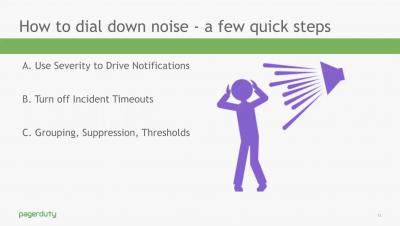
Auto-alert suppression management in OpsRamp delivers first-response actions to reduce redundant and noisy alerts. Learning-based first-response policies ensure that IT teams no longer have to create static rules for a target set of resources by configuring alarm thresholds, defining filter criteria, and specifying time intervals.

Gain more control of your incidents with Incident Split & Merge

Usability and control are key elements in BigPanda’s Operations Console, where IT Ops, NOC and DevOps users investigate and take action on IT incidents. Let’s take a look at how BigPanda’s powerful Split Incident and Merge Incidents features provide IT Ops with an added layer of control. BigPanda’s Open Box Machine Learning correlates and enriches the overwhelming amount of alerts IT Ops needs to deal with into a reduced number of insight-rich incidents (often 95% fewer).

Downtime Alerts: An Ideal Custom Setup

04 Jul 2019 Ryan Glass, lead developer at Downtime Monkey and director of Big Toe Web Design gives us the recipe for his ideal downtime alert setup... Yes! At Big Toe we use it for all our website monitoring. As well as building sites, we manage the hosting of our client's websites and we monitor these to make sure that they are up and running round the clock. That depends on the site/client.

Statuspal as Alternative to AdminLabs

It’s always sad to see products shut down, even if they are our competitors, so it’s the case of AdminLabs, as some new customers have brought to our attention. So we want to let any previous users of AdminLabs know, you’re welcome here at Statuspal, let us help you have a smooth transition to the only hosted status pages provider as feature rich, that provides native monitoring features right within your status page dashboard.

Top 11 Incident Response Influencers to Follow in 2019

The incident response industry is anything but static, and it is often said that the key to staying ahead is staying informed. But that’s easier said than done. Faced with the increasing sophistication of cyber attacks and the growing complexity of IT architectures, we often drown in our daily slew of tickets and alerts, with no time left to spare.