Operations | Monitoring | ITSM | DevOps | Cloud

Sovereign AI and the future of data centre infrastructure

What does sovereign AI really mean when the hardware powering it is made somewhere else? And how is AI changing where data centres need to be built? In the first episode of Series 2 of Perspectives from the Edge, Rob Cooper, Head of Data Centre Advisory at CBRE, joins Pulsant’s Wendy Shearer to explore the rapidly changing AI infrastructure market. CBRE is a global real estate and infrastructure advisory firm, with a specialist team focused on the data centre sector.
Compare & Sync PostgreSQL Data + AI Assistant | dbForge Studio #Shorts

Compare and synchronize PostgreSQL table data with dbForge Studio for PostgreSQL. This video shows the entire data comparison and synchronization workflow: how to select source and target databases, configure comparison options, review data differences, generate a synchronization script, and verify that both databases are identical afterwards. You will also see how dbForge AI Assistant can generate, explain, optimize, and troubleshoot SQL queries directly in the Studio.

How to operate shared platforms safely at agent scale

A platform engineering team can design robust Golden Paths for agent use yet still be unprepared for what happens after adoption. An agent may authenticate properly, call the correct tools, adhere to approval gates, and complete tasks without incident, but new operational risks arise once multiple teams begin running agents continuously and in parallel. We’ve encountered these risks firsthand at Datadog.

Monitor TAS and gang scheduling for AI training in Kubernetes

Distributed AI training workloads impose complex scheduling requirements that Kubernetes’s built-in scheduler can’t meet. Kubernetes schedules pods individually and independently, but distributed training introduces two requirements that break this model: Pods must land on hardware with the right inter-GPU bandwidth, and all pods must be scheduled simultaneously. If either requirement goes unmet, training stalls or runs far below the hardware’s potential.

Manage Cursor costs with Datadog Cloud Cost Management

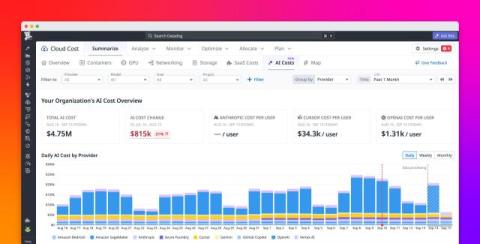
AI coding tools such as Cursor are becoming a significant source of engineering spend. But Cursor costs can be difficult for FinOps teams to manage. Cursor’s usage data alone doesn’t tell you how costs break down across users and models, and fixed-threshold alerts may not catch an unusual cost spike if spend remains below the threshold. Datadog Cloud Cost Management (CCM) brings Cursor costs into the same place where you monitor cloud, SaaS, and other AI spend.

Bindplane Agent Is Here: Build, Edit, and Understand Pipelines in Plain Language

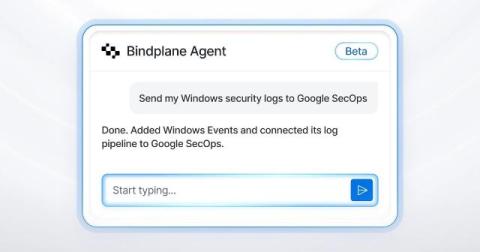
Pipeline Intelligence already recommends processors, reads live telemetry, detects log types, and generates processor bundles from natural language. But most of it lives inside a single processor node. You still have to know which one to open and what to ask for. This changes today. Bindplane Agent is your AI assistant inside Bindplane, ready to act on what you describe in plain language.

150+ AI statistics for 2026: spend, cost, and AI ROI

Worldwide AI spending will reach $2.59 trillion in 2026, up 47% from 2025, according to Gartner. Yet only 37% of organizations report any earnings impact from AI, McKinsey finds. These AI statistics cover what companies spend, what AI costs to run, and the ROI they're actually getting. That gap between the two headline numbers is the story of AI in 2026.

Datadog named the Company to Beat for observability platforms in 2026 Gartner AI Vendor Race report

Datadog has been named the Company to Beat for observability platforms in the August 2026 Gartner AI Vendor Race research. Datadog has also been named a Leader in the 2026 Gartner Magic Quadrant for Observability Platforms for the sixth consecutive year. We believe that these recognitions reflect what we have been building toward for more than a decade: a single platform where teams can observe, secure, and act on everything that matters across their technology stack.

Shipped: Know what you actually pay per token on OpenAI

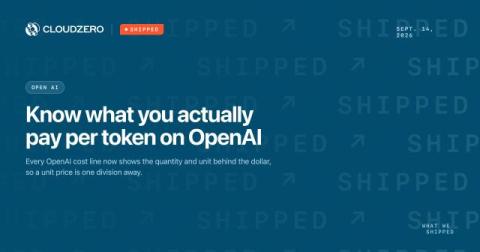
Picture two teams running the same million input tokens through the same model. One team’s tokens are cache hits, queued through the batch API. The other team’s are fresh, sent live. On a current-generation OpenAI model, cached input runs about a tenth the price of a fresh token, and batch processing cuts whatever’s left in half. Stack the two: at a list rate of $2 per million tokens, one team’s bill comes to 10 cents, the other’s to two dollars.