Operations | Monitoring | ITSM | DevOps | Cloud

The latest News and Information on DevOps, CI/CD, Automation and related technologies.

General availability announcement

After nearly 2 years of perfecting our product during our beta phase and just over 5 months since we opened for early access, I have great pleasure in announcing that Civo is now 'General Availability'. It's taken us over 4 years to get to where we are today, with a colossal amount of work being contributed by our team to build the Civo platform and developer eco-system. I can honestly say that we're lucky to have so many amazing people at Civo.

Announcing Workflows - Fix k8s issues on the fly

Meet "Workflow" from Komodor, the feature that automates troubleshooting common errors in Kubernetes. Leveraging Komodor’s change intelligence capabilities, Workflow's smart algorithm automatically detects Kubernetes issues and responds with a series of checks that quickly pinpoint its root cause. Not stopping there, Komodor uses the information to provide made-to-measure instruction for remediation, turning troubleshooting into a fast and effortless experience for dev and ops.

How to Reduce Change Lead Time

The time it takes to get a change into production, also known as Change Lead Time, is an important measure of developer productivity, and one of the four DORA metrics. In Sleuth, you can easily break down Change Lead Time into activities to get insights into potential bottlenecks. SLEUTH A deploy-based Accelerate Metrics tracker both managers and developers love.

How to easily track DORA metrics

With Sleuth, you can instantly and automatically track the four DORA metrics: Change Lead Time, Deploy Frequency, Change Failure Rate, and MTTR. No more, no less. Sleuth tracks them accurately, doesn't attempt to track dubious individual metrics, and doesn't require any manual work. SLEUTH A deploy-based Accelerate Metrics tracker both managers and developers love.

Best Practices Guide for Kubernetes Labels and Annotations

Kubernetes is the de facto container-management technology in the cloud world due to its scalability and reliability. It also provides a very flexible and developer-friendly API, which is the foundation of its control plane. The effectiveness of the Kubernetes API comes from how it manages the Kubernetes resources via metadata: labels and annotations. Metadata is essential for grouping resources, redirecting requests and managing deployments.

Getting Started With the InfluxDB Template for NGINX Ingress Controller

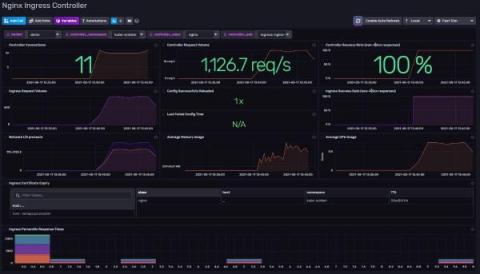
Today, many of the internet’s busiest websites and applications rely on NGINX to run smoothly. And many of those websites and apps are run as cloud-native services in Kubernetes. In particular, the NGINX Ingress Controller is a best-in-class traffic management solution for cloud‑native apps in Kubernetes and containerized environments that uses NGINX as a reverse proxy, load balancer, API gateway, cache, or web application firewall.

Provisioning bare metal Kubernetes clusters with Spectro Cloud and MAAS

Bare metal Kubernetes (K8s) is now easier than ever. Spectro Cloud has recently posted an article about integrating Kubernetes with MAAS (Metal-as-a-Service. In the article, they describe how they have created a provider for the Kubernetes Cluster API for Canonical MAAS (Metal-as-a-Service). This blog describes briefly the benefits of bare metal K8s, the challenges it presents, and how the work by Saad Malik and the team from Spectro Cloud solves those challenges.

Data centre networking: what is SDN?

The recent contexts have shown that enterprises needed to take a different approach regarding their digital transformation and its prioritisation. They’ve experienced the need to run new configurations and operations remotely on their infrastructure. This quickly showed the benefits of automation solutions to run those changes from few central locations, which highly facilitated the task of systems and network admins.