Operations | Monitoring | ITSM | DevOps | Cloud

The latest News and Information on IT Networks and related technologies.

Best Network Monitoring Tools in 2026: Compare Top Platforms

Most network monitoring tools alert you that a device is down. The best ones help you determine whether the problem is your WAN circuit, your ISP, or your SaaS provider before your users file a ticket. Traditional network monitoring tools were built for static networks. You poll devices, check interface counters, and still can’t explain why users are complaining about latency.
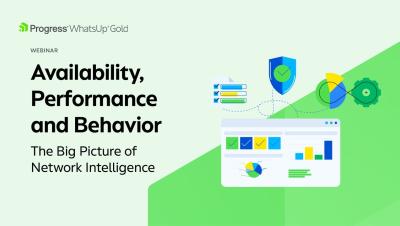
Availability, Performance and Behavior : The Big Picture of Network Intelligence

In this session, we will introduce the third dimension of network monitoring: behavioral intelligence built into the Progress WhatsUp Gold network monitoring solution. Where other tools, like SolarWinds and PRTG, require multiple modules, complex rule-writing, integrations or additional overhead, the WhatsUp Gold solution uses AI-driven behavioral analysis to automatically baseline what’s normal in your network and unveils deviations early.

N-central 2026.3 Release Roundup

Discover what's new in N-central 2026.3. This release focuses on helping IT teams operate more efficiently at scale with improvements to performance, filtering, agent management, security, and integrations. From faster device filtering and rule validation to enhanced agent upgrade workflows and stronger security controls, N-central 2026.3 delivers meaningful improvements designed to simplify day-to-day operations and improve platform reliability.

N-central 2026.2 Release Roundup

n-able.com In this release roundup, Jason Murphy, UEM Head Nerd at N‑able, walks through what is new in N‑central 2026.2 and how these updates help IT teams work smarter, respond faster, and strengthen security without adding complexity. This release focuses on meaningful improvements across AI‑assisted operations, filtering accuracy, and security visibility, all designed to reduce manual effort and improve confidence for IT teams.

Beyond polling: Why enterprises are exploring network telemetry

Polling has been the go-to approach for network monitoring for years, and it still plays an important role in keeping networks healthy. But as networks become more distributed, application-driven, and data-intensive, simply polling devices more often isn't always the most efficient way to gain deeper operational insights. That's where network telemetry comes in.

Is Your Network Holding Back Your Cloud Strategy?

Every layer of the modern network stack moves at cloud speed. If your connectivity doesn't, your entire strategy can stall. Co-authored by Fabio D’Avino This blog includes insights from Fabio D’Avino, a specialist in Network as a Service (NaaS) with more than seven years of experience researching, designing, and building global network services. Fabio’s work explores how organizations can modernize connectivity as cloud, hybrid, and AI-ready infrastructure strategies evolve.

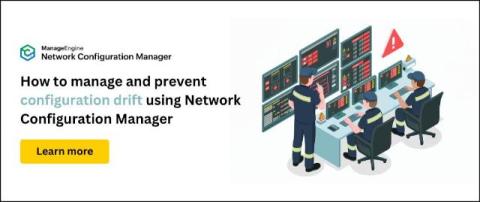
Configuration drift in enterprise networks: Causes, impact, and management

Network admins want all devices with the same role to behave the same way. But in real environments, that consistency rarely lasts. Imagine two core switches in the same data center. They serve the same function and run the same OS version. One handles traffic without issue, while the other drops packets during peak hours. Logs show nothing obvious. Routing looks correct. The team spends hours checking links, hardware, and traffic paths.

CI Can't Keep Up With AI | Blacksmith CEO & Co-Founder Aditya Jayaprakash

AI coding agents are writing software faster than ever. But what happens when the systems responsible for testing and validating that code can't keep up? In this episode of Uplink, Michael Reid sits down with Aditya "JP" Jayaprakash, Co-founder & CEO of Blacksmith, to explore why continuous integration (CI) has become one of the biggest bottlenecks in modern software development.

Unleashing Enterprise Agility: The Power of Portfolio Kanban Flow States

In the world of enterprise Agile, we face a persistent paradox: How do we empower individual teams to establish their own unique processes, while ensuring leadership maintains a clear, consistent view of the entire organization’s progress? For a long time, the answer was a compromise.