Operations | Monitoring | ITSM | DevOps | Cloud

Sponsored Post

3 Ways to Break Down SaaS Data Silos

Access to data is critical for SaaS companies to understand the state of their applications, and how that state affects customer experience. However, most companies use multiple applications, all of which generate their own independent data. This leads to data silos, or a group of raw data that is accessible to one stakeholder or department and not another. Data silos also prevent information from different sources from being blended together to gain a more accurate picture of what's happening in your application.

Context engineering: The missing layer for trusted AI in financial services

Financial services AI demands more than models and prompts. Context engineering provides real-time, governed, and explainable intelligence with Elastic serving as the foundational context layer. Artificial intelligence in financial services is no longer constrained by model capability. The real bottleneck is context.

From Atlassian JSON to Actionable Audit Insights

Atlassian audit logs carry high-value security and operational signals, yet the raw format makes them hard to use in day-to-day investigations. Nested JSON, arrays inside arrays, and localization keys turn routine questions into slow, manual work. For lean Security and IT teams, that friction shows up as delayed triage, fragile dashboards, and alerts that fire without enough context to act.

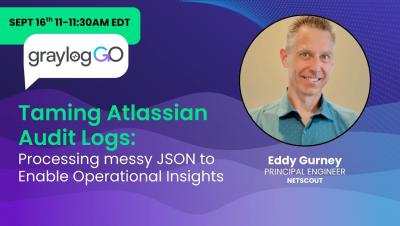
Taming Atlassian Audit Logs: Processing messy JSON to enable operational insights

Atlassian’s audit records are data-rich, but messy. In this data-driven deep dive, Eddy Gurney from NetScout shares what it took to get them into Graylog. He walks through four pipeline approaches and why each fell short, then shows how moving parsing to the edge with Filebeat unlocked Graylog. With clean, flattened events flowing in, alerts and dashboards turn “noise” into operational visibility. You’ll also see how Sidecars makes config rollout easy, plus what changes to make if you’re on Atlassian Cloud instead of Data Center.

Stop Sifting Logs: Find Production Errors in Seconds with `severity=error`

Want your log queries to be more precise? Is your vibe code flooding you with logs and need a helping hand to make sense of it all? Good news! We've upgraded our log query language to be more powerful, flexible, and intuitive, letting you focus on finding answers fast rather than endlessly scrolling through your logs. And that's not all: We've revamped our logging interface, making it easier than ever to manage logs, customize views, and leverage log attributes.

Log Drains Now Available: Bringing Your Platform Logs Directly Into Sentry

Sentry now supports log drains, making it easy to forward logs into Sentry without any application code changes or manual project-key lookups needed. If your logs already exist somewhere else, you can now see them alongside errors and traces in Sentry, no code changes required. Already want to get started? The quickstart guide is one click away.

Top 12 Distributed Tracing Tools in 2026: Complete Comparison & Reviews

Distributed tracing has become essential for modern software teams. As applications evolve into complex distributed systems with microservices, APIs, databases, and third-party integrations, understanding how a single user request travels through your entire stack is no longer optional, it’s critical for maintaining performance, reliability, and user satisfaction.

Bindplane + Statsig Integration: Unified Telemetry for Product Metrics and Experimentation

We’re excited to announce a new integration between Bindplane and Statsig, making it easier to collect, process, and route OpenTelemetry signals into Statsig at scale. This integration provides a seamless way to connect Statsig with the OpenTelemetry ecosystem using Bindplane’s vendor-neutral, OpenTelemetry-native telemetry pipeline. Focus on product insight, not collector operations.

Take Back Control of Your Observability Spend

As budgets reset for 2026, engineering leaders are making a resolution: no more vendor lock-in. Here’s how to keep that promise by building on the technical foundations of data reliability and simplified collection. It’s January 2026, and if you’re like most engineering leaders, you’re staring at your observability vendor contracts with a mix of frustration and resignation.

Kubernetes Logging Best Practices

You’re sitting at your desk, typing away, when all of a sudden you hear a “ping!” Unfortunately, you have a browser with fifteen tabs open, a task management application, email, messaging applications, and calendars all open, making it difficult to know exactly which technology just pinged you. To identify the source, you open your system settings and look at the notifications section to see which ones you allow to make a sound.

Introducing System Datasets: Observing the Observability Platform

Modern observability platforms are great at explaining what’s happening in your apps and your infrastructure. However, all too often the observability platform itself remains a black box. As observability data and usage grow, governance almost always lags behind, and teams struggle to answer basic operational questions like: This valuable data is typically fragmented across admin UIs, billing pages, support tickets, and tribal knowledge.

Helping Service Providers Build Future-Ready Autonomous Networks

As network complexity scales, Splunk empowers service providers to transition toward autonomous networking by integrating automated monitoring with AI-driven root-cause analysis. By shifting from reactive troubleshooting to proactive, automated remediation, providers can resolve issues before they impact the user experience. This evolution ensures seamless digital connectivity while simultaneously reducing customer churn and the high costs of manual network maintenance.

Observability That Works: Understand System Failures and Drive Better Business Outcomes

Modern systems don't fail because engineers lack skills; they fail because teams can't see why systems are failing at all or can’t see why they’re failing fast enough. Often, the problem isn't a lack of tools — it's a lack of clear, connected visibility across data, teams, and systems. This is where observability transforms how organizations operate. It's no longer just about keeping systems running.

Introducing The First Graylog Helm Chart Beta V1.0.0

Running Graylog on Kubernetes has been possible for a while, but let’s be honest: it usually involved a fair amount of DIY. Custom manifests, duct-taped values files, and more than one late-night kubectl describe pod. That changes today. We’re releasing the first-ever Graylog Helm chart for Kubernetes — now available in beta.

AI SRE Update: Your Feedback Shaped Our Latest Release

A note from Lauren Nagel, Mezmo's VP of Product: At Mezmo, we believe the best observability tools aren't just built for users, they're built with them. Since the launch of Mezmo's AI SRE agent, we've listened and learned from our customers. The feedback and insights have been invaluable in helping our teams refine and enhance the experience. Today, we're excited to share our latest release, packed with improvements and powerful new capabilities that make our AI SRE even faster and more intuitive.

Elevating global operations: Mastering multi-cluster Elastic deployments with Fleet

In today's global enterprises, distributed infrastructure is the norm, not the exception. Organizations operate across continents and are driven by customer proximity and regulatory requirements. For the Elastic Stack, this reality often translates into a multi-cluster deployment model, where data is collected and stored in multiple geographically dispersed Elasticsearch clusters. But, why adopt complexity? The decision to decentralize data storage is generally driven by three critical factors.

Cribl Search Pack for Outlook Email Activity

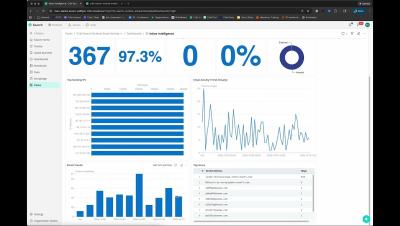
Email is still mission-critical, but most teams have very little visibility into what’s actually happening behind the scenes. In this video, I give a quick walkthrough of an inbox intelligence dashboard built on Cribl Search. It shows email volume, delivery health, and unusual activity at a glance, without digging through raw logs unless of course you like doing that.

Simplify the Collection Layer and Move to OTel Without the Agent Sprawl

This is blog 2 in our New Year, New Resolution Series on OTel migrations. Read the first post, "New Year, New Telemetry: Resolve to Stop Breaking Dashboards", here. Most New Year’s resolutions fail because they require a "big bang" change. If your 2026 mandate is to migrate to OpenTelemetry (OTel), the traditional approach is the definition of friction.

Logging in React Native with Sentry

Logs are often the first place dev teams look when they investigate an issue. But logs are often added as an afterthought, and developers struggle with the balance of logging too much or too little. As a seasoned developer, you may remember a time when you were asked to investigate an issue and then handed a 200 MB plaintext log file. Three hours and four Python scripts later, you would realize that the problem was in a different component.

Not everything that breaks is an error: a Logs and Next.js story

Stack traces are great, but they only tell you what broke. They rarely tell you why. When an exception fires, you get a snapshot of the moment things went sideways, but the context leading up to that moment? Gone. That's where logs come in. A well-placed log can be the difference between hours of head-scratching and a five-minute fix. Let me show you what I mean with a real bug I encountered recently.

Bindplane + Oodle.ai: AI-Native Observability Meets AI-Driven Telemetry Pipelines

Today, we’re excited to announce a new integration between Bindplane and Oodle.ai — combining an AI-driven, OpenTelemetry-native telemetry pipeline with an AI-native observability platform built for extreme scale. With Bindplane acting as the control plane for telemetry and Oodle.ai providing AI-powered analysis across logs, metrics, and traces, you get a single, intelligent, vendor-neutral pipeline from raw telemetry to actionable insight.

How to debug a Next.js production bug with Logs and Sentry

Stack traces tell you what broke. They rarely tell you why. In this video, Serge walks through a real Next.js production bug that only affected Firefox and Safari. The error showed up clearly in Sentry, but the stack trace alone wasn’t enough to explain what was going wrong. The missing piece turned out to be logs. You’ll see how adding logs to a Next.js API route exposed unexpected request data, how those logs connected back to traces, and how that context made the root cause obvious and easy to fix.

Cribl Search Pack for Missing Logs

Ever run a SIEM search only to see nothing for your firewall logs? In this video, we show a smarter way to detect when log sources stop sending data using Cribl Lake, Cribl Search, and Cribl Stream. Learn how to track “last seen” times, build efficient aggregations, and get real-time alerts—without burning SIEM resources or storage.

New in Bindplane: Permalinks

I’m excited to announce a new feature in Bindplane: Permalinks. Available in Bindplane Cloud right now! Permalinks will be shipped in version v1.97.0 and above in Self-hosted Bindplane. Permalinks make it easy to share a single URL that takes teammates, support engineers, or other stakeholders directly to the exact view you’re looking at. No extra navigation, no guessing, and no “can you click over here?” moments.

New Year, New Telemetry: Resolve to Stop Breaking Dashboards

It's 2026. Your New Year's resolution was to finally migrate to OpenTelemetry. But you're staring at dozens of dashboards that depend on your current data format, and that migration deadline is looming... Sound familiar? If you're an SRE or Platform Engineer facing a top-down OTel mandate, you're not alone. The challenge isn't just about adopting a new standard—it's about doing so without disrupting the observability systems your team depends on every day.

Fleet Management: Manage your telemetry collectors at scale

In this video, we introduce Fleet Management and how it helps teams control their telemetry estate as it scales. See how you can centrally manage collectors and agents, standardize configurations across environments, and roll out updates confidently, reducing operational effort and risk.

Fair usage limits: a safer way to scale observability

For the past several years, Coralogix customers have used the platform to ingest, process, and analyze large volumes of observability data without the presence of artificial barriers or unexpected constraints. This flexibility has enabled teams to experiment freely, evolve their architectures, and scale smoothly alongside their systems.

Ep 24: Governing AI in the age of agentic systems and Model Context Protocol

On this episode of Masters of Data, we unpack David's new white paper on AI governance for agentic systems. He explains model context protocol (MCP) as "APIs for agents", how AI systems talk and execute tasks. The catch? Autonomous agents are insider threats that move fast and cause serious damage. David introduces the Model Control Plane (MoCop), a twelve-pillar framework designed to prevent your AI from going rogue. We cover his roadmap for security leaders to build real controls and telemetry. His advice: treat agents like interns with root access. Get ahead of this before your agents do.