Operations | Monitoring | ITSM | DevOps | Cloud

The latest News and Information on Monitoring for Websites, Applications, APIs, Infrastructure, and other technologies.

Build or buy your crash reporting tool?

You’re in the process of creating and launching new softwareand you want it to be as stable as possible. Or, maybe your software has been running for a while, but you’re frustrated with the bug-reporting workflow in place. Either way it’s time to look for a crash reporting process that fits your application. This leads to a natural question: Should we build it? Or should we buy it? To expand on this question, which will be better for my business?


8 Tips To Improve Working From Home

Most of us here at BugSplat spend the majority of our day at our computer. If you are reading this post, there's a good chance that you probably do too. And, like us, you probably expect that computers are just supposed to work for you. However, in my experience, this close relationship we share with our machines just expands the realm of possible annoyances we encounter day-in and day-out.

Writing Tasks and Setting Up Alerts for InfluxDB Cloud

If you are using InfluxDB to monitor your data and systems, then alerts may be an essential part of your workflow. We currently have a system for monitoring your data whether it enters a critical or non-critical state. Here I’m going to give a detailed guide on setting up alerts using our InfluxDB Cloud product as well as some best practices for having a good experience using alerts.

Sponsored Post

The top web performance killers and how to prevent them

Loading speeds of websites will always be a tricky thing to manage. They depend on anything and everything between your user's choice of device and the server hardware your site runs on. There are many web performance killers that can be removed as you develop your web page. Removing as many of these barriers as possible is critical if you want your website to load smoothly and quickly for the majority of your users. Here are some suggestions for streamlining everything that is within your control to allow for the fastest possible load times for your users.

The role of infrastructure management in optimizing digital transformation

Digital transformation has now become a reality. It has moved a long way from being an option to a necessity, especially after the outbreak of COVID-19. While every department in an organization is being digitized, businesses reckon digital experience management as a key strategy in optimizing their transformation journey and also in creating a robust business model.

Avoiding Memory Leaks in NodeJS: Best Practices for Performance

Memory leaks are something every developer has to eventually face. They are common in most languages, even if the language automatically manages memory for you. Memory leaks can result in problems such as application slowdowns, crashes, high latency, and so on. In this blog post, we will look at what memory leaks are and how you can avoid them in your NodeJS application. Though this is more focused on NodeJS, it should generally apply to JavaScript and TypeScript as well.

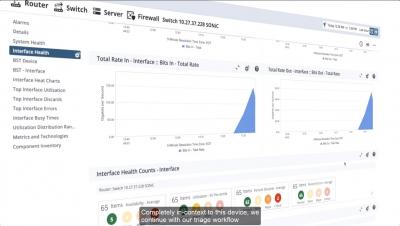
DX NetOps 20.2 Solves For Network Congestion with Industry's First AI-Driven Network Monitoring Tool

DX NetOps 20.2 network monitoring software powered by Broadcom Silicon and BroadView™ Telemetry delivers the industry’s first AI-driven, high scale operations monitoring and analytics solution. As a global infrastructure technology and software solutions leader, Broadcom provides next-generation network monitoring software that simplifies 5G, IoT, Cloud and SD-WAN deployments by applying AI and ML to the rich granular data captured at the chip level to enable a uniquely automated AI-driven solution that remediates network congestion.

Using Elasticsearch as a Time-Series Database in the Endpoint Agent

At ThousandEyes and the Endpoint Agent, we have a track record of using Elasticsearch as a time-series database for the metrics that we collect from our agents. I will be presenting how we decided to use Elasticsearch as a Time Series Database (TSDB), and how we got buy-in from stakeholders. Stathis spent several years in Athens, Greece, as a Software Engineer before moving to London. Enjoys working with large distributed systems using technologies like Elasticsearch, Kafka, Java, Kotlin. Wants to build his own tech when he grows up.