Operations | Monitoring | ITSM | DevOps | Cloud

Trace an AI SRE Agent: AURA Docker Quickstart with Phoenix and OTel

You get an answer from the agent and no way to check how it got there. The route it took is recorded, and so is the reason it gave for taking it. AURA emits OpenTelemetry spans, and the Docker quickstart wires them straight into Phoenix. Four services come up together: AURA Web Server as the persistent agent harness, LibreChat as a browser interface for chatting with the agent, Phoenix to receive the spans, and MongoDB to store stateful data for LibreChat. The Compose file arrives pre-configured to point AURA at Phoenix and to enable content recording for the local demo.

Recurring Office Hours with the AI SRE Agent Team Behind AURA

Building an agent and not sure how to approach something? Bring it. AURA office hours are recurring working sessions with the people who build it. The team has been talking to people trying out AURA and hearing the same good questions come up more than once. Office hours are the answer to that: a standing slot on a schedule, rather than one conversation at a time. The format is deliberately loose. Nobody is arriving with thirty slides to spend an hour talking at you. The session goes wherever the questions go.

Building AI SRE Agents, Part 2: Leave the Laptop, Earn Trust

Moving the agent off your machine and pointing it at real clusters — read-only, in shadow mode — then climbing a trust ladder toward carefully scoped action. This is the second article in a three-part series on taking an AI SRE agent from a weekend experiment to enterprise production. Part 1 built a local agent on a throwaway cluster: read-only, propose-only, refined against a small eval set, with portable skills and no production write access.

Why AURA Scratchpad Is Rad: Bound the AI SRE Agent Context Window

A big tool result does not have to be a big context cost. AURA moves it to disk and hands the model a pointer plus the tools to navigate what is there. A large MCP tool result can consume or overflow an agent's context window, and on a third-party server you do not control how much comes back. Scratchpad breaks the link between how big a tool result is and how much context it costs: the full output goes to disk, and only the slice the model asks for ever enters the window. Errors always pass through inline, so the model can react to them.

Multi-Agent Orchestration for SRE: AURA Runs a Model per Specialist

Give one agent every tool and every incident is a question of trust. This one hands each job to a worker that can only reach what that job needs. One AURA configuration defines a coordinator and three specialist workers. Qdrant stores the runbooks, Prometheus measures workload health, and Kubernetes provides inspection and remediation, and each of the three is wired to one worker.

Run an AI SRE Agent Entirely Inside AWS with Bedrock and S3: AURA

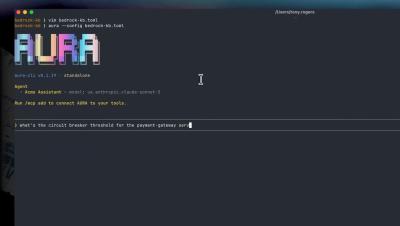
An on-call question returns the threshold and the escalation owner from your own runbooks, and the answer comes back without a call to anyone outside. AURA runs against Bedrock as its model provider, using Claude Sonnet 5 served by AWS in the same region. Authentication is the normal AWS credential chain: a profile on a laptop, an IAM role in EKS.

What an AI SRE agent actually finds when you point it at a broken Kubernetes cluster

‍ Most of the AI features that shipped into observability tools this year summarize alerts. You get a paragraph that restates the dashboard you were already looking at, and the agent never reads the cluster itself, because giving it cluster access is a security conversation nobody wanted to start. This walkthrough starts it.

No Custom Adapter: AI SRE Agent AURA Debugs Product Catalog in Dash0

The platform shows you which service is failing and which paths it touches, and stops there. Point AURA at the same telemetry and the cause comes back too. Dash0 shows the product catalog service in a failed state across the selected window, with errors on the path from the frontend service.

Kubernetes AI SRE Agent Finds a Crash Loop Nobody Asked About: AURA

You ask for a routine health check and expect a clean baseline. What came back was a pod that had restarted 788 times, unrelated to the question. AURA is connected to a Kubernetes cluster and to Prometheus through read-only MCP servers, running as one coordinator with two specialized workers. The prompt is one sentence: check the health of the cluster, and confirm whether all the pods are running. What comes back is not a baseline. AURA names the state as CrashLoopBackOff and attaches the restart count to it.

Observe Opaque Services With OpenTelemetry eBPF + proxymock

Every SRE team operates services it cannot see into: a vendor binary, an inherited legacy deployment, a container whose owning team dissolved two reorgs ago. The routes are undocumented, the dependencies are unknown, and when a request takes 130 milliseconds nobody can say whether that time is application work or a wait across a network boundary.

Toil Reduction Outside the Data Center: Lessons From the Clinical Front Office

Ask an operations team where the week went, and you'll usually get a list of things that shouldn't have needed a person. Access requests provisioned by hand. A disk cleared for the ninth time this quarter. Certificates rotated one at a time because the renewal script was scoped, estimated, and never finished. None of it is difficult, and all of it is necessary. And at the end of the quarter there's nothing to point at, because the work left no trace beyond the absence of an outage.

Free Open Source AI Agent for SRE and More: Why We Give AURA Away

Wondering what the catch is on a free, vendor-backed agent? There is not one in the license. AURA stays Apache 2, fully capable, and free to run. If you are weighing an open source tool with a company behind it, the first question is what the catch is. You have seen the project that turns out to be open core, or that is quietly hindered in one key way. This is Mezmo's answer for AURA.

Install an AI SRE Agent in Kubernetes with AURA and Helm

AURA does not have to live on your laptop. Install it into the cluster with Helm and it is still there the next time something breaks. AURA is a fully open source AI agent built specifically for SRE work. Rather than one general assistant, you configure workers: separate agent roles, each scoped to a job like inspecting the cluster.

What your AI SRE can't see (and what you can do about it)

AI SRE is having a moment. The category pulled in massive funding rounds over the last two years, Gartner published its first market guide, and vendors are promising everything from 90% faster resolution to fully autonomous incident response. If you run an engineering organization, someone has probably pitched you an AI SRE in the last quarter. And let’s be honest: faster triage, less alert fatigue, and automated frontline response are wins for understaffed teams.

SRE Agent Enhancements: Faster Triage, Greater Access Controls, Deeper System Connectivity

This blog post is part of PagerDuty’s ongoing series on how we’re helping customers navigate their journey towards autonomous operations. Read on to learn about how recent SRE Agent Enhancements build towards this vision. During an incident, everything is competing for attention at once. Responders lose time swiveling between tools, insights gathered by AI stay siloed instead of feeding into the next decision, and the pressure to move fast means learnings rarely stick.