Operations | Monitoring | ITSM | DevOps | Cloud

The latest News and Information on Incident Management, On-Call, Incident Response and related technologies.

Scaling Agentic ITOps: From AI pilots to autonomous IT operations

For enterprise IT leaders, the question is no longer whether AI agents can help run IT operations, but how to scale them beyond pilots and into the everyday work of keeping the business online. It’s no coincidence that this year’s Gartner IT Infrastructure, Operations & Cloud Strategies Conference (IOCS) opens with a keynote dedicated to scaling agentic AI to enable autonomous IT operations. At BigPanda, we’ve seen a shift from the ITOps leaders we work with every day.
Featured Post

From Signal to Action: Instrumenting Decision Latency in Kubernetes Incident Response

An alert fires. Checkout latency has crossed an error-budget threshold, the Prometheus rule is correct, and the page reaches an on-call engineer in under a minute. Then recovery stalls while the responder works through different questions. Which rollout changed? Who owns the failing path? Is the payment dependency degraded? Is rollback safe? Who needs to approve it? How do we know the system recovered?

7 weak points in your delivery model to fix before your next audit or outage

An auditor asking for evidence of your deployment process and an incident review asking what went wrong are asking about the same things. The difference is timing. One catches the weak point before it costs you anything. The other catches it in the middle of an outage, with a customer on the phone.

What Does AI Need to Know Before You Trust It? | AI SREDo you like this personality?

AI can make decisions. But can it make the right ones across your entire IT environment? For enterprise SRE teams, trustworthy AI requires three things: operational context, institutional memory, and guardrails. Without them, autonomous action becomes a risk instead of an advantage. In our latest webinar, we explore what it takes to bring AI SRE capabilities to enterprise scale.

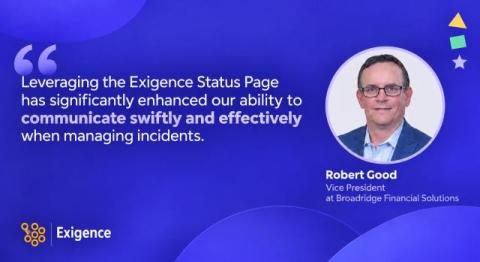
How Broadridge is transforming incident communications with targeted status pages

When an incident impacts thousands of users across multiple products, one-size-fits-all communication simply doesn't work. External and internal stakeholders want transparency, not information overload. Too much information can create as many problems as too little. For global financial technology leader Broadridge, managing incident communications across multiple clients, products, and internal stakeholder groups with precision was critical.

The October 20, 2026 Google Cloud europe-west2 Outage

Multiple Google Cloud services in europe-west2 (London) experienced service disruptions, elevated error rates, API timeouts and processing latency on October 20, 2026, according to Google's incident page. Google's preliminary incident report records the start at 23:00 US/Pacific on October 19, 2026 (06:00 UTC on October 20) and the end at 05:10 US/Pacific on October 20 (12:10 UTC) - 6 hours 10 minutes.

A walkthrough of a root cause analysis with ilert AI SRE

It's 3am and a complaint has made its way to you: customers can't see product reviews. Nothing has crashed, and no alert points anywhere useful. Somewhere in your stack one service is failing, and the one showing the error is probably not it. Before you can fix anything you have to find it, and that search is most of your night. Now imagine you open the laptop, type one sentence and go grab a coffee. By the time you’re back, the root cause is ready, evidence attached. Your job is to check it.