Operations | Monitoring | ITSM | DevOps | Cloud

IBM Warranty Check: How to do it And How to Automate it

An IBM warranty check sounds like a ten second task: type in the serial number, read the expiration date. In practice, a lot of people hit a sign in screen or a result telling them the machine cannot be found. The reason is rarely the serial number itself. Most hardware that people still call IBM is serviced by Lenovo today, so half of these lookups happen on the wrong website.

MSP Ticketing System: How to Evaluate and Choose the Right Platform

Most managed service providers do not replace their ticketing tool because ticket volume got too high. They replace it because a client asked for a report the tool could not produce. That moment usually arrives between the third and tenth client. The shared inbox and the general help desk that carried you this far stop holding the accounts apart. Per-client reporting is usually the first thing to give way. An MSP ticketing system takes support requests from every client you serve.

The Essential Eight: Patching Applications and Operating Systems at Maturity Level Two

Why do so many patching programs pass every internal check and still come back from an Essential Eight assessment rated at Maturity Level One? The answer is rarely speed. Teams that miss the mark are usually patching their servers, browsers, and office suites on schedule, then losing the rating on the fifty applications nobody put on a list. Maturity Level Two is where the Essential Eight stops asking how fast you patch and starts asking how much you can see.

PCI DSS Requirement 10: Logging and Monitoring in v4.0.1

Version 4.0 renumbered PCI DSS Requirement 10 from end to end, and the Council retired v3.2.1 on 31 March 2024. Sub-requirement numbers written before then mostly point somewhere else now. Four more Requirement 10 rules changed status on 31 March 2025, automated log review among them. Checking your numbering against v4.0.1 costs an afternoon and saves a finding. In this blog, you will: PCI DSS Requirement 10 covers audit logging and monitoring across the cardholder data environment.

ITSM for Healthcare: IT Service Management in Hospitals and Health Systems

How long does a nurse stand at a workstation waiting for a record to load before the ward gives up and reaches for paper? In most hospitals nobody measures that number, and the ticket that reaches IT describes a symptom instead of a cause. Hospital IT support runs on a different clock from corporate IT. There is no quiet Sunday night and no safe window for maintenance.

Log Filtering: How to Cut Log Ingest Volume Without Losing Evidence

Every log estate reaches a point where volume grows faster than the value inside it. The usual response is to find the biggest source and drop it. Cutting volume is the easy part. Cutting the right half takes judgment. Log filtering is only one of four options for an expensive source, and the other three matter just as much. In this blog, you will: By the end you can defend every rule you write, including the ones that keep data. A volume cut fails in two directions.

Agent vs Agentless Monitoring and How to Decide What Goes Where

Why does half the infrastructure end up returning no monitoring data? The standard plan is to install collection software on everything, which moves quickly across servers and stops dead at the first device running closed firmware. Storage arrays, firewalls, and switches will never accept an install, and the rollout stalls there. That plan usually gets set once for the whole environment, with a single collection model applied to hardware it was never suited for.

Help Desk Software for Schools: Managing IT Support Across Campuses

How many support requests reach school IT staff each week without ever becoming a ticket? A teacher stops a technician in the corridor about a projector that will not connect. An office administrator sends a direct email about a locked account, and a student tells the librarian their laptop stopped charging during second period. Help desk software for schools collects those requests into one queue, routes them by site and category, and keeps a record of what was done.

10 Top Website Monitoring Tools for Uptime, Page Speed and Real User Data

Your uptime tool reports the site as available all month. Support reports something else, because customers in one region spent the morning unable to complete a checkout. Both records are accurate, and that is the problem. An external check confirms the page answered. It cannot tell you that the answer took nine seconds for everyone routed through one CDN edge, or what caused the delay.

ITSM Maturity Model: The 5 Levels And Where AI Fits at Each One

An ITSM maturity model is a practical framework for measuring where your Service Management stands across people, processes, technology, and governance, then turning that baseline into a prioritized improvement plan. Most models describe five levels — from ad hoc to optimized — with clear characteristics and outcomes at each stage. This guide explains the levels, how to assess your current state, how to map capabilities to ITIL 4 practices, and actionable steps to get started.

PII Redaction in Logs: Mask, Redact, Hash, or Drop?

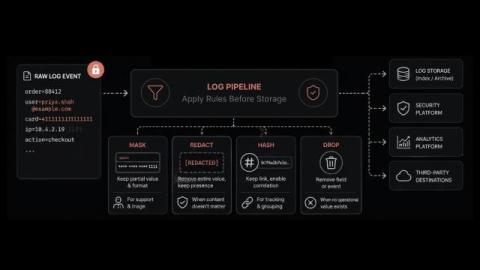
Sensitive values reach your logs without anyone deciding they should. A debug line prints a whole request object. An error message carries the query string. A customer email address is suddenly stored in three systems. PII redaction in logs then gets treated as one setting to switch on. In practice it covers four separate treatments. The value is already inside the message before log ingestion finishes. In this blog, you will: By the end you can write a rule for each field and defend it.

Log Processing: What Happens to a Log Line Before You Can Search It

A log line arrives as plain text and leaves as a record you can query. Six steps sit between those two states. Each one adds something useful, and each one costs you time, CPU, or storage. Most teams never look at that chain until a search comes back empty. Here is what log processing does to an event, step by step: By the end you can look at your own chain. You will know what each step buys you. Six steps turn a raw log line into a searchable record.

How Logicalis Scaled Security Operations with Autonomous Endpoint Management

Learn how Logicalis, a global technology service provider, partnered with Ivanti to transform their IT operations. Discover how they leveraged automation and Ivanti Neurons to streamline workflows, reduce manual intervention, and deliver exceptional service at scale. Key Highlights: How Logicalis simplified complex global IT environments. The role of automation in improving service delivery and response times.

How NIST Compliance Turns Observability Data Into Audit Evidence

Can you prove, on demand, which production systems were under continuous monitoring last quarter? Buyers, auditors, and insurers all ask a version of that question, and the answer decides contracts as often as audit findings. NIST compliance means aligning security controls and operations with standards from the National Institute of Standards and Technology, then holding evidence that the alignment stayed continuous. The frameworks are precise about outcomes and quiet about mechanics.

Best Storage Monitoring Software: 10 Tools Compared

Storage rarely fails loudly. A pool fills. Latency climbs on one LUN. The first to notice is a user whose application timed out. The best storage monitoring software catches it earlier. It watches capacity, IOPS, latency and drive health across your arrays, which is what storage resource monitoring is for. In this blog, you will see: By the end you will know which one fits. Storage monitoring software tracks the health, capacity and performance of your IT storage.

The invisible challenge that kills IT projects

The verdict on enterprise AI is starting to sound familiar: It didn't deliver. But the real question is: Did we ever define what deliver meant in the first place? If success was never tied to measurable business outcomes, AI was always going to fall short, no matter how capable the technology was. Before the next budget cycle dismisses AI, ask whether the problem is the technology or the lack of clear success metrics.

InvGate Updates: AI Hub Reports, VSA in Slack, Asset Leasing and more

New updates are now available across InvGate Service Management and InvGate Asset Management. Watch the video for a quick look at our latest additions, including the AI Hub Reports to measure your Virtual Service Agent’s performance and the ability to interact with the Virtual Service Agent directly within Slack. We’ve also introduced an asset-based lease cost model for hardware contracts and added granular control over location and people access permissions by role.