Operations | Monitoring | ITSM | DevOps | Cloud

New in Skylar One - Kyoto: Helping IT and Business Teams Focus on What Matters Most

When technology works, businesses thrive. Employees stay productive, customers stay connected, and critical services keep running. But when something goes wrong, the real challenge is not only detecting the issue. It is understanding what it affects, who may fell the impact, and how urgently the business needs to respond. That is the value behind the Kyoto release. The latest Skylar One update helps teams better connect IT health to business impact.


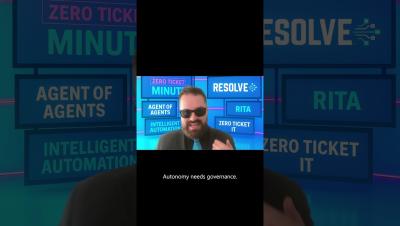
Never Touch Another IT Ticket Again | AI That Resolves IT Issues Automatically

What if your IT team never had to touch another password reset, VPN issue, or software request? This hilarious commercial imagines a world where IT tickets resolve themselves. See how agentic AI automates password resets, access requests, VPN troubleshooting, software installs, and more, so your service desk can focus on higher-value work instead of repetitive tickets. Resolve's AI-powered platform helps enterprises reduce ticket volume, improve first contact resolution, lower ITSM costs, and move toward Zero Ticket IT with autonomous resolution.

What if AI could resolve your IT tickets before they're ever created?

Watch how agentic AI automates password resets, VPN troubleshooting, access requests, software installations, and other repetitive IT service desk tasks without human intervention. Resolve helps enterprises reduce ticket volume, lower ITSM costs, improve employee experience, and move toward Zero Ticket IT. If you're researching AI for IT support, ServiceNow automation, ITSM automation, autonomous IT operations, or AI service desk solutions, this Short shows what's possible.

Mission-Critical Data Orchestration with Agentic AI | Automated SFTP, DataOps & Workflow Automation

How do you automate mission-critical data pipelines without risking downtime? In this Resolve Reels episode, see how Resolve's Agentic Automation Platform enables DataOps teams to build resilient, end-to-end workflows that automate secure SFTP transfers, preflight system validation, database operations, exception handling, intelligent retries, and self-healing remediation.

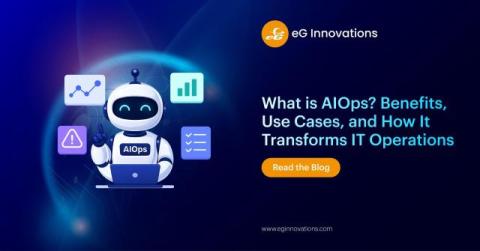
What is AIOps? Benefits, Use Cases, and How It Transforms IT Operations

Decades ago, IT operations was relatively simple, with a few components such as client, server, network, and the static environments. IT teams relied on manual analysis to manage these systems. Over time, however, IT operations has evolved significantly, driving the adoption of AIOps technologies.

Designing the Operational Architecture for Continuous SLA Exposure Governance

Organizations seeking to reduce SLA volatility often attempt incremental enhancements to existing monitoring stacks. While additional analytics layers may improve telemetry visibility, exposure governance cannot function effectively when data, service context, and execution capabilities remain fragmented. Treating exposure management as an add-on capability limits its ability to protect across interdependent systems in real time.

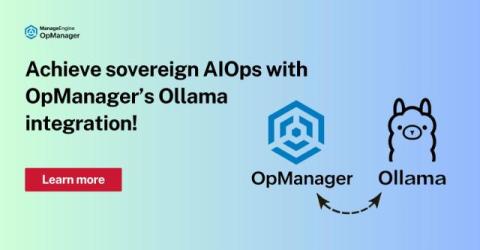
Achieving sovereign and secure AIOps with Ollama and OpManager

Enterprise IT networks power business operations across the world. As businesses scale to catch up with an increasingly-demanding user base, networks also grow more complex. IT teams managing these networks have to monitor more data than before, under more stringent SLA terms, with little room for failure. Trying to do this manually across thousands of devices can take a lot of time and effort, and are prone to errors.

6 use cases for agentic AI in major IT incident management

Enterprise IT operations leaders are realizing that legacy incident management processes cannot keep pace with today’s sprawling, hybrid-cloud enterprise environments. Enterprise IT doesn’t look anything like it did even five years ago. Hybrid cloud architectures, distributed microservices, and increasingly rapid CI/CD cycles have increased the speed and complexity of IT operations by orders of magnitude, leaving ITOps teams struggling to keep up.

How High-Performance IT Organizations Prevent SLA Exposure Before It Becomes a Customer Disruption

Over the past decade, significant progress has been made in incident detection and response across enterprise IT environments. Observability platforms, event correlation engines, and AIOps capabilities have measurably reduced mean time to detection and mean time to resolution. Operational teams are better equipped to identify anomalies, triage alerts, and coordinate remediation across increasingly complex architectures.

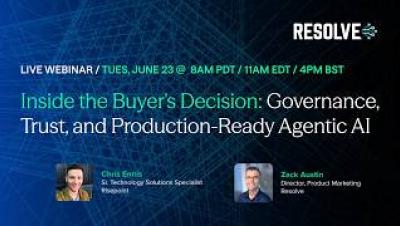
Inside the Buyer's Decision: Governance, Trust, and Production-Ready Agentic AI

Why do so many AI pilots succeed in testing but fail to reach production? In this webinar, Resolve and IT leaders from RisePoint explore one of the biggest challenges facing enterprise AI adoption today: trust. While organizations are investing heavily in AI agents and automation, many initiatives stall before deployment due to governance concerns, compliance requirements, risk management, and lack of operational visibility.

Platform Confidence Is the Prerequisite for Modernization Speed

Over the last year, one theme has consistently emerged in conversations with customers: organizations want to move faster, but not at the cost of the operational stability their business depends on. Whether the discussion is about modernization initiatives, automation programs, AI adoption, or platform upgrades, the underlying challenge is often the same. IT leaders are under pressure to deliver innovation while maintaining stability.

Why ITSM Still Isn't Solving Tickets (And What Comes Next)

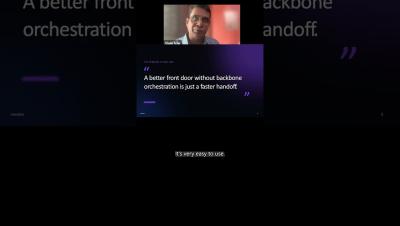
Most ITSM platforms make it easier to submit tickets. They don't make it easier to resolve them. As we said in our webinar: "A better front door without backbone orchestration is just a faster handoff." The future of IT isn't faster ticket creation. It's autonomous ticket resolution powered by AI, automation, and orchestration.

The Illusion of Control: Why Dashboards Do Not Equal SLA Protection

Modern operations teams work within a constant stream of dashboards, status summaries, and health indicators that turn complex environments into organized visual displays. Large screens show color-coded service conditions. Executive reports quantify uptime. Observability platforms map system dependencies across cloud, hybrid, and distributed architectures. This visual structure creates a sense of order. In environments defined by constant change, that sense of order can feel like control.

AI Agents Are the New Employees: The Identity & Security Crisis Enterprise IT Must Solve

As AI agents become more autonomous, enterprises face a new challenge: How do you secure a workforce that isn't human? In this episode of Agents of IT, Fran Fernandez, Zach Austin, and Ian Coppock explore the growing identity and security challenges surrounding Agentic AI. From permissions and governance to digital identities and access controls, the team breaks down what enterprise leaders need to know before deploying AI agents at scale.

Visibility Isn't Reliability: Why Observability Alone Cannot Protect SLAs

Over the past decade, enterprises have invested heavily in observability platforms designed to deliver comprehensive insight into increasingly complex environments. Modern systems generate continuous telemetry across infrastructure, applications, networks, cloud services, and third-party dependencies. Metrics, logs, traces, and topology maps now provide a level of technical transparency that would have been difficult to imagine only a few years ago.

Building More Resilient Multi-Cloud Operations

The last post in this series looked at how disconnected alerts can slow incident response and how stronger correlation helps teams investigate issues with more clarity. That same operational context has value beyond triage. It also plays an important role in resilience, service assurance, and the ability to maintain confidence across increasingly complex multi-cloud environments. Resilience depends on more than reacting well during an outage.

How Skylar MCP Gives Agentic Workflows the Operational Context to Act With Confidence

AI models can reason over language, summarize findings, and explain patterns. What they cannot do on their own is see the real-time operational state of your environment. Ask a model about a critical incident and it will answer from whatever context it is given, which means the answer is only as trustworthy as the input. In operations and compliance workflows, an answer is only useful if it is grounded in current service context and governed access to the systems that define reality.

Proactive Alerting with AIOps

Modern IT environments generate huge volumes of telemetry across infrastructure, applications, cloud services, and networks. Teams now have more data than ever, but that does not automatically lead to better decisions. In many organizations, the real problem is no longer visibility alone. It is the ability to identify which signals matter, understand what they mean, and respond before users or business services are affected.

Seven Straight Years of Verified Customer Trust

Seven years ago, our customers started telling the world what the ScienceLogic AI Platform does for their operations. They haven’t stopped. For the seventh consecutive year, that steady stream of verified customer reviews has earned the ScienceLogic AI Platform a TrustRadius Top Rated award, again. Seven years in a row shows that customers keep choosing to share their experience because the platform keeps delivering value. This recognition doesn’t come from us.

What Is Enterprise Service Management (ESM)? Explained

Enterprise service management (ESM) applies the proven model of IT service management, catalogs, workflows, self-service, and SLAs, to the whole business: HR, facilities, finance, and more. Here is what it is and how it works. What is enterprise service management, and how is it different from ITSM? In this explainer we define ESM, show how it works across departments, clarify how it builds on IT service management, and cover the mistake most teams make: copying IT ticket forms instead of orchestrating work across teams.

Incident Prevention & Incident Assistant Demo - The best incident is one that never happens

The best incident is one that never happens. The BigPanda team recorded a live demo of the AI Incident Prevention & AI Incident Assistant as part of ITSM Week, hosted by the Service Desk Institute. ITSM teams are measured by how effectively they prevent disruption. Yet many teams still spend too much time reacting to noisy, low-context incidents after impact has already begun. Watch this on-demand session to learn how leading organizations are moving beyond manual firefighting to autonomous operations with Agentic AI.

Turning Disconnected Alerts into Actionable Insights

The previous post in this series focused on shared context and why hybrid operations depend on a connected view across cloud, network, and infrastructure. Once that context is in place, the operational benefits become easier to see—especially during incident response, where signal volume and fragmented tooling can slow teams down. Alert noise remains one of the most persistent challenges in hybrid environments. Every layer of the stack can generate its own warnings, anomalies, and service events.

AI Agent Governance: The Missing Piece of Autonomous IT

AI agents are making decisions, accessing systems, and resolving issues autonomously. But as organizations deploy more agents, one challenge becomes impossible to ignore: governance. Who has access? What changed? Who is accountable? The future of Autonomous IT requires autonomy with accountability.

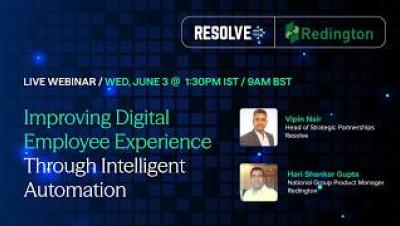
Improving Digital Employee Experience with Intelligent Automation | Reduce IT Tickets by 70%

Are your employees still waiting hours or days for IT issues to be resolved? Many organizations have invested heavily in ITSM platforms, self-service portals, and chatbots. Yet service desks continue to struggle with growing ticket volumes, rising costs, slow resolution times, and poor digital employee experiences. In this webinar, Resolve and Redington explore why traditional service management approaches often stop at ticket creation instead of ticket resolution, and how intelligent automation is helping enterprises move toward a Zero Ticket IT model.

How IT Teams Can Start Their AI Automation Journey | Agentic AI, ITSM & Zero Ticket IT

How should IT leaders approach automation and AI? Where should they start, and how can they drive measurable results without getting caught up in the hype? In this episode of Agents of IT, Fran Fernandez and Zach Austin sit down with Chris Ellis, Senior Technology Solutions Specialist at RICOne, to discuss practical IT automation strategies, agentic AI, service desk transformation, and the journey toward autonomous operations.

What Enterprise AI Gets Wrong About Usage

AI is moving out of the experimental phase and into the everyday rhythm of work. Teams are no longer using it occasionally for novelty or quick wins, but instead are exploring more robust use cases to investigate issues, answer questions faster, surface context, and help them move through complex workflows with more confidence. That’s the shift that most organizations’ leadership teams have been asking for.