Operations | Monitoring | ITSM | DevOps | Cloud

Demo Roundups! Breaking the MTTR Bottleneck: Automating Diagnostics for Modern Incident Response

Discover how PagerDuty Automation eliminates the manual triage bottleneck that's slowing down your incident response. In this demo, you'll see how automating diagnostics can compress resolution times from hours to minutes by instantly analyzing your environment, correlating events across systems, and identifying root causes with transparent AI reasoning.

What is Automated Incident Response

While writing our 2024 recap, we found that teams handled over 2.2 million new incidents. Critical incidents alone tripled, increasing from 3,000 in 2023 to 9,200 in 2024. Dealing with such a large volume of incidents is not an easy task. And dealing with them manually is definitely not easy. Your valuable time goes into routine tasks like creating tickets, setting up war rooms, and notifying stakeholders. These keep you from fixing the actual problem.

Understanding Incident Response vs Incident Remediation

At a high level, incident remediation is a part of the incident response process. An Incident response plan manages the incident lifecycle across planning, detection, investigation, and recovery. Meanwhile, incident remediation focuses on identifying root causes and implementing measures to prevent future occurrences.

Incident Response for DevOps, SREs, and IT Teams

That 3 AM alert is never fun. Your heart races as you try to figure out what broke this time, and how fast you can fix it. But with an incident response in place, that panic turns into a calm, step-by-step fix. It helps you handle everything, from a server crash to a security breach, in an organized way. In this guide, I’ll walk you through what exactly an incident response is, why you need it, its key components, and how to build one.

9 Best Incident Response Tools (Plus 4 Open-Source Options)

I’ve curated a list of 9 best incident response tools, plus 4 open-source options for you. But first, a quick note: Many people mix up alerting, monitoring, and incident response. Incident response is what you do after receiving an alert. It includes alert acknowledgment, escalations, incident communication, post-incident analysis, and response automation. Yes, some of these (incident communication and post-incident analysis) overlap with incident management.

From Alert to Answer in Seconds: Accelerating Incident Response in Dynatrace

It is 12PM and you just start eating lunch when your phone starts buzzing. A storm of different monitoring and system-level alerts start stacking up on your phone and slack. The incident response "war room" opens and downtime communications are being drafted to customers. Your team is under pressure to find the root cause, but you are immediately hit with roadblocks.

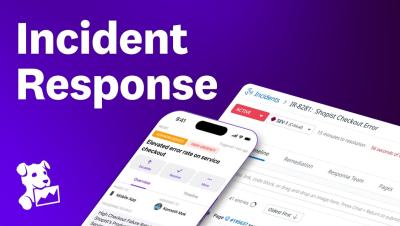
Datadog Incident Response: Unify remediation and communication

With Datadog's new AI voice agent in Incident Response, you can quickly get up to speed on the issue and start taking action directly from your phone. Handoff notifications make it easy to jump straight to the relevant context and quickly communicate with other responders. Finally, our status pages enable you to automatically update users on your remediation progress.

Introducing Live Call Routing for Incident Response

Today, we are introducing Live Call Routing, a direct phone line that connects incoming calls to on-call engineers. It captures human-reported incidents that monitoring tools might miss—closing the loop between automated alerts and real-world observations so nothing falls through the cracks. It helps you respond to critical incidents faster by eliminating manual call routing, reducing response times from minutes to seconds.

How to Strengthen Your Security Operations with Incident Response Software

When our organization – a mid-sized, fast-scaling technology company specializing in enterprise service management solutions, serving clients in regulated industries like finance and healthcare – faced its first serious cybersecurity breach in early 2024, we realized our incident response management approach wasn’t just outdated – it was putting the business at risk. Back then, we had alerts. We had logs.

How to Implement Robust BEC Protection and Avoid Financial Losses

When it comes to cyber threats, Business Email Compromise (BEC) continues to be one of the most financially devastating that many organizations face across the globe. The complexity of these schemes and their targeted nature means BEC is a real threat to organizations of all sizes. Strong BEC protection is necessary to avoid expensive financial loss and protect sensitive data. This article provides practical advice and insights on how to build effective countermeasures against BEC threats.