
Operations | Monitoring | ITSM | DevOps | Cloud

From Plan to Practice: Strengthen Incident Response with Tabletop Exercises

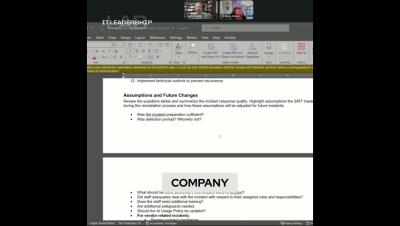
N-able Head Nerd Lewis Pope explains how Managed Service Providers (MSPs) and IT teams can use cybersecurity tabletop exercises to improve incident response readiness. Learn how to design, facilitate, and get business value from these exercises -plus access free CISA and N-able resources to help you get started. Watch now to strengthen your team’s response before the next cyber incident hits.

Incident Management and Response

In this video, discover how Cortex transforms incident management by automating key processes, reducing response times, and providing real-time visibility into your engineering ecosystem. With seamless integrations and AI-powered insights, Cortex helps teams go from reactive to proactive, improving reliability and accelerating recovery.

We Built an SRE Agent With Memory And It's Transforming Incident Response

If you feel like your incidents are multiplying while your stack gets more complex by the week, you’re not alone. Event volumes keep climbing, signals live in a dozen tools, and human responders are stretched thin. That’s exactly why we built the PagerDuty SRE Agent—a vendor‑agnostic AI teammate that improves with every response to make the next one faster, smarter, and more reliable.

PagerDuty Incident Responder custom agent for Github is now Generally Available!

This custom agent in GitHub’s AI ecosystem gives users access to PagerDuty data (including change correlation, incident data, and more) directly in GitHub Copilot, saving time from context switching for faster resolution. The agent can help users analyze incident context, identify recent code changes, and suggest fixes via GitHub PRs. Learn more about PagerDuty’s MCP capabilities for GitHub and other tools here.

Bring incident response to AI stack with ilert's MCP Server

ilert’s engineering team has developed an open Model Context Protocol (MCP) server that enables AI assistants to securely interact with your alerting and incident management workflows, from determining who is on call to creating incidents. In this article, we provide a simple explanation of MCP, outline the reasons behind our investment in it, describe the high-level architecture, and explain how to connect Claude, Cursor, and other MCP clients to ilert today.

What Is Incident Response Lifecycle?

The Incident Response Lifecycle is a step-by-step process that helps engineering teams detect, respond to, and recover from unexpected system disruptions or outages. It includes a series of six practical stages: Detection, Analysis, Impact Mitigation, Incident Resolution, Service Restoration, and Post-Incident Analysis. By following this lifecycle, teams can minimize downtime, reduce business impact, and continuously strengthen system reliability.

Why Multi-Layered Bot Detection Is Crucial for Modern Online Security

Malicious bots have evolved far beyond simple automated scripts. They now operate at scale, mimic human behavior, and bypass traditional security systems. These sophisticated threats target businesses of all sizes, from global e-commerce platforms to SaaS applications and financial institutions. A single layer of defense is no longer enough. Multi-layered bot detection strategies combine technology, analysis, and adaptive measures to safeguard digital environments against evolving threats.

Why a Cyber Fusion Center Is Essential for Cloud-First and Remote Work Environments

A cyber fusion center brings together security operations, threat intelligence, and incident response under one roof. Instead of teams working in silos, it encourages constant collaboration between analysts, engineers, and business units. This model shifts security from a reactive approach to a proactive one, anticipating risks before they spiral out of control.

My Criteria for Automated Incident Response Tools

Managing incidents manually isn’t realistic when their number keeps growing. That’s where automated incident response tools come in. They handle routine tasks so you can focus on actual problem-solving. In this blog, I’ve put together a list of the 9 best automated incident response tools for you. I looked at each one based on four key areas of the incident response process. This will help you see how they handle everything from start to finish.