Operations | Monitoring | ITSM | DevOps | Cloud

The latest News and Information on Containers, Kubernetes, Docker and related technologies.

Securing Kubernetes using Egress Access Controls

A majority of existing workloads are non-Kubernetes, and for the platform teams involved, this creates challenges because the cluster will need to be securely connected to those resources. Calico Enterprise includes several features that enable fine-grained access controls between your microservices and databases, cloud services, APIs, and other applications that may be protected behind a firewall. There are different approaches to managing Kubernetes egress access, depending on your needs and where you want the control point to be

Kubernetes Namespaces: A Practical Guide

Kubernetes namespaces enable you to organize cluster objects, such as applications, devices and variables. Once you define namespaces, you can use this classification to filter, group and manage objects. You can use the same namespaces in duplicated environments and apply policies to specific clusters segments. Kubernetes namespaces are also important for defining roles and ensuring proper access configuration. If you're monitoring Kubernetes, you should try out MetricFire.

Ensuring a smooth Kubernetes Dockershim Deprecation with Chaos Engineering

Trying to improve the reliability of your Kubernetes deployment? Start with these 5 chaos experiments. Kubernetes 1.20 is scheduled to be released next week, and this version contains a number of amazing enhancements including graceful node shutdown, more visibility into resource requests, and snapshotting volumes. But the change generating the most buzz is the deprecation of Docker as a container runtime.

What is Cloud-Native Storage?

Cloud-native is the ultimate buzzword lately. So, is “cloud-native storage” just an attempt to grab on to this concept, hoping for a little boost? Actually, there is something more to it, and I’ll unpack that here. The premise of cloud-native storage is simple: its native habitat is a Kubernetes cluster. When we design with the assumption that a technology will exist in Kubernetes, we get to look around and see what functionalities already exist in that system.

How to switch the Docker container runtime to containerd with Charmed Kubernetes

This article describes how easy it is for users of Charmed Kubernetes to switch from the Docker container runtime to containerd. You may have heard that Kubernetes is deprecating Docker as a container runtime after v1.20. Docker as an underlying runtime is being deprecated in favor of runtimes that use the Container Runtime Interface(CRI) created for Kubernetes, such as containerd.

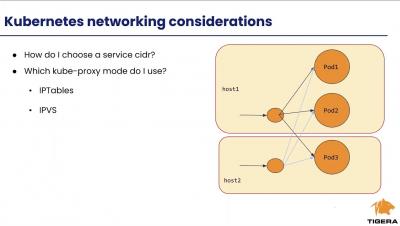
Deploying Calico in Your On-prem Kubernetes Cluster: Networking and Security Considerations

If you are deploying Kubernetes on-premises in your datacenter, this is a talk and demo you won’t want to miss. Networking and security might not be the first things that come to mind, but without some understanding of the networking and security decisions you’ll need to make, and the right options for your environment, you’re likely to get stuck or make the wrong assumptions. These may limit your ability to scale or integrate with the rest of the datacenter network.

Your team is running containers, but are they secure?

Organizations are modernizing IT infrastructure, restructuring teams, and accelerating application delivery with containers and Kubernetes. As with any technology, organizations are at various places within their journey. However, according to Gartner, more than 75% of global organizations will be running containerized apps in production by 2022. Chances are your team is using containers for some applications.