Operations | Monitoring | ITSM | DevOps | Cloud

The latest News and Information on DevOps, CI/CD, Automation and related technologies.

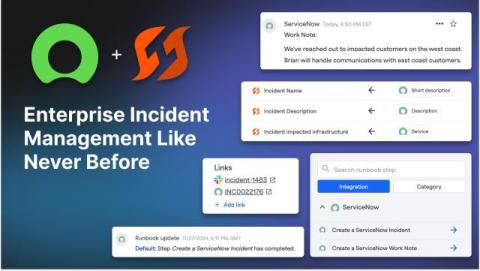
Copied Press Release: FireHydrant Acquires Blameless to Further Solidify Enterprise Market Leadership

The addition of Blameless' enterprise capabilities combined with FireHydrant's platform creates the most comprehensive enterprise incident management solution in the market.

Elevating Developer Productivity with Speedscale Ephemeral Environments

Speedscale leveraged Ephemeral / Preview Environments to help balance developer productivity and high-quality code by dynamically spinning mini-staging environments up and down on command for experimentation and deployment safety. The primary goals of the project were to reduce cloud infrastructure operating costs and increase deployment frequency. Benefits included speed, resource efficiency, and improved collaboration.

How Cloud-Native Artifact Management Can Facilitate the Move to Platform Engineering

In this session we will explore why prioritizing artifact management is essential in advancing to self-service IDPs and how adoption of Cloudsmith offers solutions to common challenges such as high infrastructure costs, managing security vulnerabilities, and maintaining productivity. Attendees will gain insights into best practices of implementing an artifact repository at the center of their CI/CD pipeline.

How does Git work?

If you're like me and have less than twenty years of software engineering experience, the thought of a world without Git doesn't seem possible. When I started to research for this post, I almost fell out of my chair when I read that Git was created in 2005. It doesn't seem that long ago... either that, or I'm simply getting old. When I started programming, I asked myself a question I sometimes still ask myself today - How does git work? I often find myself being scared of certain Git commands.

Using K8S But Not Overhauling Your Devops Processes

Kubernetes is now the industry standard for cloud-based organizations. Slowly, many enterprises and mid-level companies are adopting it as the default platform for managing their applications. But we all know Kubernetes adoption has its challenges, as well as its associated costs. How do we decide when and what to migrate to Kubernetes? Does migrating to Kubernetes mean overhauling all DevOps processes? Adopting K8S should not lead to an overhaul of your DevOps process - it should complement it.

How to monitor your Kubernetes metrics server

In this article, we will examine a Kubernetes metrics server and its uses. We will also learn how to set one up and use it to monitor Kubernetes metrics. Finally, we will explore using Hosted Graphite by MetricFire to monitor Kubernetes metrics. To easily get started with monitoring Kubernetes clusters, check out our tutorial on using the Telegraf agent as a Daemonset to forward node/pod metrics to a data source and use that data to create custom dashboards and alerts.

Building On-call: Our observability strategy

At incident.io, we run an on-call product. Our customers need to be sure that when their systems go wrong, we’ll tell them about it—high availability is a core requirement for us. To achieve the level of reliability that’s essential to our customers, excellent observability (o11y) is one of the most important tools in our belt. When done right, observability improves your product experience from two angles.

Network Management: Definition, Best Practices, and Tools

The efficiency of your IT infrastructure can make or break your business, specially in the IT world. At the core of this infrastructure lies Network Management (NM)—a critical process that ensures your network operates smoothly, securely, and efficiently. Whether you're managing a small office network or a sprawling enterprise system, understanding NM is key to maintaining optimal performance and security. But what exactly does Network Management involve? And why is it so important?

3 Key Strategies for End-to-End DevOps Automation

DevOps automation is essential for speeding up delivery, minimizing errors, and boosting team collaboration. But selecting the right approach can make or break your organization’s agility and scalability. Let's break down three key approaches—DIY with Infrastructure-as-Code (IaC), Platform-as-a-Service (PaaS), and DevOps Automation Platforms—so you can identify the best strategy for your needs.