
How to Save 6 Hours Weekly with Stripe Salesforce Integration

Growth creates opportunities, but it also exposes inefficiencies.
Consider an organization preparing for a major expansion. More customers are expected to join, transaction volumes are increasing, and multiple teams will need access to the same customer and payment information. Existing processes may seem manageable today, but growth often reveals a challenge that many organizations overlook: critical data is spread across multiple systems.
This scenario closely reflects the challenge faced by The Learning and Performance Institute (LPI), a global authority on workplace Learning & Development. As the organization prepared to relaunch its membership program, it needed to connect Salesforce, where member relationships were managed, with Stripe, where payments were processed. Without an integration, subscriptions required manual updates across both platforms. Teams had to switch between Salesforce and Stripe to reconcile payments, track membership status, and manage renewals. As membership numbers increased, these manual processes risked slowing operations and taking valuable time away from more important work.
This challenge is becoming more common as businesses rely on a growing number of applications. According to MuleSoft’s 2026 Connectivity Benchmark Report, organizations must balance 957 applications, rising to 1,057 for those furthest along in their agentic journey, and only 27% of those applications are connected. As businesses add more systems to support different functions, important customer and revenue information can become fragmented across platforms.
At first, the impact may seem small. Someone checks payment information before contacting a customer, another updates a customer record after reviewing a transaction, and a manager combines data from multiple reports. Individually, these tasks take only a few minutes, but repeated across hundreds of interactions, they become a significant source of administrative work.
The scale of payment activity makes this challenge increasingly important. Businesses using Stripe generated $1.9 trillion in total payment volume in 2025, showing how much payment data is now part of everyday customer and revenue processes. However, when payment information and customer data remain separated, teams often spend additional time switching between systems, checking records, and manually updating information.
In this article, we'll explore why disconnected payment and customer data creates extra work, where operational inefficiencies typically appear, and how Stripe Salesforce integration can help growing organizations improve visibility and reduce repetitive processes.
How disconnected systems affect different teams
The impact of disconnected payment and CRM data is not limited to one department. Different teams experience the challenge in different ways depending on how they interact with customers, revenue processes, and reporting. Salesforce’s State of Data and Analytics research highlights the broader challenge organizations face with fragmented and unreliable data, with data and analytics leaders estimating that 26% of organizational data is untrustworthy. When important customer and billing information exists across separate systems, teams may spend additional time verifying information before they can use it.
Sales teams
Sales teams need a clear understanding of customer activity when managing renewals, expansions, and ongoing relationships. Payment status can be an important part of that context, especially for subscription-based businesses.
Without connected payment information, sales representatives may need to leave Salesforce to confirm details such as whether an account is active, whether a subscription is current, or whether there are outstanding billing issues before continuing a customer conversation.
This additional step can slow down account discussions and make it harder for sales teams to work with a complete view of the customer relationship.
Finance teams
Finance teams are often responsible for maintaining accurate payment and revenue information.
When systems are not connected, finance teams may need to compare Stripe transactions with Salesforce records, verify account information, investigate differences, or update related records manually.
As transaction volumes increase, maintaining consistent information across systems can require additional effort.
Customer success teams
Customer success teams often need relevant customer context when handling account questions, renewals, or ongoing relationships.
A customer asking about a subscription, payment status, or account change may require information from both CRM and payment systems. When that information is stored separately, teams may need to coordinate with other departments or check multiple platforms before responding.
Having a relevant payment context available alongside customer information helps teams provide faster and more informed support.
Leadership teams
Business leaders rely on accurate information to understand revenue performance, customer trends, and business health.
When sales and payment data exist separately, teams responsible for reporting may need additional preparation, manual data exports, or reconciliation before information can be analyzed.
Connecting customer records and transaction data helps create a better view of revenue activity and supports more reliable reporting.
The hidden cost behind Salesforce payments Stripe manual processes
Many organizations do not notice the impact of disconnected systems immediately.
A single payment check, record update, or report adjustment may only take a few minutes. However, when the same tasks are repeated across many customer accounts and transactions, the time spent maintaining information can quickly increase.
A team processing a small number of transactions may manage these tasks without difficulty. As the organization grows, the same processes require more coordination and manual effort. The amount of time spent on these activities can become significant as businesses grow. According to the QuickBooks Survey, businesses reported spending an average of 25 hours per week on manual data entry or reconciling data across applications.
Common examples include:
- Checking payment status before customer conversations,
- Matching transactions with customer records,
- Updating Salesforce records after payment activity changes,
- Reviewing multiple systems to answer customer questions,
- Combining sales and payment information for reporting.
These activities do not necessarily indicate a problem with the individual systems. Salesforce and Stripe each serve important business purposes. The challenge appears when teams need information from both platforms to complete everyday tasks.
Over time, these additional steps can create a significant administrative workload. Manual processes can also increase the chance of inconsistent information. A delayed update, missing record, or outdated payment status can affect reporting accuracy and customer communication.
This is why organizations often consider integration as they grow. The goal is not only to reduce the time spent on repetitive tasks, but also to create a more connected way of managing customer, payment, and revenue information.
What changes when you connect subscription billing to Salesforce?
A Stripe billing Salesforce integration helps connect customer information with payment activity, allowing businesses to bring relevant payment data into the Salesforce workflows they already use.
Instead of managing customer relationships and payment information separately, organizations can associate payment activity with Salesforce records and create a complete view of customer accounts.
|
Before and after connecting Stripe with Salesforce |
||
|---|---|---|
|
Business process |
Without connected Stripe and Salesforce data |
With connected payment and CRM data |
|
Sales conversations |
Teams may need to check payment or subscription information before discussing an account |
Sales teams can view relevant CRM data and payment activity alongside Salesforce records |
|
Customer support |
Teams may search across multiple platforms to answer billing-related questions |
Support teams can access relevant payment details faster when responding to customers |
|
Revenue reporting |
Teams may need to combine customer and payment information manually |
Finance and leadership teams can work with connected customer and revenue data |
The goal is not simply to move data from one system to another. The goal is to reduce the repeated manual steps required to understand customer activity, manage revenue processes, and keep information consistent across teams.
Choosing the right Stripe Salesforce integration approach
So, how does Stripe integrate with Salesforce? Some businesses build custom integrations internally, especially when they have highly specific requirements and dedicated development resources. Others choose ready-made solutions that are designed to work within the Salesforce ecosystem.
For Salesforce users, the AppExchange (now AgentExchange) marketplace is often one of the first places to explore solutions that extend Salesforce capabilities.
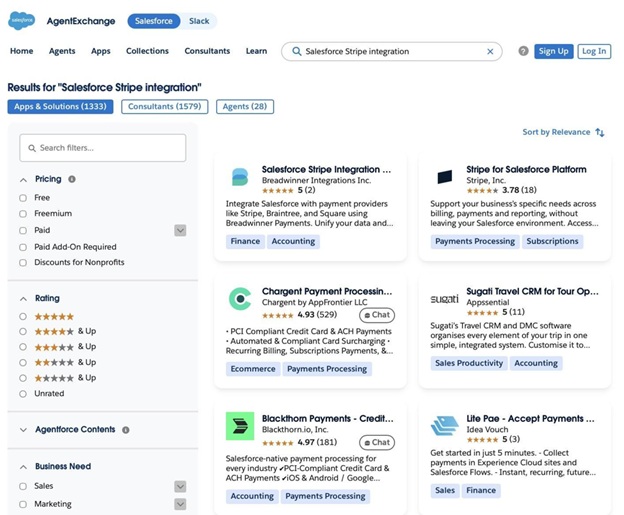
Salesforce Stripe integration on AppExchange
When searching for Stripe integration options, Breadwinner appears as one of the available solutions designed to connect Stripe data with Salesforce workflows.
Breadwinner connects Salesforce with payment providers such as Stripe, Braintree, and Square, bringing payment, subscription, invoice, and revenue-related information into Salesforce. The solution is designed to help teams manage payment activity alongside their existing CRM processes rather than working across separate platforms.
The integration allows organizations to sync information such as:
- Payment transactions and payment history,
- Customer payment profiles,
- Subscription details and billing cycles,
- Invoices and invoice status,
- Refunds, disputes, and revenue-related data.
For businesses setting up recurring payments in Salesforce, connecting payment workflows can help reduce manual steps between sales and finance teams. Teams can access payment status, balances, and transaction information within Salesforce while maintaining visibility into customer activity.
The application is built as a Salesforce-native solution, using Salesforce security and permission models, with tokenized payment handling designed to keep sensitive payment information protected.
For organizations looking to reduce disconnected workflows, the value of this type of integration is not only bringing data into Salesforce. It is creating a more connected process where customer, payment, and revenue information can support everyday business decisions.
Where the time savings come from when Stripe integrates with Salesforce
The time savings from a Stripe Salesforce integration do not come from one single automation. They come from removing multiple small manual tasks that teams perform every day.
With Breadwinner, Stripe payment activity can be connected directly with Salesforce records, reducing the need to manually check, copy, and reconcile information between systems.
Reducing manual payment checks
Before integration, a team member may need to open Stripe, search for a customer, confirm payment status, and then update Salesforce or share the information internally.
With Breadwinner, Stripe payment activity can be connected with Salesforce records, allowing teams to view relevant payment information, such as transaction history, balances, and invoice details, within Salesforce workflows.
Simplifying subscription management in Salesforce
For companies with Salesforce recurring payments, Stripe subscription management can create additional administrative work when information is split between systems.
Breadwinner allows users to create and manage Salesforce subscription billing while keeping the details and billing information connected with customer records.
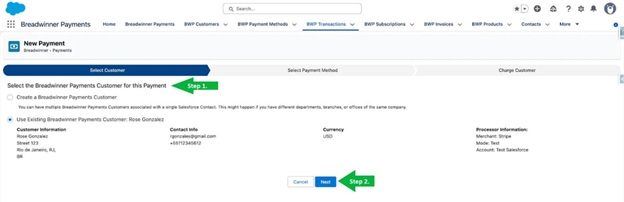
Creating a new Transaction with Breadwinner
Reducing manual reporting work
Revenue reporting often requires combining CRM and payment data from different sources.
By bringing Stripe data, including payments, invoices, subscriptions, refunds, and disputes into Salesforce, Breadwinner helps teams work with connected customer and revenue information without relying on repeated exports and manual reconciliation.
Improving coordination between teams
When payment information is available within Salesforce, sales, finance, and customer teams can work from the same customer record.
Instead of requesting payment status or subscription details from another team, users can access the relevant information available to them based on their role and permissions.
Conclusion: Turning disconnected Salesforce Stripe billing data into connected workflows
Small manual tasks that seem manageable at an early stage can become significant work over time. Checking payment status, updating customer records, handling subscription management Salesforce, and preparing revenue reports can all require additional effort when teams rely on separate systems.
A Salesforce Stripe integration helps address this challenge by connecting payment activity with the workflows teams already use to manage customer relationships. Solutions such as Breadwinner help bring Stripe payment, subscription, invoice, and revenue-related information into Salesforce.
The experience of The Learning and Performance Institute (LPI) shows how these improvements can create measurable results. By connecting Salesforce and Stripe, LPI reduced manual work related to subscription management, payment tracking, and customer record updates, saving around 6 hours each week.
These time savings did not come from one single automation. They came from removing repeated manual steps across daily workflows and giving teams better access to the information they need.
As organizations continue to grow, connected data becomes more than a convenience. It becomes a foundation for creating more consistent processes, helping teams spend less time managing information and more time using it to support customers and make informed decisions.